
Books
The great horseman
The Life and Times of R. R. Byramji: A Master of his Craft by Maj Srinivas Nargolkar (Retd). Published in 2018 by the author. Pp: 311. Price: Not mentioned.
An Irani called Rustomjee Byramjee came from nougat-producing Gaz in central Iran, to Poona, around 1890; and heralded four generations of champion race horse trainers. The most outstanding amongst them, as also in India, was Rashid Byramji, whose life story this book narrates.
Byramji won 29 Indian classics (including 10 Indian Derbys), numerous regional Derbys, Invitation Cups and virtually every important race in the country over a career spanning 60 years. In a sport where corruption is no stranger, Byramji was like Caesar’s wife, beyond suspicion. He was humble, modest, unassuming, simple, a loyal family man, helpful, charitable — almost a saint, in an arena which is often worse than a bordello.
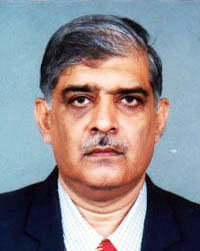
Maj Srinivas Nargolkar (pictured on pg 40), India’s celebrated racing historian and writer, has a great eye for detail and believes in flawless accuracy of facts. For racing enthusiasts (of the non-punting kind), this is a must read. Even for those with no interest in racing, this book has unwittingly chronicled the rise and fall of the rich and mighty. Dr Vijay Mallya, for whom Byramji won 83 classics, would be mobbed like a film star every time he entered the paddock at Mahalaxmi, that is, until very recently.
When Byramji began his career in 1956, the Maharajas still ruled the roost. Gwalior, Kashmir, Idar, Kolhapur raced with passion and honor. Then came Bollywood. Chandulal Shah, owner of Ranjit Studios, the then undisputed shahenshah (king) of the Bombay film industry, won the Indian Derby twice with his legendary horses — Balam and Chakori. His partner, Daulat Hiroo’s dogs were led on chains of silver, when he came to watch trackwork in the morning. Both lost everything on the stock market and at the race course. Shah travelled by the local train and was seen walking upto Mahalaxmi, unable to afford a taxi. Hiroo took up a job as a racing official.
Byramji won 29 Indian classics (including 10 Indian Derbys), numerous regional Derbys, Invitation Cups and virtually every important race in the country over a career spanning 60 years. In a sport where corruption is no stranger, Byramji was like Caesar’s wife, beyond suspicion. He was humble, modest, unassuming, simple, a loyal family man, helpful, charitable — almost a saint, in an arena which is often worse than a bordello.
Maj Srinivas Nargolkar (pictured on pg 40), India’s celebrated racing historian and writer, has a great eye for detail and believes in flawless accuracy of facts. For racing enthusiasts (of the non-punting kind), this is a must read. Even for those with no interest in racing, this book has unwittingly chronicled the rise and fall of the rich and mighty. Dr Vijay Mallya, for whom Byramji won 83 classics, would be mobbed like a film star every time he entered the paddock at Mahalaxmi, that is, until very recently.
When Byramji began his career in 1956, the Maharajas still ruled the roost. Gwalior, Kashmir, Idar, Kolhapur raced with passion and honor. Then came Bollywood. Chandulal Shah, owner of Ranjit Studios, the then undisputed shahenshah (king) of the Bombay film industry, won the Indian Derby twice with his legendary horses — Balam and Chakori. His partner, Daulat Hiroo’s dogs were led on chains of silver, when he came to watch trackwork in the morning. Both lost everything on the stock market and at the race course. Shah travelled by the local train and was seen walking upto Mahalaxmi, unable to afford a taxi. Hiroo took up a job as a racing official.
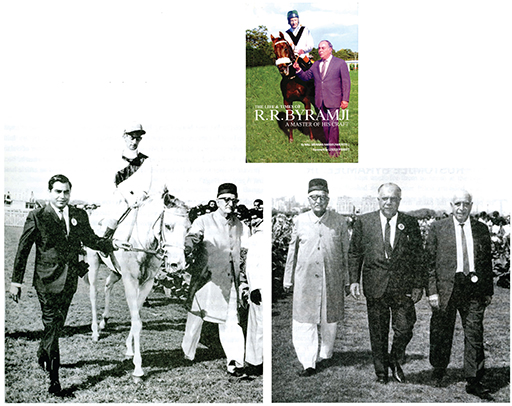
Above (l): F. A. Irani (in duglo and pheto) leading in Fire Fly; (r) Rustomjee Byramjee Jr flanked by F. A. Irani (l) and K. A. Irani
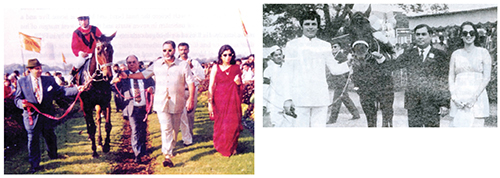
Above left: Continual ridden by Pesi Shroff being led in by Dr Cyrus Poonawalla (in hat)
and Dr Vijay Mallya after winning the Indian 2000 Guineas;
right: Rashid Byramji (center) with Sanjay and Zarine Khan
Byramji trained for the exceedingly handsome cinestar, Sanjay Khan, whose Prince Khartoum gave Byramji his first Indian Derby in 1972. Satisfied with quick success, Khan and his Parsi wife, Zarine, wisely did not invest any further in horses. Decades later, Sanjay (whose stud farm, Kunigal, belonged to Mallya, that is, until very recently) nearly perished in a studio fire while shooting the TV serial, The Sword of Tipu Sultan.
Byramji’s owners included the internationally acclaimed vaccine baron, Dr Cyrus Poonawalla’s father, Soli; actor Sohrab Modi’s brother, P. M. Modi; F. A. Irani, leading horses while dressed in a Parsi duglo and pheto; Noshir and Dolly Dhunjibhoy — parents of India’s ace horseman, Khushru; the Princess of Kutch and the Maharaja of Kolhapur; the Gokuldases and the Dagas.
With Prime Minister Indira Gandhi abolishing their privy purses in 1971, royalty faded away; and was replaced by industrialists. Byramji scored several impressive wins for textile magnate Sunit Khatau, in his ‘all-red’ colors. A few years later, the textile industry became sick. The glory days of the Khataus, when ladies got into a melee to purchase the latest Khatau ‘voile’ saris, were over. Hitmen shot dead Khatau in broad daylight, not too far away from Mahalaxmi.
 However, Byramji’s career reached its zenith with the dashing Ranjit Bhat, who, with very few horses, won the Indian Derby thrice in succession (1976 — Commanche; 1977 — Squanderer, and 1978 — Manitou) and after a year again, in 1980, with Mohawk. A feat which is almost impossible to emulate for any owner or trainer. The charismatic Bhat is quoted in the book:
 "Ranjit Bhat once described what set Byramji apart from his contemporaries. ‘When you drive a car,’ he said, ‘if you hear a minor rattle, you tend to ignore it and don’t bother to get it fixed. This can then become a major problem.
‘"With Byramji, he listens for sounds of "rattles” from his horses and stops on them till the problem resolves itself. That allows the horse to reach its full potential.’”
In his mid-50s, Bhat succumbed to cancer.
The green eyed monster of jealousy danced on the turf, unable to digest Byramji’s phenomenal success; as he continued to pocket championship after championship every year. The RWITC (Royal Western India Turf Club) stewards, then controlled by a racing satrap Radha Sigtia (who used to hold daily durbars at the Cricket Club of India), imposed a limit on the number of horses a trainer could train. Byramji had always maintained that if this was implemented, he would oppose it, on principle, and move to Bangalore. Bombay’s loss became Bangalore’s gain. Still miffed with Byramji’s unstoppable juggernaut, the RWITC stewards, seized upon an interview given by the trainer to a magazine called Celebrity in which Byramji was alleged to have made unkind remarks about the stewards, and asked him to apologize. Byramji denied ever having made any such remark and refused to apologize. Western India nevertheless suspended him for three years, during which his assistants had the dubious honor of saddling still more Derby winners trained by him. The author, as a disciplined army man, has not cited Byramji’s alleged offending remark: "The only thing fair about Western India stewards is the color of their skin.”
The book describes how the great trainer partnered with great jockeys —Lester Piggot, Sandy Barclay, Jagdish, Vasant Shinde, Pesi Shroff, Aslam Kader; as also with pioneering breeders like Maj P. K. Mehra who started the famed Usha Stud from a backyard in the Rashtrapati Bhavan, where Mehra was ADC (aide-de-camp). The dashing Mehra bred a string of champions, until his helicopter crashed on New Year’s eve, instantly killing him, his wife and one of his three daughters.
Religiously devoted to his wife Dolly, and their only son Darius (also a champion trainer who has won two Indian Derbys), Byramji’s life was as homely and staid with his loved ones, as his racing exploits pulsated with adrenalin and excitement. Integrity and Rashid Byramji were synonyms in the racing world. However, Rashid’s father Rustomjee Byramjee Jr, also a champion trainer, was a very colorful character, both on and off the race course. When Rashid was barely 45 days old, his father was banned for life from training.
Nargolkar, the perfect gentleman that he is, has rather politely glossed over this most colorful caper in Indian racing, citing inability to obtain authentic facts, since the episode occurred at Poona, in 1934. The senior Byramjee was accused of pulling off a daring gamble, by applying a coat of white paint on the leg of a superior horse, in order to substitute him for a look alike but far inferior horse (naturally, the superior horse would have thumped the inferior field). It started raining and the paint came off in full view of a shocked racing fraternity. Although this happened nearly 85 years ago, folkore has it that the trainer quickly ‘eliminated’ the horse. There are many other rib ticklingly salacious tales, too inappropriate to recount in this review. After his training career was cut short, the gentleman founded, the aptly called breeding operation, the Maharashtra Stud.
Later, Byramji went on to train for two of the ‘Big Three’ of Indian racing — Mallya and Deepak Khaitan, noted industrialist from Calcutta of the Williamson Magor/Mcleod Russel group which manufactured Eveready batteries. The third man was the irrepressible baron of the turf, Dr M. A. M. Ramaswamy, the Raja of Chettinad. Both of Byramji’s clients were fiercely ambitious with a burning desire to win. Byramji balanced their often conflicting interests, with great honesty and impartiality. He won two Indian Derbys for Khaitan (Astronomic and Elusive Pimpernel) and for Mallya (Cordon Bleu and Littleover). Quite naturally, Byramji never trained for Ramaswamy, as their approach to racing was like chalk and cheese.
Khaitan too tragically passed away, rather young, after a spirited battle with cancer. Strangely, most of the celebrated winners of this sport were ultimately felled by some misfortune or the other. Ramaswamy, in his last years, battled his adopted son in the law courts; and died a lonely death in his impressive but empty palace in Madras, not a single person present at his bedside, when the Raja breathed his last.
The author has no literary pretensions and the book’s aim is only to faithfully record the life and times of this greatest ever trainer, but more importantly, such great human material. If there are future editions, a glossary explaining racing terms, will be helpful.
◆ ◆ ◆
From the archive