
A rational rebel
Khorshed Wadia Ezekiel served as a mentor and inspiration for many in the fields of theater, writing, cooking and culture
At 19 in 1946 she did the unheard of for a young, single woman — travelled solo from Bombay to Delhi and then to Kashmir.
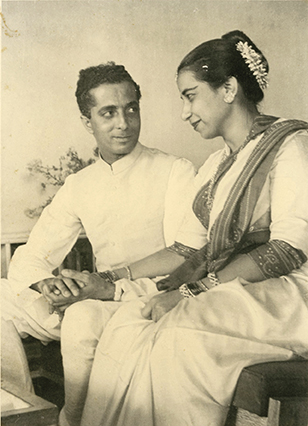
The founding of the modern state of Israel in 1948 was a powerful moment in Mum’s life. It started a lifelong love for Israel and the Jewish people long before she met our father. Then came the bombshell when Mum announced to her shocked family that she was going to marry a tall, dashing naval officer from the Bene-Israeli Jewish community, Joe Ezekiel who later joined Hindustan Steel Limited (now Steel Authority of India Limited) and Indian Institute of Management, Calcutta. Thrown out of the family home without a paisa, it caused a scandal in Parsi circles. Her parents, five brothers and sister reacted in varying degrees.
The wedding was held in 1955 at the home of Ebrahim and Roshan Alkazi with whom she helped found the Theatre Group in Bombay in 1946, the birth of the English theater movement in India. Roshan, sister of legendary adman and dramatist Alyque Padamsee was Mum’s BFF (best friend forever) right till her death in Delhi in 2007.
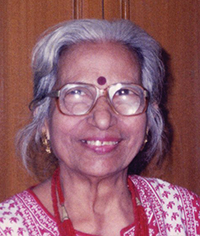
Khorshed Wadia Ezekiel
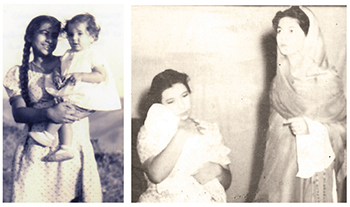
Khorshed with Adil Jussawalla in her arms, 1941; (far right) with Roshan Alkazi
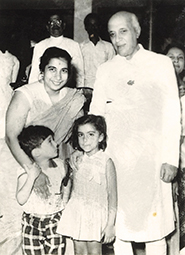
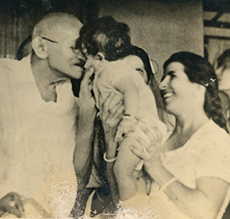
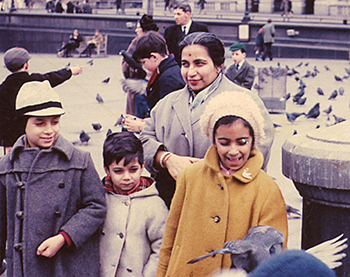
Gool Mehta with daughter Shireen and Mahatma Gandhi, 1946
In his tribute to Mum, Alyque wrote: "Her personality was always bright and cheerful and she brought a smile to everyone’s face. She served diligently in the Theatre and her vivacious presence charmed the audience when she appeared on stage. She was a loyal and helpful friend to dozens of people in Bombay where she spent her early years.” It was at Mum’s suggestion that Dad visited family friend Kawas Nanavati in jail after the sensational murder case, one of the few naval officers to do so.
Said Amal Allana, director of National School of Drama and daughter of the Alkazis: "I was so touched that Khorshed never missed even a single one of my productions, feeling proud of me, supporting and applauding me, giving me moral courage to continue in our artistic pursuits… She was a person who only gave in full measure, a woman with a huge heart, bringing joy, warmth and love into our lives.”
In 1980, while living in Calcutta, Khorshed was invited to direct The Merchant of Venice for the Jewish Girls Schools for an inter-school drama competition and helped them win first place. Mandira Agnihotri was one of her students: "I was fortunate to have Aunty Ezekiel direct me and she made a great Portia out of me! Her insight into human nature was incredible and she was able to draw out the best in each of us young aspiring actresses.”
One of her early inspirations was the award-winning poet Padma Bhushan awardee Nissim Ezekiel, her future brother-in-law. In 1994 one of Mum’s poems, written when she was around 23, received an award at the Fifth All-India Poetry Competition organized by the British Council in Madras and was published in a book, Poetry in India: Voices in Time. Over 8,000 poems were submitted and 67 of the best were published in the book. Nissim being one of the judges, Mum submitted her entry under the name of ‘EW Khursheid’! It was titled On Hearing News from Calcutta:
We heard of him who died at breakfast time —
Pass me the butter, someone said.
Young in limb, in thought and desire –
Did you make this toast on an open fire!
We thought of him who died throughout that day
Saw a movie, and crackled at chips.
We felt for him as for one we had borne, and
Say…! Hasn’t that girl got luscious lips!
Just look at the way she sways her hips.
We sat round to dinner rather late that night
Wanting to eat and still keep quite light
And into the conversation of meat and fish
Crept the name of the boy who had died last night.
Had he a job, a brother, a wife…
Would somebody please pass me another knife!
For Mum, family always came first and she nursed her brothers Hoshi and Dinyar in their last years in Bombay as well as niece Faranak Nagarwalla who died in Poona in 2006. Brother Dr Pheroze Wadia from New Jersey, USA remembers: "Khorshed was my very special sister. When we were growing up, we had so much in common — our love for art, particularly poetry and theater and also for people. That’s how she met her future husband Joe with whom I had a special relationship as well. When Khorshed came to the US, my late wife Judy and I used to have such a good time going with her to the theater, museums and restaurants in New York City.” Another brother, Dr Maneck Wadia from California recalls: "Khorshed played multiple roles in my life. She was not only a loving sister, but taught me to appreciate the theater, taught me ballroom dancing and through thick and thin, she always displayed a great sense of humor.”
Cousin and award-winning poet Adil Jussawalla recalls Khatu’s (her pet name) "way of telling stories that invariably made us laugh. The one in which she reported seeing me take my first steps in Sinhgad so astonished my mother (Mehera) that she had to sit down on the floor to stop herself falling over. Almost 70 years later, with part of that event in mind, I dedicated my poem ‘When First I Walked’ to Khatu. She was a joyous presence in the family.”
The first of the five-part poem has been extracted with permission from The Right Kind of Dog, Duckbill Books:
"Rickets,” the well-fed doctor says,
"this child won’t last.” My feet skid
on everything they touch. Prefect Twiss,
measuring my chest, mutters, "What a kid.”
Shoes I had to lose one day,
shoes my mother blessed,
were boats that held my bones,
helped me brave the waves
when first I walked.
New pairs, but pointing to old journeys,
take the floor. They don’t know
what’s brought them to this shady joint,
the deformed bone or the doctor I want to avoid.
When my parents’ eldest was born in 1956, Dad was acting in the George Bernard Shaw play Arms and the Man in which a character is named Raina and one of Dad’s lines was, "Where is Raina?” So that became my sister’s name. Mum was particularly influenced by Jawaharlal Nehru and when her second child was born on November 14 (Nehru’s birthday), he was promptly named Jawahar Pheroze. It was her Gool-maasi (mother’s sister) who had a huge impact on Mum’s way of thinking. One of the few women in Mahatma Gandhi’s Dandi salt march in 1930, she was married to Dr Dinshah Mehta who was the personal physician of the Mahatma. I was thus named Gul-Fraaz after my great aunt and Mohan after Mohandas Karamchand Gandhi.
During her college days Mum took part in processions demanding independence from the British — yet another thorn in the flesh for her traditional Parsi parents! Khorshed spent hours listening to the views of the likes of the Mahatma, Nehru (Indira Gandhi was a close friend), Gaffar Khan, Sardar Patel, Maulana Azad and other legends. She shared the podium with Nehru, her aunt and uncle in the 1948 first post-Independence Congress session held in Jaipur.
As acknowledged daughter Raina Rahael Imig, "My mother had many gifts of creativity. Among these the greatest were her acting skills. I was privileged to witness these during my teen years when she was on stage and made characters come alive. Second among her skills was a flawless facility and flair with language both spoken and written (besides English, at least four others.) Third it must be said, was her sense of humor and rapier wit. I was in the audience at a qawwali concert when she composed an Urdu couplet on the spot in response. Fourth, her brilliant and intuitive cooking skills for which she was justly famed. She made instant friends with strangers and people never forgot her. Traveling until well into her 80s, she showed all through her life a spirit of adventure and great courage in many areas. Many young people over three generations considered her a mentor and an inspiration.”
As the youngest child I got my love for the English language from my mother and my love for sports from my father. Combine the two and sports journalism was but a natural career choice. Mum always knew my passion would one day become my profession and backed me all the way. The help I got from Mum in writing school essays shaped my ability to write articles and books. Despite all members of our family being published, I always maintained Mum was the best writer in the family. I also like to think I inherited my sense of humor from Mum and over the past three-and-a-half years when she was gravely ill, my greatest joy was to hear Mum’s laughter ring out as I staged impromptu one-man skits, told crazy jokes and recited nonsensical rhymes mainly about three things Mum loved — cats, chocolates and children — and add to that, cooking and culture! Mum was a regular at concerts, plays and poetry readings in Delhi and was famous for her exotic ensembles — loads of necklaces and bangles up to the elbows.
Cooking and humor is what son Jawahar Pheroze Ezekiel remembers most fondly: "It sounds like a cliché, but I did really get my love for cooking at my mother’s apron strings. Mum was a legendary cook — the whole Ezekiel clan looked forward to her coming for the holidays because there would be roasts and casseroles and cakes and puddings. And the house was always full of cookbooks. It was no surprise that I started my career as a chef, and that I have continued to do that for both pleasure and profit. My whole career has been based on the love for food and the spirit of curiosity I got from her. And humor too. Mum was my best friend. What we shared was unique and special. My best tribute to her is to continue to live life to the fullest and to drain as much joy as possible from every minute. Her spirit lives on in all of us.”
Cookery and writing is what got her a large fan following with her cookbook reviews in the Madras-based Indian Review of Books (IRB) journal in the 1990s. She was also a consultant and editor/proof reader for numerous cookbooks. According to IRB editor Subashree Krishnaswamy, "Khorshed wrote wickedly funny cookbook reviews with inimitable turns of phrase. I believe she raised the standard of cookbook writing in India. Khorshed was, without doubt, our favorite reviewer. Several scholars and intellectuals who wrote lofty pieces for us revealed that they eagerly flipped through new issues to read her reviews. If anything, her company was even more tempting than her writing.”
In Madras, in the 1980s, she also contributed ghazal and qawwali concert and album reviews to the Indian Express daily and gave exposure to new talent, among them Pankaj Udhas and Penaz Masani. It was radio legend Ameen Sayani who gave her Urdu lessons while in college and in his tribute said: "She was one of the kindest, sweetest persons I ever knew and I’ll always miss her deeply, just as everyone else close to her will.”
She would grab the latest copy of Parsiana off my hands, read it cover to cover, make notings with pencil, discuss with me and preserve all copies. I guess that is more devouring than reading! (She was one of the Parsiana family and we always looked forward to her inputs, story suggestions and letters. Thanks to her periodic phone calls giving a frank appraisal on the contents of the magazine, we had established a strong rapport with her. We will miss her benign and supportive presence — editors).
Mum was an agnostic or more realistically, a rationalist. All rituals and orthodoxies were anathema to her. At her father’s funeral in Bombay in 1972 all the relatives made a circle with their chairs and recalled Sohrabji Papa’s legendary sense of humor, the venue of the funeral ringing with laughter. And it happened at Mum’s funeral too as friends, family and staff recalled her jokes — what a way to go!