
Comment
Memories of Mummy
A daughter celebrates the life of Khorshed Adi Sethna who now lies in eternal sleep next to her husband
It’s still not sunk in that Mum won’t come in the evening to visit us. It’s not set in that she won’t bring her chocolate fudge and oatmeal cookies and that she will not be there for me to demand "Mum — today is Rushad’s/Jehangir’s/Daraius’/Zubin’s/Tushna’s exam — you must pray for them please.”
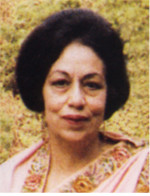
One of my earliest recollections is of a young mother with a small baby and three other little girls standing alone at the entrance of a four-berth train compartment on a dark pre-dawn morning. She stood there shielding us from the open door with her slim body, leaning out to see where we were reaching. Dad had told her that the train would halt at Mettapalayam station at 4 a.m. for a few minutes only. She was responsible for getting us off at the correct place with our tons of baggage.
We also remember and honor the mother who could make a row of non-family dug out tin structures into a home — a beautiful home — where trunks were covered cleverly to make sofas, where with a tiny oven she still baked the most glorious feast.
She had grown up in the lap of luxury. She and her sister, Firoza, were nicknamed "Princess Elizabeth and Princess May” after the English royals of their age. They lived royally — their parents taking troops of the girls’ friends and dogs on holiday to Simla and Ooty and Abu. They took their tailor to watch Erroll Flynn movies so that he could copy the actresses’ dresses for them. But they were also trained in the old-fashioned virtues — generosity, hospitality and, above all, compassion.
After her English governess left she entered the world of school competition and excelled — topping every exam till her MA from Bombay University. In table tennis she represented the state. Mum met and fell in love with Capt Adi Sethna, ADC to the Governor General, on March 21, 1949, at her cousin Dr Minoo Shroff’s wedding. But because both fathers were keen at getting their young people together, and Mum was a feminist (when it suited her) she kept poor Dad waiting till November 1951 when they married at Sir Nowroji Hall, Shahibaug, Ahmedabad, our ancestral home. Her sari came from Paris. Kwality ice-creams were sent specially from Bombay for the feasts that followed. All the society papers carried their pictures and details, so much so that Dad, a young captain, got a dressing down from his commanding officer.
Dad took her to meet Rajaji, Governor General Rajagopalachari, at the Government House, now Rashtrapati Bhavan. Rajaji introduced her to her first cup of coffee, a drink she had never touched before. Over the years she met prime ministers and queens and kings as also jawans and their families, their lonely parents and war widows. She worked tirelessly for them all over the country.
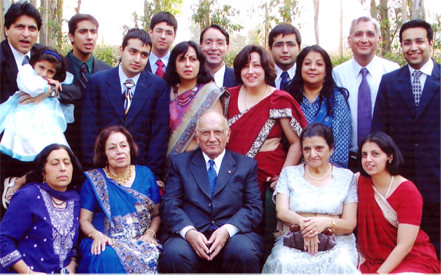
The Sethna clan with Khorshed (seated second from left) next to Adi
What few know is that Mum was also a professional in her own right. She was one of the earliest women to write for Sainik Samachar, the Army Journal, and then under a pen name ‘Kay’ she wrote a regular column for The Times of India and other newspapers and magazines across the country. Her first cookbook, in her beautiful handwriting starts with a recipe for boiling an egg, but she trained with the Cordon Bleu at Windsor with Constance Spry and later at London, their Marylebone headquarters. Today we have trunks full of her long cookbooks, all in her perfect handwriting. She took the most difficult courses in flower arrangement and made herself into one of the greatest hostesses in the Indian Army. Her homes were immaculate, like herself.
Mum was always perfectly color coordinated, decades before Page 3 discovered the term. She always scolded us: "Your ayahs are better dressed than you, my four daughters.” Like her mother Jollie, she was a perfectionist and it drove everyone crazy, especially painters and carpenters. But she taught us that if a thing is to be done, be it a dinner party, a speech or a book, it must be done with complete concentration and dedication. Her lists showed the meticulous details she looked into every day.
Mum gave up her writing career to become a full time homemaker and we enjoyed that benefit completely. She continued with her art, she was a gifted painter, till the youngest, Shireen was born. After we all were in college, she went back to research and writing. Her book Bhikaiji Cama, in the Builders of Modern India Series is a seminal study for which she researched all over India and abroad. All the later works on Madame Cama has drawn upon this first book.
Mum was also a good Amdavadi Gujarati — her acumen about the share market and her detailed study of it amazed many professionals. Till last year she handled all our shares and finances even doing all our Income Tax Returns herself. Of course she despaired at Dad because he never understood money but it’s thanks to her that they invested so wisely and provided for all of us so well.
When a few months ago I was preparing Mum’s biodata for the India International Centre after Dad’s passing, I realized just how many social service organizations she had helped create and promote. As vice president of Army Wives Welfare Association she was board member of The Indian Spinal Injuries Centre and Delhi Commonwealth Women’s Association, among the many charities she helped and supported. But to us it was the Mummy who picked up the sick puppy or cat or bird and taught us to nurse it back to health whom we celebrate. She taught us charity lies in action and she exemplified it, as did our father.
She took us outside after the rain to see raindrops on a cobweb, she taught us how to love the mountains, she taught us how to care for the elderly. She looked after her in-laws, her father and Gulan, our childhood governess who was alone, till their dying day — and added Gulan’s name to the list of elders in our family prayers.
Mum never expressed her emotions and taught us to keep a stiff upper lip. When the national flag was taken off Dad’s coffin and handed to her, though devastated, she insisted on trying to stand. "That’s the correct way.” That was her strength but finally her tragedy. She adored Dad. Though she scolded him, she supported him. Though they argued on everything sometimes, they couldn’t live without each other. She couldn’t accept he had cancer. She would not live without him. All of last year, if you asked her anything, all she would say is, "I have to be with my husband.” If there was anyone who died for love, it was Mummy.
They are laid now next to each other in the aramgah. All their lives Mum and Dad always had their beds so arranged that Dad could get out of bed on the right side — he believed in that superstition and Mum would joke, "You think I must get up from the wrong side!” Their new beds in Spenta Armaiti’s earth are so placed that Dad can again get up from the right. But they are together and will always be together in Garo Damana where some day we will all join them at the Frashokereti — the Zoroastrian resurrection — which a western religious historian has likened to a huge, noisy family reunion.
◆ ◆ ◆
From the archive