
Media
Rebel with a cause
Piroja Jokhi has championed unpopular causes from her childhood
Decades ago, as a young woman she wielded a fiery pen against the British rule; now it is the orthodox faction of the Parsi community that she is taking on through her writing. "From my early days I was a rebellious person,” says 91-year-old Piroja Jokhi (pictured), a writer-teacher-entrepreneur.
Outspoken, witty and rather spry for her age, Jokhi, has never shied away from controversy. She believes in candidly expressing her views in the community media. "I just wrote a short while ago on the Wadia Atash Behram controversy, with Parsis opposing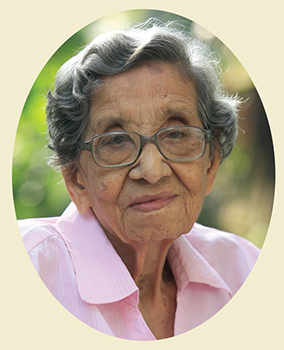 (Bombay’s) Metro-3 tunnels running underneath. We are not experts, the high priests are not experts. Let those who are assess the issue. And if they give a clean chit, let it go! Now the magnetic connect of the fire to the soil and all that I don’t believe in. The connection with the Divine is through your heart…
"Even in the agiaries, if a non-Parsi has some work inside, we close all the doors and hide the atash from them. What happens? We suffocate, we suffer, our eyes burn, not theirs. If you keep the doors open and someone sees the holy fire from afar, what is going to happen? Nothing!”
Seated in the living room of her Mancherji Joshi Dadar Parsi Colony residence, Jokhi opens an aging file full of yellowing clippings in print. "‘Stree, sanskaar ané samaaj (Women, values and society),’” she reads some of her hard-hitting headlines out loud. "‘Kom né aajé kevaa dharam guru ni jaroor chhè (What kind of a religious head does the community need today)?’ ‘Dharam su atyaachaar maaté chhè? (Is religion to commit atrocities)?’ I also used to run a weekly paper, Raagini, and once won an award for one of the articles I published… I used to write in Gujarati but now even my own children don’t read Gujarati so I switched to writing in English.”
Active since the days of the freedom struggle, she wrote not only against the British rule, but also addressed contentious religious and community issues. Somebody once warned her father, "She’ll go to jail for propaganda against the British!” She would have liked to join Mahatma Gandhi’s ashram also, "but coming from a conservative family I was not allowed to do that. There was that enthusiasm to do something for my country,” she relates.
Outspoken, witty and rather spry for her age, Jokhi, has never shied away from controversy. She believes in candidly expressing her views in the community media. "I just wrote a short while ago on the Wadia Atash Behram controversy, with Parsis opposing
(Bombay’s) Metro-3 tunnels running underneath. We are not experts, the high priests are not experts. Let those who are assess the issue. And if they give a clean chit, let it go! Now the magnetic connect of the fire to the soil and all that I don’t believe in. The connection with the Divine is through your heart…"Even in the agiaries, if a non-Parsi has some work inside, we close all the doors and hide the atash from them. What happens? We suffocate, we suffer, our eyes burn, not theirs. If you keep the doors open and someone sees the holy fire from afar, what is going to happen? Nothing!”
Seated in the living room of her Mancherji Joshi Dadar Parsi Colony residence, Jokhi opens an aging file full of yellowing clippings in print. "‘Stree, sanskaar ané samaaj (Women, values and society),’” she reads some of her hard-hitting headlines out loud. "‘Kom né aajé kevaa dharam guru ni jaroor chhè (What kind of a religious head does the community need today)?’ ‘Dharam su atyaachaar maaté chhè? (Is religion to commit atrocities)?’ I also used to run a weekly paper, Raagini, and once won an award for one of the articles I published… I used to write in Gujarati but now even my own children don’t read Gujarati so I switched to writing in English.”
Active since the days of the freedom struggle, she wrote not only against the British rule, but also addressed contentious religious and community issues. Somebody once warned her father, "She’ll go to jail for propaganda against the British!” She would have liked to join Mahatma Gandhi’s ashram also, "but coming from a conservative family I was not allowed to do that. There was that enthusiasm to do something for my country,” she relates.
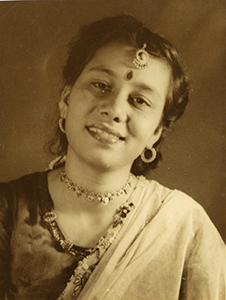
Jokhi in her younger days
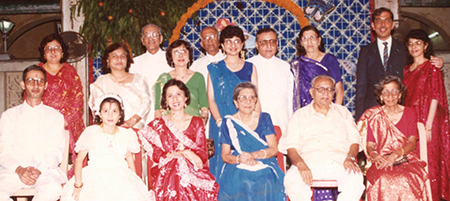
Homi and Piroja (seated, extreme right) at a family function, circa April 1995
Born in Allahabad in 1926 at the home of her maternal uncle Ardeshir Gazdar who was associated with Motilal Nehru, Jokhi went on to spend the first decade of her life in Calcutta where her father Jehangirji Gandevia worked for Madan Theatre.
"My father had a very hard early life,” recounts Jokhi. Having lost his mother when he was only seven years old, his father remarried thrice. The fourth wife banished all his six children from the house. "Someone spotted my father sleeping in a graveyard and went to his masi (maternal aunt) who left him in the care of his older brother,” who although only 15 himself at the time and working as a compounder, looked after all his siblings. "None of them had a real education; they grew up doing odd jobs for people and making what little money they could. Then when Jehangirji was 15, he left for Calcutta to work at the Madan Theatre…
"The Madan family treated him like one of their own sons… He was a thorough gentleman, very honest and hard-working. During wartime someone once left a box full of gold guineas at the Theatre. My father made sure that it was returned to the rightful owner, who was so impressed that he wanted to reward him with one. He refused it and said that ‘if you allow me to, I will purchase two, but I will not accept anything by way of reward for being honest.’” Working for a monthly salary of Rs 15, he went on to become the manager of 100 theaters.
"My mother Tehmina was also very noble.” Although she knew that her step mother-in-law had thrown out the six young boys, when the old lady got cancer, "my mother brought her into our home and cared for her till she passed away.”
A young Piroja, the third of four siblings, was 10 when her father took up a job with (New) Empire Theatre and the family relocated to Bombay. "The Theatre was our home, we were given a flat there,” she remembers. The first-ever viewing of a Shirley Temple movie in India at the (New) Empire was made possible by her father.
Enrolled at the Bai B. S. Bengallee Girls’ High School, Jokhi went on to appear for the first-ever SSC examinations held there, securing a distinction. A brilliant student securing prizes in all subjects except music and PT (physical training), she was keen to attend college, but her father forbade it. "He said there was no sense sending girls to college since we were only to be married off young.” No one in the family openly challenged Jehangirji’s wishes. Otherwise pleasing and very gentle, "in this respect (he was) most orthodox… and old-fashioned.”
She was not allowed to attend school when she was menstruating: "Té tau jhulam hato (That was an infliction!) "And we were made to lie alone on a metal bed in separate quarters of the house, with a metal bowl underneath, in which our food would be served. My grandmother used to tell us that if we did not observe the custom (of menstrual quarantine) properly, we would be punished in the afterlife by having to wade through a pond full of blood. We were not even allowed to bathe.”
Despite the setback to her education, Jokhi was determined to keep herself busy and not settle into the role of a homemaker early on in life. "After my SSC, I enrolled in various classes — cooking, photography, etc. There were working women back then, but in our family we were not allowed to take up jobs.” Her elder brother Dali was instrumental in drafting the first railway engine in India while younger brother Jehanbux was the seniormost partner at the chartered accountant’s firm P. C. Hansotia and one of the directors and later chairman of The Zoroastrian Co-operative Bank Limited. Elder sister Kolan Hataria was a homemaker. Fortunately Jokhi’s parents did not oppose her writing. At the Rashtriya Hindi Prachar Sabha, she passed the highest Hindi exam at the time and later learnt Urdu as well.
It was in 1955 that Piroja married Homi Jokhi. "For that generation it was rather a late age, but I had categorically told my parents that I would only marry when I felt like doing so!” she smiles. Originally from Vyara in Gujarat, Homi used to come to Bombay to visit his brother who was married to Piroja’s cousin. "We got along well; our ideas were the same. He was in the Congress doing political work and I was also interested in politics at the time, particularly against the British rule.”
Homi originally practiced as a civil judge and judicial magistrate but Piroja convinced him to forego his transferable job and pursue a private legal practice in Bombay once their children were born. Today Piroja’s daughter Pervin Vanskuiwalla is head of corporate finance and vice president at Godrej, and her son Dr Vispi Jokhi is medical director at Masina Hospital.
"Before my husband’s practice in Bombay was well-established, life was a struggle for a while,” recounts Piroja. "I used to perform a few odd jobs whenever I could.” When they moved residence to Dadar, Pervin was studying at J. B. Vachha High School. "It so happened once that a Hindi teacher was going on leave and she asked me to fill in during her absence. I stayed on even after her return, teaching for 10 years. This was during the ’60s and ’70s. Then I started organizing Girl Guide tours and camps for the children. We would take 150 of them at a time on excursions. I ran the school canteen for some time as well.”
Once the family was financially stable and able to save up some money, she opted to start another venture. "I had heard of the cable business and thought it a new opportunity worth exploring, so we were one of the first to start offering cable services in Bombay. Once I had established the business, I left the school entirely. Then I started supplying Internet (services) in the ’90s, without knowing anything about computers!... Son-in-law Darayus looks after the Internet side of things… On any given day I have about eight employees going out on service calls. All my customers telephone me if they have any issues. I am now thinking of handing over the cable business to somebody else to run from January 2018; I’ve decided I want to retire.”
At 11 a.m. every morning, she is involved in stock trading, "strictly from an investment point of view. I don’t sell much! But I have a good intuition when it comes to the stock market.”
The formidable lady has every intention to continue with her writing. And with the life that she has led, the cause closest to her heart seems gender equality within the Parsi community. Although not in favor of intermarriage "from the cultural perspective,” and in the interests of compatibility, Piroja is unhappy that children of outmarried men are accepted whilst not those of outmarried women even though "they are born of her womb, they are the flesh of her flesh. I believe even adopted children should be accepted into the religion; the atmosphere in which they are brought up is more important than the facts surrounding their birth.”
Acceptance is essential and inevitable when it comes to the issues that are polarizing factions within the community, feels Jokhi. "All this constant infighting, never seems to stop, always, always (on)!
"And all this of not allowing non-Parsi friends and family to view the faces of the dead. Just let them see the face, what is going to happen? We talk to non-Parsis, we mingle with them, live among them and when we are dead they cannot just give a little farewell to us? Téma su thai gayu (what is the harm in that)?”
Practicality, Piroja feels, is sadly lacking among Parsis today. "I mainly receive praise from most people for my views and writing, but there are of course a few critics. They say things like I’m not fit to be a Zoroastrian. I say ‘mind your own (business) — don’t interfere in somebody else’s.’ After all, we are all human beings.”
◆ ◆ ◆
From the archive