
Events & Personalities
Shrine for BehramYazad
A shrine dedicated to the worship of Behram Yazad located in the compound of the Dadysett Atash Behram, Bombay was inaugurated on December 4, 2016 by Behram Ardeshir, trustee of the Dadysett Charity Trust, who cut the ribbon. Fellow trustees Veera Choksey did achhu michhu and Mehernosh Humranwalla broke the auspicious coconut. The fourth trustee, Shapoor Pallonji Mistry, was not present.
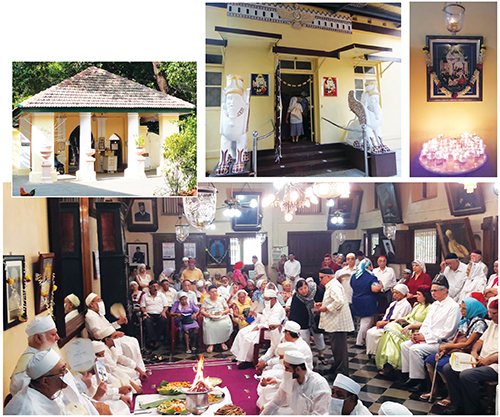
(Clockwise from top): Dadysett Atash Behram; entrance to Behram Yazad shrine;
24 x 7 divo inside shrine; jashan Photos: Jasmine D. Driver
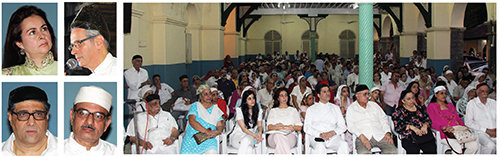
(Top, l-r): Veera Choksey, Behram Ardeshir; (above, l-r): Mehernosh Humranwalla,
Ervad Darayesh Katrak; (right): audience; Photos: Jasmine D. Driver
Housed in a formerly dilapidated structure adjacent to the Atash Behram, now renovated, the shrine has a divo that will burn 24x7, while devotees may light lamps there as well. The inside of the shrine is bereft of ornamentation and contains, apart from a photographic representation of the divinity, hundis (glass receptacles) from which the divas are hung from the ceiling and stands where oil lamps are placed. However, two ornate godhas stand guard just outside the entrance which has a farohar on top.
A jashan led by Ervad Darius Nalladaru was performed before the inauguration at which Dastur (Dr) Firoze Kotwal was present. A humbandagi followed. In his opening speech Ardeshir remarked that he was pleasantly surprised at the large number of persons present at the jashan and lecture, as generally the throngs arrive at dinnertime! He spoke of the activities of the Trust and appreciated the many dedicated persons behind the scenes who helped it to function. Among them were Ervad Darayesh Katrak, secretary of the Trust, Hosi Kharas, assistant secretary, the Nalladaru family of priests who had been associated with the agiary and atash behram for four generations and whose head, Ervad Parvez had served the fire temples for 60 years, as had Ervad Minoo Nalladaru. He lauded chasniwala Pervez Driver’s work and said the only grouse was that he would not accept a mobile phone from the trustees!
Katrak gave a talk on Behram Yazad in which he described the various attributes of the divinity and how much faith people had in him. He is known as Mushkil Aasan as he eases people’s difficulties, fulfills wishes and helps in achieving success and victory. (Many Parsis perform the weekly ritual where the story is narrated of a poor woodcutter who achieves fame and fortune after praying to Behram Yazad — editors) Katrak urged devotees to pray the Behram Yasht for 40 days, in the Iranian tradition, for fulfillment of their wishes. He announced that this was the first such shrine in India and a humbandagi will be conducted there every month on Bahram roz as is done at the Bhikha Behram Well on Avan roz. A musical interlude by Marazban Wadia was followed by a vegetarian community dinner sponsored by the Parsee Vegetarian and Temperance Society, and catered by Ketayun Khambatta.
Independent researcher on Zoroastrianism Farrokh Vajifdar of London, whom Parsiana contacted in regard to the shrine, replied: "We Parsis are very prone to the worship of ancient Indo-Iranian deities, despite Zarathushtra’s very clear rejection of all these yazads, amshaspands, fravashis.
"Bahram has an entire Yasht (XIV), ‘sacrificial hymn,’ dedicated to him where his manifold nature is clarified. There he appears in 10 different forms (such as): the strong, beautiful wind; a golden-horned, mighty bull; a white horse with golden ears and saddlery; a 15-year-old, resplendent youth with clear vision and fleet of foot; a raven with magical, healing powers in its feathers; a ram with back-swept horns; a sharp-horned fighting buck; and finally, a heroic warrior with jewel-encrusted gold-bladed sword.
"In all these guises Bahram/Varathraghna always appears as champion of humanity; he is portrayed as the best-armed of all the celestial deities.”
Vajifdar wished all those who worship at the new shrine "every spiritual joy and fulfillment of their desires. I have never been religious since I realized the true humanist nature of Zarathushtra with his awesome philosophy; yet I will not withhold goodwill towards my fellow-Parsis… There are several shrines to various pre-Islamic deities and, let it be noted, they were primarily set up near crossroads to guide the lone traveller and to ensure his/her safety.”
Not so accommodating was Hanoz Mistry who wrote in the orthodox online publication The Parsee Voice: "The inauguration of a shrine for Behram Yazad in the complex of the Dadysett Atash Behram has left us quite disturbed. That the community has lost its spiritual moorings is no secret; but that this kind of misguided act should take place in the complex of a consecrated atash behram padshah, is the new low!
"Since many years, a certain nefarious practice has crept into our community in invoking Behram Yazad, which requires to be condemned (referring to the story of the woodcutter)… We now have another uncalled for practice being institutionalized without a second thought for the holy entity residing in the form of an atash behram padshah, in the form of a so-called shrine in the name of Behram Yazad… The atash padshah is and should be the only altar for worship of Behram Yazad. His place cannot be taken by a concocted photograph! Also, if constructing shrines to Behram Yazad were part of the Zoroastrian tradition, then how come one has never come across such a shrine in the many centuries of the community’s existence in India?”
Aban Mukherji shared what her aunt Piloo Jungalwalla had written in Our Sacred Calendar: A Quiz for Young and Old: "Behram (is) the angel of victory. Our large fire temples are named atash behrams, fires of victory. Zoroastrian kings in Iran always had a thanksgiving jashan performed in an atash behram after victory in battle. In former times our grandparents and great-grandparents always recited the Behram Yasht before going on a long journey, specially a perilous journey.” According to Dastur Maneck Dhalla "...they (the Yazatas) permeate all later texts, and form an indissoluble part of the Zoroastrian pantheon.”
◆ ◆ ◆
From the archive