
Observation
Such a long journey
Performance of a navjote ceremony later in life requires conviction and motivation
Since I was a child, I have always been fascinated with my mother’s Parsi background and my father’s Hindu one. To me, I am and always will be a Meher-Homji and a Thakore. My mother Shireen may have married out of the Parsi community, but that didn’t  change who she was on the inside. She raised me to follow the tenets of good thoughts, good words, and good deeds. I was always drawn to my mother’s Zoroastrian faith, and have had a burning desire to officially become part of the community since I was very young, not only because it is in my blood, but also because I believe so strongly in the religion and its teachings. Unfortunately due to the prevailing controversy, my sister Sameera, and I were both unable to have our navjotes performed when we were children. It hurt. It hurt not to be accepted by some in the community, and while that may have ultimately led to my sister feeling alienated and being an underlying reason for her converting to Islam, I became motivated to learn as much as I could about Zarathushtra, the religion, its history and culture. I am proud of my Zoroastrian background and feel blessed that my history is embedded in the religion. To me it is imperative that I pass on to my children the knowledge and understanding of the blood that runs through their veins, who they are, their family history, the beliefs of the Zoroastrian faith and the importance of the community that practises it.
change who she was on the inside. She raised me to follow the tenets of good thoughts, good words, and good deeds. I was always drawn to my mother’s Zoroastrian faith, and have had a burning desire to officially become part of the community since I was very young, not only because it is in my blood, but also because I believe so strongly in the religion and its teachings. Unfortunately due to the prevailing controversy, my sister Sameera, and I were both unable to have our navjotes performed when we were children. It hurt. It hurt not to be accepted by some in the community, and while that may have ultimately led to my sister feeling alienated and being an underlying reason for her converting to Islam, I became motivated to learn as much as I could about Zarathushtra, the religion, its history and culture. I am proud of my Zoroastrian background and feel blessed that my history is embedded in the religion. To me it is imperative that I pass on to my children the knowledge and understanding of the blood that runs through their veins, who they are, their family history, the beliefs of the Zoroastrian faith and the importance of the community that practises it.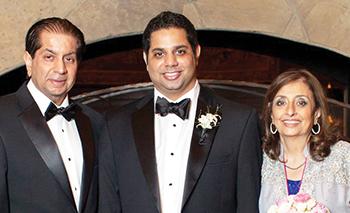
Ashish Thakore (above and center) with his father Suhrid
and mother Shireen, his "biggest supporters"
When I was growing up I always felt like a bit of an outsider. Houston has one of the largest Zoroastrian pockets in the United States, and although my mother was active in the community, and as a family we have always had a large circle of Parsi friends, there was always something that distanced me from the community as a whole. I have also been lucky enough to travel to Bombay almost every year of my life, but despite all the joy I felt every time I was reunited with my family, there were moments of sadness and pain that I kept to myself for years. As the youngest among my cousins, I was too small to understand what was going on during their navjotes; but I distinctly remember waking up in Marble Arch through the years, watching my cousins performing their kusti prayers and wondering why I was not doing the same. I remember the sadness I would feel at having to sit in the car while my family would go into an agiary to pray. It was difficult to understand why, but my parents attempted to fill the void of religion in our lives by sending both Sameera and me to a Methodist church. Although I attended church for a number of years in my youth, and it did provide a sense of religion for me, I felt that I did not really belong there. As I grew older and read more of the Bible, it didn’t take long to see that so many of the basic tenets of Abrahamic religions have their foundations in Zoroastrianism.
My sister and I have both been very lucky to grow up in a highly educated and liberal family. It was during our years in college that we really formed the foundation for our religious beliefs. Not only our parents, but our aunts, uncles and cousins all supported us with the decisions we made and the paths we chose. Sameera has chosen to follow Islam, and I am supportive of her, just as she is supportive of me for my Zoroastrian beliefs. I know that with the history of the two religions this can be controversial, but considering what we both went through as children, I can understand why she may have been hesitant to pursue what I believe is our birthright.
While at university in London, I made the decision to follow my passion, and spent my undergraduate years studying the history of Zoroastrianism and its subsequent influences on the Abrahamic religions. Those four years were an eye-opener; I took advantage of all the resources that London had to offer and ended up learning so much about the religion, its culture and influences, but most importantly, the understanding I gained of my family’s history was priceless.
It was during those years that I began speaking to my mother about my desire to have my navjote performed because I wanted to officially proclaim my faith and be recognized as a member of the community. As my biggest supporters, both my parents were ecstatic; however, my mother was worried about how it might be received in the community. Also, it was important to me for my wife to understand my decision. My wife, Shirin, is Iranian-American. Her parents grew up in Iran and were raised being very aware of Zarathushtra. They have always had the utmost respect for Zarthoshtis and the religion of the Persian Empire. Shirin was very happy with my decision to join the faith. I have not spoken to many people in the community about my navjote, but my wife and I are members of the Zoroastrian Association of Houston and all those to whom I have spoken have been very supportive and offered to help in any way they can.
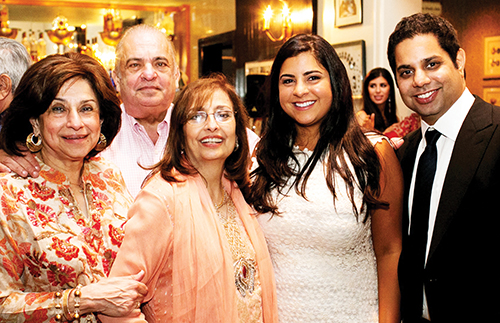
From left: Roshan and Homi Patel, Shireen, Shirin and Ashish Thakore
My mother and I often discussed my navjote, and I had hoped to have the ceremony performed over the past few years, but with my wedding planning, pursuing an MBA and working, logistically it was difficult to plan. In August 2015 tragedy struck my family when my mother passed away. Having lost my best friend and biggest supporter, I worried that the navjote might never happen. Luckily, my wife and both my mother’s and father’s families filled the void and continued to support and motivate me to have my navjote performed. I wanted to keep the navjote private, so my father, Suhrid, and his wife, Anita, will be hosting the ceremony at their home on September 18. It will be performed by the same priest who conducted the prayers when my mother passed away, Ervad Bahmansha Sanjana, with only close family attending. Although my mother will not be able to witness the ceremony, I am so very grateful that my Roshan masi and Homi masa will be flying to Houston from London, and my mother’s cousins who live in Houston will also be in attendance.
A few months ago, while going through her things, my sister found something our mother had written on a piece of paper which she always kept with her. It read:
"If Ahura Mazda brings you to it, He will bring you through it.
Happy moments, praise Ahura Mazda.
Difficult moments, seek Ahura Mazda.
Quiet moments, worship Ahura Mazda.
Painful moments, trust Ahura Mazda.
Every moment, thank Ahura Mazda.”
I keep that piece of paper with me now, and read those words every day. It has been a long journey, but I am looking forward to officially joining the faith. To all of my family and friends, especially my Roshan masi, I say a big thank you.
◆ ◆ ◆
From the archive