
Cover Story
"Appreciate their roots"
On reaching adulthood Anahita and Ayesha Dua opted to have their navjote ceremony performed
It was a navjote like any other. And it was a navjote like no other.
Family and friends gathered together for the navjote celebrations at the Zoroastrian Darbe Mehr in Chicago, on Saturday, August 27, 2005, from as far away as India, Oman and Canada. The grandmother of the girls to be navjoted, brought the sudrehs and kustis from her home state in Maharashtra, India to her daughter’s home in Wisconsin (USA). The two sudrehs that would be worn for the ceremony, were lovingly hand-stitched by her, as custom dictates.
After much singing and sagan at their home in Rolling Medows, Wisconsin, the two sisters to be navjoted were driven to the Darbe Mehr in Chicago. After their nahan (ceremonial bath), they were led for the ceremony, clad in the traditional white pyjamas, silver topis and a beautifully embroidered Kashmiri shawl draped around their shoulders. Close relatives carried the ses and the grandmother did ‘achhoo-michhoo’ to ward off the evil eye and welcome the girls onto the flower bedecked stage. Two priests in pristine white intoned the ancient Avesta prayers. The voices of the girls rang out in clear conviction as they repeated the prayers after the priests. The sudrehs were slipped over their heads and the kustis wound thrice around their waist, as they pledged their affirmation to their faith. Two new Zoroastrians, spreading the light of Ahura Mazda, were added to the religion.
Anahita and Ayesha’s navjote was like any other, a joyous occasion, followed by feast and festivity.
It was also a navjote like no other.
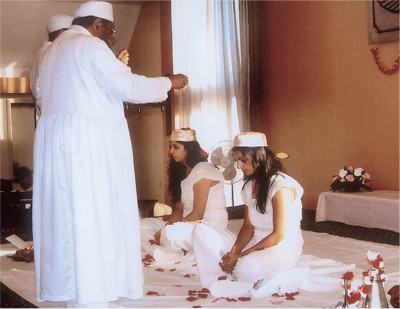
The navjote ceremony in progress
Anahita and Ayesha were 21 and 18 years of age. Their mother Arnavaz Fouzdar is a Zoroastrian. Their father, Kulwinder Singh Dua is a Sikh. The girls, their parents and their grandparents knew that sections of both the Zoroastrian and the Sikh community would condemn and ostracize them. All of them had thought about it long and seriously and decided to go with the courage of their convictions.
Arnavaz (Fouzdar) Dua is an eminent endocrinologist. Her husband Kulwinder is an internationally acclaimed gastroenterologist who is invited the world over for medical conferences and camps. His inventiveness and expertise have led to many pain mitigating and life saving procedures. A widely used stent called the ‘Dua Stent’ is named after him.
We hesitantly asked the renowned Sikh doctor if he was comfortable with the decision of his grown daughters to embrace Zoroastrianism. He stated with sincerity that he was perfectly happy. The son of Inder Singh Dua, a former officer in the Indian Armed Forces, Kulwinder said, "I see religion as a uniform. You may belong to the Artillery, the Cavalry or the Guards. Your ultimate aim is the same. To vanquish the enemy (evil) and to safeguard your country and people ( good).” He went on to add that his daughters can and do go to a Sikh gurudwara as well which has no taboos on who enters it or believes in the values it propounds.
Without exerting any obvious pressure and by being a living and practicing example of ‘ashoi,’ Arnavaz had shown her daughters the path of true righteousness. Not an easy task in normal circumstances. Infinitely more difficult in an inter-religious marriage and when living in the USA.
That the girls look up to their mother, was evident from Anahita’s remark: "I am very aware that my mother is the amazing person she is, in part due to her faith. I want to do everything I can to learn and pass on this legacy to my own children, in the hope that they too will appreciate their roots.”
Twenty-one-year-old Anahita is a second year medical student at the University of Aberdeen in Scotland, UK. She was firm in her conviction and forthright in her views. "The navjote ceremony was not only our initiation into Zoroastrianism. It was a stand against the man-made rules that have caused this great religion to go into near oblivion,” she said. "The Zoroastrian religion is the oldest religion in the world. It is a pity that today there are only a few thousand who practice and more importantly can pass on this faith to coming generations.”
Ayesha at 18 years of age is a pre-medical student at the University of Wisconsin at Madison. For her the navjote was a deeply moving experience. "In that single hour of the ceremony, I grew as a person, more than I have in all of my 18 years.” Ayesha said she always considered herself to be a Parsi and a Sikh. "However, I could only declare it but not ‘sustain’ it,” she reflected. Now, after her initiation "I can practice the faith, educate others about the meaning of being a good Zoroastrian and feel proud of being a part of an everlasting tradition.”
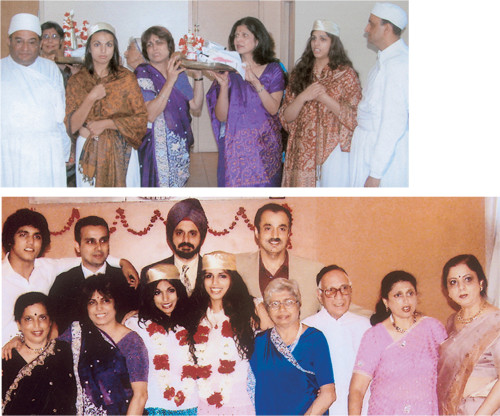
Top: Proceeding for the navjote after the nahan Above: The new initiates with close family
Arshish, the 15-year-old Dua son, Cy, the dog and Kitty, the cat wandered in and out of the comfortable ‘home-theater’ in the basement, as we talked and viewed the navjote video. There was no mistaking it was a Parsi home from the divo and ses, Zarathushtra frame and family pictures that shared shelf and wall space with other works of art and of religious significance. "Arshish is at an age when he is still an agnostic,” smiled Arnavaz. "In time he may want to be navjoted. He may not.” My admiration for this soft-spoken, sensible woman was growing by the minute. "The girls had their navjote at this late age when they fully understood the implications of what they were doing and wanted it,” said Arnavaz. "They were never pressured by anyone.”
For days after meeting the Duas we were beset by conflicting feelings — unease, amazement and admiration. Who were the real heroes in this story? Kulwinder of the mighty, martial Sikh race, whose vision and largeness of head and heart could accommodate the idea of Zoroastrianism for his progeny?
Kulwinder’s parents, brothers, sisters and family who came for the navjote and supported it every step of the way?
The gentle and beautiful Arnavaz who steadfastly followed her religion, in spite of being married outside it and whose faith and feeling for Zoroastrianism was passed on to her daughters in such strong measure?
Arnavaz’s parents, Kamal and Bejan Fouzdar, for the firm beliefs they brought their daughter up with?
The priests who performed the navjote ceremony, Ervad (Dr) Kersey Antia (a practicing psychologist) and Ervad Arda-Viraf Minocherhomjee (a financial consultant) knowing they would be widely criticized?
Or Anahita and Ayesha, the courage of whose convictions made it possible for the sudreh to be slipped over their sports bras and the kusti tied in ‘bhar majlis (amidst a congregation)’ with family and friends as witnesses?
Says Anahita, "In having our navjote ceremony, we have consciously chosen a revolutionary direction. My sister and I were in a position where we could choose to sit in our house in silence or demand the right and recognition to be good Zoroastrian women.”
Are we going to give them that recognition?
◆ ◆ ◆
From the archive