
Life-Style
Acceptance with ashirwad
Interfaith couples opt for traditional ceremonies and a Parsi style wedding trousseau
There are some invitation cards that boldly state the date and time of the Zoroastrian ceremony, of the Hindu rituals, and of the wedding reception. Interfaith unions that were once considered a digression are now viewed as a norm. Marriages within or without are generally regarded as occasions for celebration unlike earlier times when interfaith unions caused considerable heartburn with the parents fearing "kaum maa monoo kèm dékharsoo (how will we face the community)?”
Beyond the walls of the venue where the interfaith marriage is being celebrated "comments or taunts may be heard, but at the function itself you’ll hear positive, encouraging remarks even from senior citizens like ‘you have found a good partner,’ or ‘look after each other’ which indicates the acceptance of non-Parsi spouses,” observes photographer Homyar Mistry of Homz Prints who during the celebration season (usually November to February in Bombay) is booked for five or six intercommunity marriage receptions. And when it is a second generation interfaith marriage, the parents having already experienced a successful interfaith union, the confidence and comfort level with the non-Parsi spouse is higher, he adds. He is usually booked by one of the partners who is a Zoroastrian and whose guests are largely from the Parsi community.
More alarming than the increase in the number of interfaith unions is the cancellations among community marriages, mentions Mistry. Having known of two or three last minute break-ups in the recent past he realizes that couples are having a rethink before tying the knot.
Although he has been in the photography profession for the last nearly 30 years, Sarosh Daruwalla of Mazda Audio Video Lab considers himself fortunate that in his entire career he has not had to shoot photographs of more than a dozen interfaith marriage receptions. He is also relieved that on two occasions after receiving enquiries to shoot navjote photographs of the children of a Parsi mother who had married out of the community, "God spared me” from this assignment. "I am not sure what is right,” he candidly declares. He refers to the strict rules at the Banaji Atash Behram, "and rightly so,” where the hall cannot be hired by an intermarried family. The application form even asks for the names of the grandparents to ensure that there is no mixed marriage in the family.
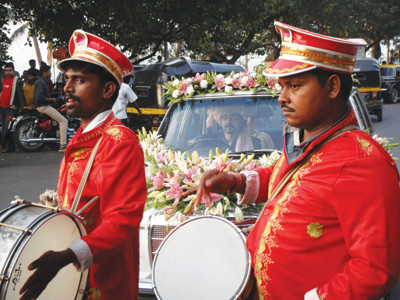
Band accompanying a marriage procession
Likewise at the Fanaswadi (Seth Dadibhai Nosherwanji Dadiseth) Atash Behram, the Cama Baug and the Salsette Community Hall, their premises cannot be hired for an interfaith marriage or for the navjote of such a couple’s children. At Allbless Baug, they permit functions if the man is marrying out of the community. Saher Agiary and the Malcolm Baug Hall are available for receptions only of interfaith unions and navjotes of children if the father is a Parsi. At the Seth Jeejeebhoy Dadabhoy Agiary at Colaba, the grounds are available for a reception after a jashan has been performed. The Sethna Agiary premises can be used if any one partner is a Parsi. Ripon Club and the Elphinstone Cricket Club permit their premises to be used for any function so long as the booking is done through a Parsi member. The Dadar Parsi Colony Gymkhana and private restaurants permit their facilities to be used for any interfaith marriage or navjote of mixed marriages. At the Athornan Boarding Madressa Hall, the answer was "no comments.”
The ashirwad ceremony when "the blessings of Ahura Mazda are invoked on the newly married couple” can be undertaken by one priest or two priests, says Ervad Khushroo Madon who performs this ritual for even interfaith unions, once the marriage is registered under the Special Marriage Act, 1954. Since most Parsi baugs do not permit this ceremony for intermarried couples, these are frequently performed in a hall, or a terrace or a club, he notes. After the ceremony Madon usually gives a five-minute talk explaining the significance of the ashirwad ritual and the aachhoo-michhoo that precedes it. Although such couples are not doing anything contrary to law they prefer to "avoid publicity and unnecessary controversy,” he adds.
Irrespective of whether it is the man or the woman marrying out of the community, Ervad Framroze Mirza performs the Zoroastrian wedding rituals and finds that unlike a decade ago when it would be done in a closed room and no photographs of the event would be shot, currently "everybody is open, no chori-chhoopi. After the controversy public ni beek nikli gai (people’s fear of ostracism has been mitigated).” When families of interfaith unions tell him "khaali Tandurasti bhano” or "khaali ék kardo bhano (only pray the Tandurasti or one verse),” Mirza says he refuses on the rationale "Why do ardhu kaam? Karo tau pooroo karo nahi tau naa karo (do the full rites or don’t do any).” He insists on starting with the nahn (purificatory bath), proceeding with the aaraa-antar (symbolizing the initial separation with a curtain and the eventual union of the couple) and then performing the ashirwad. He is emphatic, "A civil marriage is only a legal formality. If you don’t do the ashirwad ritual for the married couple how can you do the navjote of their offspring?”
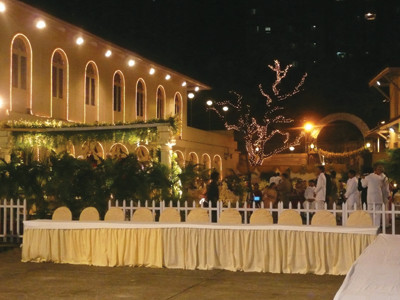
Celebration in progress at the Seth Jeejeebhoy Dadabhoy Agiary Photo: Jasmine D. Driver
It is hypocritical that some baug venues are available to the couple to celebrate the interfaith marriage only if a jashan is performed, believes Mirza. Knowing that the explicit purpose of booking the baug is only for the reception, why insist on such a prerequisite? he asks. The loud strains of Congratulations that can be heard are clearly for the married couple and not for the completion of the jashan, points out Mirza who is happy to perform ceremonies for interfaith married couples and their children but is "very strict about conversion” maintaining that "every person should remain in his faith.”
Dressing up in traditional attire, and buying a gara at wedding time becomes a priority even for interfaith marriages, states Farzeen Boomla whose late mother Naju Daver popularized garas in the community. "Crystals and bling” do not interest interfaith couples, she mentions. "Most Parsis have a gara so they do not value it as much as a non-Parsi who is thrilled to own it,” she has realized. Viewing it as "an heirloom that will be handed down,” usually the choice is for one good sari that would cost upwards of Rs 35,000.
When it is a Parsi man marrying out, frequently it is his mother who comes and selects, leaving the final choice to the non-Parsi daughter-in-law who would decide depending on the color that suits her and her figure. Being wedding time, they will avoid the color black because it is considered inauspicious, and red because they are not sure whether they will be able to carry it at a later age. "Purple and blue therefore are the colors most preferred.” For those opting for embroidery in one color, Boomla suggests a contrasting blouse, preferably in lace to highlight the sari.
Jewelry too that interfaith couples opt for is the typical Parsi styles, observes Viola Wadia of K. Wadia. Even when she suggests something new they "don’t want to explore,” she reveals. When a Zoroastrian woman comes with her non-Parsi spouse Wadia finds that in fact he encourages her to opt for authentic Parsi designs. The only difference is that "they will avoid pearls as recommended by the mother-in-law” and opt for diamonds. Parsis though are happy to own their "moti-manek (pearl-ruby) sets,” she states. If the Parsi man is marrying out, it is his mother who makes a choice and "emeralds and rubies are the preferred stones, blue sapphires being considered inauspicious.”
Since the last 10 years Khushroo Press of B. Jamshedji Jivanji has witnessed a discernible "rise in interfaith marriages but there is no noticeable difference in our business” for they continue to patronize Parsi establishments. When couples are marrying within the community "they know exactly what jewelry they want but in the case of ganga-jamuna (interfaith unions) they are lost because they are not familiar with the Parsi favorites like chhéras,” he says. He has also observed that Parsis are more quality conscious and would prefer to have a smaller diamond of a superior quality unlike others who give importance that the precious stone "dékhaavu joiyé (should be visible).”
Interfaith unions may result in a blend of palates. The food served at the wedding reception depends on which community the man or the woman is marrying into. "If it is a Muslim, the food served will be a fusion of Parsi, Moghlai and Afghani. If it is a Punjabi, then chole bhatura, black dal, chicken farcha or sali murghi will be on the menu. If the spouse is a Gujarati, then mithi dal, dhokla, shrikhand, mithais are the staple fare,” reveals Adil Bhesadia of Y. A. Bhesadia Catering Services. "Paatraa ni machhi though reigns supreme” and is considered the universal favorite at any Parsi wedding. As compared to the paat system that the Parsis observe, other Indian communities prefer the running pangat where after presenting the gift a guest is expected to proceed to the dining table where continuous meal service is available.
"Since our food is not available in restaurants they take pleasure in booking our authentic Parsi bhonu,” mentions Tanaz Godiwalla who finds that even for interfaith marriage celebrations that are clearly on the rise there is demand for "traditional Parsi food with paatraa ni machhi, sali chicken and dhansak dal” being considered a must. The peak season, Godiwalla finds is "getting compressed as Parsis will avoid celebrations during sambhi (onset of) Diwali (in October or November) and will not plan functions after February when examinations commence. Fridays and Saturdays are invariably booked first” and she may have to cater to several assignments over these two days and fewer during the rest of the week. "Leap years take a beating too,” she has noticed. In the case of interfaith marriages where no ceremonies are performed she finds that the "guests walk in late and the celebrations last longer.”
Godiwalla’s name being associated with "luxury and serve king size” she however is not comfortable when she has to operate from gymkhanas and other venues which permit interfaith marriages but do not offer the necessary infrastructure despite being exorbitantly priced. According to her, "Parsis are blessed to have baugs” and she wonders what will happen to them with the rise in interfaith marriages and the possible reduction in navjotes in the years to come.
◆ ◆ ◆
From the archive