
Business
The milky way
The new managing director of Baroda Dairy, Jehangir Daruwala states the pros and cons of the milk farming business in India
Milk supplied through the unorganized sector can be adulterated, mostly by water, and at times with harmful substances, cautions Jehangir Daruwala (pictured), newly appointed managing director of Baroda District Co-Operative Milk Producers’ Union 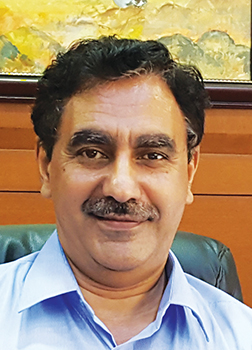 Limited, more popularly known as Baroda Dairy (BD). Of all the ‘surplusable’ milk produced in India only 35% goes into the organized dairy sector, "where it is systematically collected, scientifically tested, transported to a chilling unit, analyzed for quality parameters, processed and packed in a dairy plant,” according to the milk man. He explains that ‘surplusable’ refers to that milk which is available for sale from individual producers after their household consumption. The remaining "goes into the unorganized sector, distributed and consumed unpacked. Very few developed countries allow loose milk handling,” he states.
In a telephonic interview with Parsiana on June 28, 2016, the dairy man explained that at present milk production in India is approximately 150 million tons annually. "Efforts are under way by the government of India, National Dairy Development Board (NDDB) and milk cooperatives, along with private dairy plants, to increase the share of the organized sector.” For this to happen, public awareness needs to be heightened about the ill effects of consuming loose milk, he caveats.
A major hurdle for the organized sector is lack of proper infrastructure, he complains, in response to Parsiana’s questions. Capacity is being expanded, but "the rate of increase of production and consumption of milk is also increasing,” states Daruwala. The milk sector at present "has a turnover of approximately Rs 500,000 crore,” he quotes, mentioning that there are no industry wide records for exact numbers. For increasing the volume handled by the organized sector, a huge investment in developing infrastructure is required, in procurement, chilling, processing, packing and product making, and also in storage and marketing, lists the senior executive.
Limited, more popularly known as Baroda Dairy (BD). Of all the ‘surplusable’ milk produced in India only 35% goes into the organized dairy sector, "where it is systematically collected, scientifically tested, transported to a chilling unit, analyzed for quality parameters, processed and packed in a dairy plant,” according to the milk man. He explains that ‘surplusable’ refers to that milk which is available for sale from individual producers after their household consumption. The remaining "goes into the unorganized sector, distributed and consumed unpacked. Very few developed countries allow loose milk handling,” he states. In a telephonic interview with Parsiana on June 28, 2016, the dairy man explained that at present milk production in India is approximately 150 million tons annually. "Efforts are under way by the government of India, National Dairy Development Board (NDDB) and milk cooperatives, along with private dairy plants, to increase the share of the organized sector.” For this to happen, public awareness needs to be heightened about the ill effects of consuming loose milk, he caveats.
A major hurdle for the organized sector is lack of proper infrastructure, he complains, in response to Parsiana’s questions. Capacity is being expanded, but "the rate of increase of production and consumption of milk is also increasing,” states Daruwala. The milk sector at present "has a turnover of approximately Rs 500,000 crore,” he quotes, mentioning that there are no industry wide records for exact numbers. For increasing the volume handled by the organized sector, a huge investment in developing infrastructure is required, in procurement, chilling, processing, packing and product making, and also in storage and marketing, lists the senior executive.
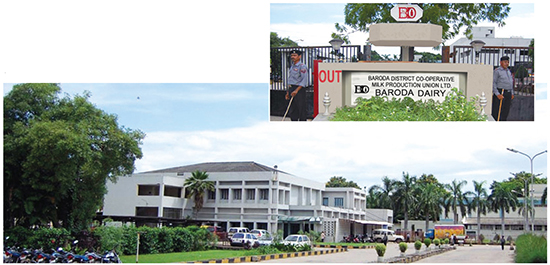
Views of Baroda Dairy
Outlining the cattle farming scenario in the country, Daruwala states that large scale dairy businesses, on par with international dairy players, are not popular in India due to huge investment required for land, cattle, and infrastructure. "Apart from that, labor requirement and health care are major issues.” Milk marketing is a big challenge, as bulk milk rates vary depending on season, availability and uncertainty in national and international pricing of butter and milk powder. "Currently the international prices of these commodities are so low, they are much below the cost of local production,” he highlights. The realist in him states that every few years the cycle reverses and the prices of milk products increase. "At that time farmers gain,” he believes.
Dairy farming in India is an integral part of the Indian rural scene, he elaborates, but cautions that most households have one to 10 head of cattle and very rarely more. The cooperative structure in the country is three-tiered, first being the village cooperative society which collects milk from various individual milk producers; the second being the district level milk union which procures milk from village cooperatives, processes and packs milk and milk products and distributes to consumers. The third tier comprises state level dairy federations that monitor and manage logistics for intra-state and inter-state marketing.
Village milk cooperatives elect their representatives, who become board members of the union for a five-year term; board members then elect their chairman, he explains. "The board has responsibility for efficient functioning of the milk union with an executive member functioning as managing director ... the board and the managing director have to ensure that consumers get quality milk and milk products at reasonable prices.”
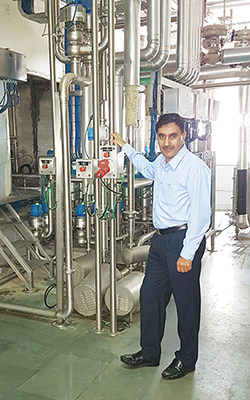
Jehangir Daruwala in the pasteurization plant
Daruwala’s adopted state of Gujarat is where the milk cooperative movement originated in 1946 and led to what is now the Amul Dairy. The first ever co-operative, the Kaira District Co-operative Milk Producers Union Limited began with just two village dairy cooperative societies and 247 litres of milk. "The dairy cooperative culture is very strong and functioning effectively (in Gujarat),” he states. In other states also, this structure ("we call it the Amul pattern”) is replicated by local governments.
Though a major milk producing nation, India’s share of exports of milk and milk products is minuscule, "mainly because the domestic requirement is huge and is increasing with population growth,” explains Daruwala. Various countries provide heavy subsidies to milk farmers, which affect international milk product prices. He lauds a governmental and NDDB driven project for "hygienic, mechanized milking and installing chilling units at village level to improve the quality.”
India being one of the largest producers of milk in the world and also one of the most populated countries, the booming demand has attracted various corporate houses to the sector, Daruwala reveals. Large companies like TVS, Mahindra and ITC have therefore entered into the business. "It may not be easy for them to compete with the cooperative sector, in spite of its various shortcomings,” states the managing director. Cooperatives have a well established infrastructure along with credibility within the rural populace.
Immediate need
A focus on the commercial aspects of milk farming and milk production is the need of the hour for the dairy industry, states Daruwala. "At present, most farmers keep cattle and dairy business as a concurrent activity with agriculture and hence do not separately evaluate costing and viability,” he rues. Awareness is increasing, but commercial viability should be the primary focus of the industry, he emphasizes. Explaining that the cost of each head of cattle varies from Rs 20,000 to upwards of Rs 1,00,000 depending on breed, number of calvings, history of productivity, adaptability to local environment and general health, he stresses that the most important factor in improved productivity is feeding. "The farmer has to have knowhow about the right feed requirement which is cheap and at the same time increases quantity and quality (the nutrient content) of the milk,” he advises. This will provide him maximum rates, making milk farming profitable. The dairy veteran emphasizes that the cooperative sector along with NDDB is running a drive to impart knowledge on balanced feed for cattle.
Established in 1957, BD is the fourth largest dairy in milk sales in Gujarat. The Dairy can process up to six lakh litres of milk per day and retails milk and milk products — sweets and ice cream — through 2,100 outlets in Gujarat. BD also undertakes production on behalf of the Amul brand, reveals Daruwala. It has two chilling plants at Bodeli and Savli and buys from "over 1,250 cooperatives having approximately 217,000 members.” He mentions that "efficient utilization of surplus milk is a challenge,” he states. Revealing that BD will soon operationalize a new cheese spread manufacturing plant having a capacity of 40 metric tons (MT) per day, he believes that "its timely installation and commissioning is a major task ahead.” The Dairy, which already has a milk product and ice cream unit, retailing its products under the brand name Sugam, will "in future, use surplus milk in value added products” (like cheese spread). Conservation of energy will be a priority. Going ahead with full automation of internal processes to maintain and enhance quality standards is another item on his to-do list "to improve on the quality as well as to maintain the standards of all the products manufactured.” BD is expanding the manufacturing capacity of its cattle feed plant based at Itola in Baroda district, from 150 MT per day to 250 MT.
"There are various opinions on milking of cows and other cattle,” explains the long time dairy expert. "After lactation and initial growing period of the calf, milk production continues or sometimes even increases ... hence milking is a necessity for cattle, else it will create health problems for them.”
A focus on the commercial aspects of milk farming and milk production is the need of the hour for the dairy industry, states Daruwala. "At present, most farmers keep cattle and dairy business as a concurrent activity with agriculture and hence do not separately evaluate costing and viability,” he rues. Awareness is increasing, but commercial viability should be the primary focus of the industry, he emphasizes. Explaining that the cost of each head of cattle varies from Rs 20,000 to upwards of Rs 1,00,000 depending on breed, number of calvings, history of productivity, adaptability to local environment and general health, he stresses that the most important factor in improved productivity is feeding. "The farmer has to have knowhow about the right feed requirement which is cheap and at the same time increases quantity and quality (the nutrient content) of the milk,” he advises. This will provide him maximum rates, making milk farming profitable. The dairy veteran emphasizes that the cooperative sector along with NDDB is running a drive to impart knowledge on balanced feed for cattle.
Established in 1957, BD is the fourth largest dairy in milk sales in Gujarat. The Dairy can process up to six lakh litres of milk per day and retails milk and milk products — sweets and ice cream — through 2,100 outlets in Gujarat. BD also undertakes production on behalf of the Amul brand, reveals Daruwala. It has two chilling plants at Bodeli and Savli and buys from "over 1,250 cooperatives having approximately 217,000 members.” He mentions that "efficient utilization of surplus milk is a challenge,” he states. Revealing that BD will soon operationalize a new cheese spread manufacturing plant having a capacity of 40 metric tons (MT) per day, he believes that "its timely installation and commissioning is a major task ahead.” The Dairy, which already has a milk product and ice cream unit, retailing its products under the brand name Sugam, will "in future, use surplus milk in value added products” (like cheese spread). Conservation of energy will be a priority. Going ahead with full automation of internal processes to maintain and enhance quality standards is another item on his to-do list "to improve on the quality as well as to maintain the standards of all the products manufactured.” BD is expanding the manufacturing capacity of its cattle feed plant based at Itola in Baroda district, from 150 MT per day to 250 MT.
"There are various opinions on milking of cows and other cattle,” explains the long time dairy expert. "After lactation and initial growing period of the calf, milk production continues or sometimes even increases ... hence milking is a necessity for cattle, else it will create health problems for them.”
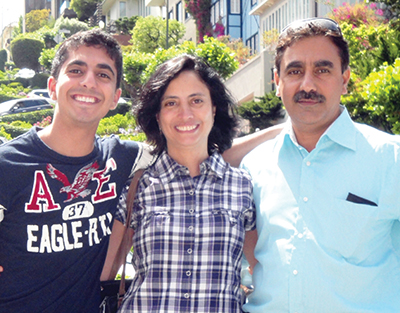
With son Jimmy and wife Shiraz
Born into a family with agricultural roots, Daruwala was raised in Deori, 24 kms from Jabalpur in Madhya Pradesh (MP) where "we (parents Dolly and Rustom) had agriculture land, orchards and poultry.” A graduate in agricultural engineering from the Jawaharlal Nehru Krishi Vishwa Vidyalaya at Jabalpur, he pursued his masters in dairy and food engineering at IIT Kharagpur ("the only IIT having agricultural engineering courses”). Starting his career with the MP Cooperative Dairy Federation in 1984 as an assistant engineering manager, he has served as chief executive officer at Indore, Bhopal and Ujjain Cooperative Milk Unions within MP before joining BD in June 2016. Wife Shiraz is a cost accountant from Jamshedpur and is based in Bombay as national head (operations) with Tata Motor Finance. Son Jimmy, who pursued his masters in industrial engineering from State University of New York, is now based in Michigan, USA.
A practicing Zoroastrian, Daruwala believes that choice of method of disposal of the dead should be left to the individuals concerned. "I am personally not averse to interfaith marriages, but am of the opinion that full respect should be paid to one’s faith” he avers.
◆ ◆ ◆
From the archive