
Observation
Picturesque Prague
Ancient castles, bridges, cobbled streets and architecture attract tourists
On the motor coach drive from Vienna to Prague we stopped at Altenburg to see the Rosenburg Palace. The 500-year-old castle is a fine example of the architecture of the Renaissance Age. In 1800 a major fire devastated parts of the Palace, after which it lay in disuse for many years before it was restored by Count Ernst Carl von Hoyos.
The castle and the grounds are now used by a privately owned falconry. Guides and staff in fancy historic costumes took us around. The beautiful chapel on the ground floor has wall paintings dating back to circa 1560. It also has a monastery where monks are trained for the priesthood.
The tour of the palace was followed by a falconry demonstration in the courtyard by highly trained birds and their expert trainers. This live show was an unusual experience of precision commands and instant response by the huge birds perched on their trainers’ wrists. In the same central courtyard of Rosenburg Palace, theater performances, including an annual Shakespeare Festival are held, we were told.
The castle and the grounds are now used by a privately owned falconry. Guides and staff in fancy historic costumes took us around. The beautiful chapel on the ground floor has wall paintings dating back to circa 1560. It also has a monastery where monks are trained for the priesthood.
The tour of the palace was followed by a falconry demonstration in the courtyard by highly trained birds and their expert trainers. This live show was an unusual experience of precision commands and instant response by the huge birds perched on their trainers’ wrists. In the same central courtyard of Rosenburg Palace, theater performances, including an annual Shakespeare Festival are held, we were told.
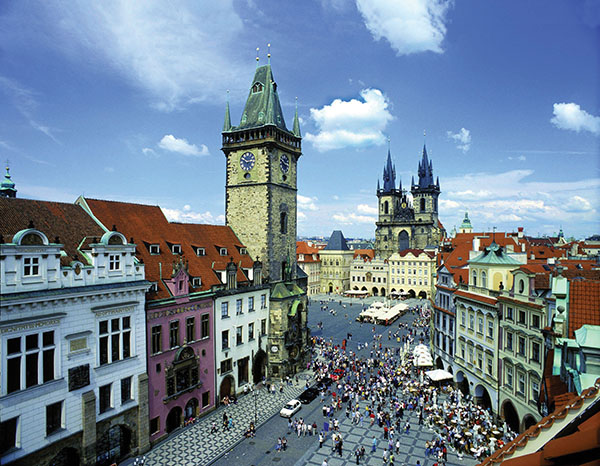
Old Town, Prague
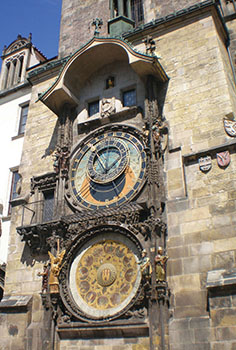
Astronomical Clock Photo: Wikipedia
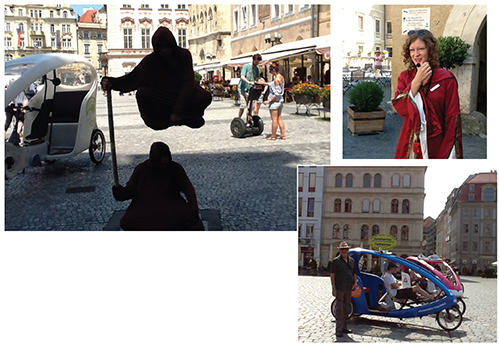
(Clockwise, from above): feat of strength and control; guide at Rosenburg Palace
in medieval costume; colorful autorickshaw for tourists
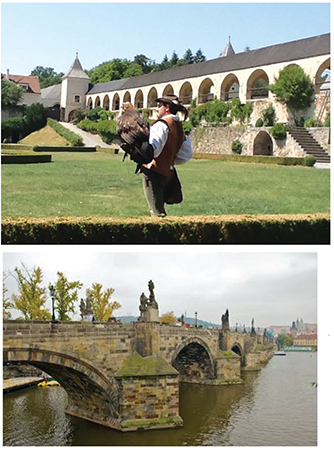
(Above): Falconry demonstration; Charles Bridge by daylight
From Altenburg we drove on to Prague, a four-hour drive that included a border crossing from Austria to the Czech Republic. Formerly, Prague was the capital of Czechoslovakia. In a divorce that went against the wishes of many of its 15 million citizens, Czechoslovakia split into two countries, Slovakia and the Czech Republic, on January 1, 1993.
Most people visit Prague for its ancient bridges, cobbled streets and glorious architecture. But, we were told there is a grittier, murkier side to the city. It is a favorite destination for sex tourism and is open to all ideas, all possibilities — same sex, opposite sex or just voyeurism. Our guide, a dapper dude who thought he was irresistible to women, informed us that at one time "TV Nova, a local station, had naked newscasters to telecast the weather!” Some prudish politician must have put a spoke in the wheels!
On our first night in Prague we walked over Charles Bridge, savoring the sophistication and bright lights of the city. Commissioned by Charles IV in 1357, the bridge is one of the most visited sights, a popular haunt for tourists, locals, lovers and pickpockets on the prowl. The bridge rests on 16 arches and is lined with 30 Baroque style statues of religious figures. Till 1841 it was the only means of crossing the Vltava River, connecting the Prague Castle to the Old Town, and more importantly, making Prague a trade route between Eastern and Western Europe. The evening ended at a Czech pub with great local beer and atmosphere.
The next day’s sightseeing revealed why Prague is considered one of Europe’s most attractive capital cities. We saw castles and cathedrals, the Old Town and the Astronomical Clock which was once the envy of all Europe. Every hour hundreds of tourists from around the globe gather in front of the Old Town Hall in Prague, waiting with bated breath to watch a fascinating mechanical performance which, in the Middle Ages, was considered one of the wonders of the world! As the hour strikes, 12 apostles emerge from the windows on the clock face, to cheers from the crowds below.
Made 600 years ago, the Astronomical Clock continues to be one of the city’s greatest treasures. No other instrument in the world has been able to replicate the procession of apostles and the visualization of time, as this clock does. It was once believed that after clockmaker Master Hanus created this masterpiece for the city of Prague the city councilors had him blinded for fear he would be invited to other European cities to build similar clocks. "More recent research has thrown some doubt on this story,” our guide explained.
Prague, once strong on religion, has statues of saints dating many years ago. But after the advent of communism the people turned agnostic.
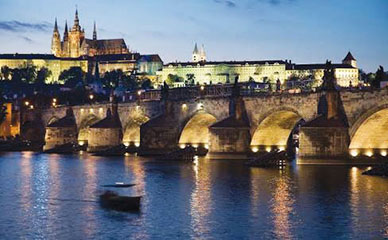
Charles Bridge at night
"Pickpockets are very common and very clever so be careful of your wallets,” our guide warned us. "Their operation is so smooth and painless, you will not even know your wallet has been stolen,” he said. "Every time I park my car and find it where I left it, I heave a sigh of relief,” he added. Two hundred cars are reported stolen every day.
The Czechs are big beer drinkers. They boast that they taught the Germans how to brew beer! A typical dinner would be roast pork cooked in beer, with dumplings on the side. Carp is a popular fish found in the many natural and artificial lakes there.
While Budapest was bombed and destroyed during World War II, Prague was left relatively untouched. On February 13, 1945, in the semi-darkness of dawn, some German planes accidentally dropped a few bombs on Prague. Germany did not want to bomb Czechoslovakia because the country had large deposits of coal which the Germans hoped to use.
Commenting on the local population, our guide said "The people of Prague are not over-friendly. A hangover from the days of the Communist regime, when everyone was suspicious of everyone else. Not only are they reserved, some can be downright rude.”
Czechs who left their country seem to have done well for themselves. Madeline Albright, whose parents migrated to USA from Czechoslovakia rose to become the first woman Secretary of State during Bill Clinton’s presidency.
Tennis legend Martina Navratilova of tennis fame left the country when she was 18 years old, as part of the Czech national tennis team, and never came back. "Left for the love of freedom and for the love of McDonalds,” she said. In 2014 Navratilova married Julia Lemigova who had been crowned Miss USSR in 1990. The Czech people never speak of Navratilova in public or with pride.
Prague is famous for its deep red garnets and sparkling crystal. So save a few Koruna (Czech currency) for shopping.
◆ ◆ ◆
From the archive