
Cover Story
Milk, mithai and more
The Parsi Dairy Farm and Dairyland brands continue to evoke loyalty and trust among their customers
"We are open,” proclaimed the banner, gladdening the hearts of many in the community who believed a chapter of their life had closed when Parsi Dairy Farm downed shutters in November 2006 following a strike called by the labor when their financial demands were not met.
"Our customers, touch wood, are very faithful to us,” observes Meher Patel, one of the nine partners of this family business, reporting that 95 percent of their community clientele have come back to them, patronizing their milk and dairy products. Her sister Shernaz Irani, also a partner, recalls the day this May when they were opening shutters of their Princess Street shop to clean the premises and a visibly happy lady, unknown to her, came and hugged her to express her joy at the establishment reopening, and that too on her birthday! "People would say ‘we are praying for you’… they were genuinely concerned… that makes us feel so good,” conveys Meher.
The strike was called off unconditionally ultimately. But the damage had been done. Some customers, especially those who patronized their four different varieties of high fat, low fat, no fat and cow milk left them with the result that now their daily milk business is in the region of 1,200 litres, the Marwaris constituting nearly 50 percent of their client base. But it was reassuring for them, as notes Shernaz, when the cream of their clientele like the Ambanis resumed their consumption of Parsi Dairy milk. Among their faithful high profile customers is yesteryear Bolly-wood actor Mumtaz who "loves our items” and periodically comes to the shop and creates a flurry among the bhaiyas (their workforce, most of whom have their roots in and around Uttar Pradesh, where the Hindi term bhaiya means brother) especially when she starts conversing with them, as mentions Shernaz.
The hallmark of Parsi Dairy products is supposed to be "purity, no compromise on quality,” asserts Shernaz. Each can of milk is tested at the laboratory on their premises. Whilst originally their uniformed employees assigned home delivery of milk would carry the consignment in cans, measure it and empty it in the vessels placed before them, now the cans contain pre-packed and sealed pouches as "it is more practical and ensures that there is no adulteration and no short measure,” states Rusi Nariman, the only surviving son of the founder Nariman Ardeshir who started the milk business 91 years ago from these same premises.
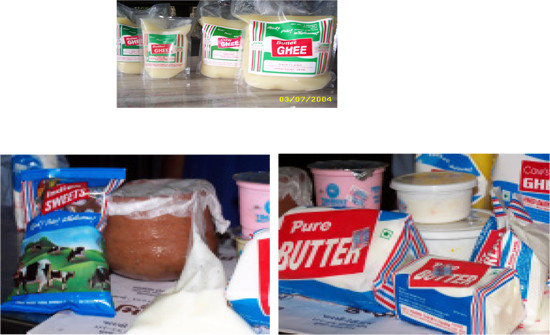
Parsi Dairy Farm and Dairyland specialities in constant demand
Within the next five years he had introduced sweetmeats and the kulfis came soon thereafter. Their specialities then, as now, were made on the premises across the road and it is the same recipes over the years that have continued to delight their die-hard customers, says Rusi. Some of their sweets that have a longer shelf life and can be safely preserved in the freezer for up to a year are known to be carried overseas by non resident Indians who have taken up homes in foreign lands.
While the Parsi favorites continue to be malai khajas, bois, jalebis and suterfenis for which there is maximum demand at Navroz time, during Ganesh Chaturthi their modak and pedas are in demand and at Raksha Bandhan time it is kaju katli and pedas. During Diwali, there is a demand for mixed mithai but they are particularly famous for their Surti ghat na penda. Rusi believes, "We are the only people in Bombay to make suterfeni,” referring to the laborious hand-made process that takes four-five days to organize the strands. The other shops that sell suterfeni usually get it from Gujarat and market it here. A favorite among all communities are their toffees, marketed in the name of Milk Drops, and they find it very gratifying that even those settled abroad like to carry these packets back with them despite the infinite chocolate options available there.
They know of customers too who like to carry their ghee to the Middle East. "Kya sugandh aataa hai (experience its aroma),” they justify their efforts. Also popular among their dairy items is white butter. Being saltless and without preservatives, it has a unique taste which needs to be cultivated to enjoy it, reveals Meher.
A product which has evolved over the decades is the humble curd. Before the yogurt and its flavored varieties were introduced curd would be made in large containers and measures sold from the dahi nu tapelu (vessel containing the curd). When the contents of the vessel were nearing their end, Rusi remembers customers urging them to break into the next vessel, "Nariman, top forni.” (The literal meaning of top fori is firing a canon gun.) Thereafter came the plastic containers for curd that were believed to be convenient. The demand for curd in earthen pots though remains high especially from foreigners who value its distinctive, natural taste in matkis where it stays fresh for a longer time.
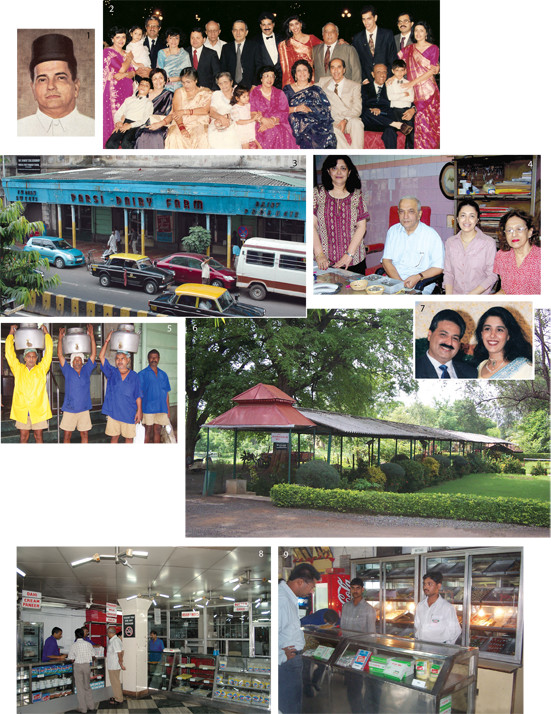
1. Founder Nariman Ardeshir 2. Three generations of the family 3. First shop at Princess Street with partners 4. Shernaz Irani, Rusi Nariman, Meher Patel and Jeroo Nariman ; 5. Bhaiyas carrying milk cans for home delivery 6. Dairyland estate 7. Urvaksh and Amy Hoyvoy 8. Parsi Dairy and 9. Dairyland premises Photos 3 & 8 by Chetan Mistry
For the last eight years Rusi’s younger sister Jeroo Nariman’s home-made brownies, cakes, biscuits are marketed by Parsi Dairy too. In fact, she was the only one amongst the five siblings to study catering after school, reveals Rusi who with his three elder brothers Dinshaw, Meherwan, Naval would be usually seen manning the cash counter. In fact there was an implicit understanding that only someone from the family could handle the cash portfolio, a tradition that continues to this day. Assisting in the business at Princess Street are Rusi’s wife Silloo and the late Dinshaw’s wife Roshan (mother of Shernaz and Meher). Earlier Naval’s wife Taz too would share the responsibilities. From the third generation, besides Shernaz and Meher is their cousin Binifer Kaushal (daughter of Rusi and Silloo, now settled in Singapore). After Naval’s demise, son Urvaksh chose to function independently and daughter Rukhshana Ankle-saria is married and settled in Poona (see "Diversifying with Dairyland”). The fourth generation too has started evincing an interest in the business when free from their studies: Shernaz’s sons Bakhtyar, 25, and Sarfaraz, 23, and Meher’s daughters Zeenia, 21, and Parvana, 20. Rusi happily announces how three members of the Nariman family share the founder’s birthday (roz Fravardin, mah Dae) son Dinshaw, granddaughter Rukhshana and great-grandson Azamaan, with the founder being born in 1898 and Azamaan from the fourth generation in 1998. While Meher’s husband Khushru Patel is the managing director of Jak Printers Private Limited, Shernaz’s husband Kershasp is an advocate practising in Poona. Even though they are preoccupied with their respective professions the sisters know they can fall back on their husbands’ "moral support” when required.
Religiously inclined, the family has great faith in their Zoroastrian prayers and Meher mentions that it is not uncommon to find one of the family members with prayer book in hand in some quiet corner of the shop. "Without His blessings we would not have been able to come out (of this impasse),” Meher is convinced. The founder’s practice of visiting the two neighboring atash behrams daily was continued by the second generation with the eldest son Dinshaw visiting the Wadia Atash Behram and the youngest Rusi going to the Anjuman Atash Behram. Now it is Dinshaw’s grandson who tries to go to the Wadia Atash Behram daily while Rusi is yet a regular at the Anjuman Atash Behram. What do they feel about adhering to the time-honored customs? "I am a liberal,” states Meher. "I am a liberal,” echoes Shernaz. "I was orthodox; had to be liberal; had to move with the times,” confesses Rusi.
"Parsis are not business minded nowadays,” observes Rusi, adding, "They want an easy life; no tension. Dhandho hoi to savaar thi raat kaam karvu paré (in business you have to slog from morn to night).” Attests Meher, "Even after we close shop for the day there are so many things happening, so many things to be looked into.” Although there was a time when Parsi Dairy would be open even on Sundays, presently they are open to customers from Monday to Saturday, 7.30 a.m. to 9 p.m. When the sisters started taking an avid interest in the business, it took time for the bhaiyas to accept them. Earlier dealing with the workforce was Din-shaw’s portfolio and now Shernaz has assumed this responsibility. She walks into labor meetings with them. "They don’t have a choice; they have to accept us,” she smiles.
Many people are now becoming health conscious and asking for sugar free goodies. Parsi Dairy has yet not started manufacturing such items. They do though cater to the demand for low fat and no fat products. "If kulfi is low fat, there is no fun in eating,” explains Meher, stating that most in demand are their malai (cream) and pista kulfis although they have introduced fresh fruit varieties like mango, litchi, chikoo, custard apple, watermelon. Prestigious hotels and restaurants in Bombay offer Parsi Dairy kulfis as also some outlets in Delhi. Every week a consignment of 100 kilos of kulfi is sent to Delhi. Efforts are now on to promote their kulfis in the Middle East.
Diversifying with Dairyland
Equally keen to promote kulfis in the Middle East is Urvaksh Hoyvoy, grandson of founder Nariman Ardeshir, who has since 2002 (five years after the passing away of his father Naval) opted to operate independently under the name of Dairyland. Milk and milk products continue to be his main line of business too and as per the informal understanding within the family, while he caters to the north Bombay market, the south Bombay market is in the hands of the other partners who retain the Parsi Dairy brand. "I left the retail part and opted to take the factory with me. It is my personal belief that if I give a large margin to any wholesaler I don’t have to sit and manage a shop,” believes Urvaksh, elaborating on their franchise agreement with Nature’s Basket at Oshiwara and World Trade Centre.
Last month when accompanying the Indian delegation of the World Zara-thushti Chamber of Commerce to Karachi, he got an opportunity to present his kulfis to the governor of Sind and the minister of trade and industries earning him encouraging remarks from Pakistani officials like: "This calls for a joint venture...” "Whatever licences you need, consider it done...” "We’re a kulfi eating nation but we’ve never tasted kulfi like this.” Karachi is the gateway to the entire UAE and the Middle East, points out Urvaksh, "I see Karachi as a very economical place to set up a manufacturing unit.”
More than in milk, Urvaksh sees greater profit margins in ghee and other dairy products which are their specialties. "The days of gulping glasses of milk are gone,” observes Urvaksh, "Now people want better packaging and better price. Although there is demand for low fat products, full fat is here to stay in India…” The majority of Bombayites being vegetarians, they consider ghee and paneer as better protein options with a longer shelf life than chicken and mutton. Besides developing a base to become a public limited company, he would like to give India "good quality, longer shelf-life milk” and refers to the proposed establishment of a dairy collection center in Maharashtra that could handle one lakh liters of milk a day.
As per the findings of the Technology of Indian Milk Products quoted in The Economic Times of September 17, 2007, "traditional milk products are the largest selling and most profitable segment of the domestic dairy industry and account for 50 percent of milk produced and 95 percent of all milk products consumed in India.” This has prompted brands like Nestle and ITC to turn to traditional dairy products, "the segment emerging as the biggest driver of the Rs 227,340-crore domestic dairy industry... with a fresh zeal.” Experts believe that the reason why branded Indian sweets "haven’t made it big in the past is because marketers haven’t invested enough in research and development.”
Presently the shops at Lalbaug and Dadar come under his purview as also their tabelas (stables) at Jogeshwari. "Nothing has changed over the years except that I’ve put on more weight and gone grey.” Since some of the old-time maharajs (expert cooks) are with Dairyland and some with Parsi Dairy, it is basically the same sweet goodies that they both produce. He insists there is no change in the taste of his Parsi customers. "Being very vociferous…they tell us when the taste is not up to their standard. They keep us on track.” His sons Armaan who is 13 and Azamaan who is 10 love their chocolates because of which Dairyland Parlour has now started making almond rocks and "motivate” the father to develop new products like a low-fat spa yogurt which tastes like a classy soufflé and a low-fat yogurt ice cream. His wife Amy oversees the accounts and financial aspects of the business.
Dairyland, the frequent stopover for motorists between Talasari and Sanjan on the Bombay-Ahmedabad highway is managed by him too and he takes pride in reporting that Upper Crust magazine rated their restaurant the best for its vegetarian thali sold at Rs 120. Not to be missed is their rich lassi which served in a large brass glass for Rs 70 can constitute a meal by itself. Believing that golf is the upcoming game in India he would like to build a golf resort there. The 350 acres of grassland had been purchased by the Narimans nearly three decades ago when the Dairy Owners League Cooperative Society decided to shift the tabelas out of Bombay. Whilst not all dairy owners honored this decision, Parsi Dairy Farm shifted their buffaloes there and Urvaksh remembers his father, a hands-on man, doing night shifts at the main Princess Street shop and utilizing his weekly off to develop Dairyland.
His sister Rukhshana Anklesaria who is now married and settled in Poona had in her younger days studied food and dairy technology in England. On her return, with the support of their father, they succeeded in introducing yogurt to India, recalls Urvaksh. While some may still confuse yogurt with curd, Urvaksh explains that the culture of the two products is intrinsically different. To make curd, milk is split by introducing acidity whilst an enzyme treatment is necessary to make yogurt which has a totally different texture.
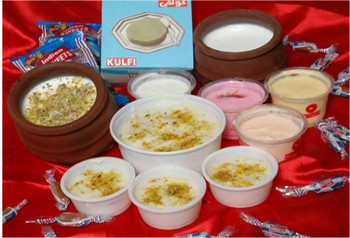
Varieties of curd and flavored yogurt Photo: Chetan Mistry
Urvaksh who had studied marketing in the United States started urging the family run galla business which had grown into a "reasonably large company” to adopt strategic managerial practices, employ professional managers to supervise the staff and control thefts. Parsi Dairy needed to offer something more than just "impeccable honesty” was the view of the only male member of the family from the third generation. "Being a large family, there were differences in opinion,” says Urvaksh who reports that until Naval’s passing away in 1997, he respected his father’s attempts to keep the family united. Instead of involving himself in the dairy business he tried his hand at different business ventures: Dairyland Plantations India Limited which sold teak trees; The Green Grocers, a vegetable trading company which bought vegetables from the wholesale market, cleaned, sorted and cut them as per the customers’ requirements and delivered the consignments on a weekly basis. But after Naval’s demise Urvaksh decided to immerse himself in the affairs of Parsi Dairy and "due to disagreements, big and small, the family opted for arbitration” where it was suggested that they split amicably.
"You are not going to improve the community through religion but through better social and economic standards,” says the avid businessman who when observing Parsis working in the top echelons of different enterprises and contributing to their success wishes they could help Parsi enterprises to flourish. "I am not community minded but I would rather have a Parsi work for me. There is not one Parsi working for me,” he remarks. Rather than dwell on "where have the sethias (of yore) gone?” he would prefer to dwell on "Why have they gone and how can we get them back?” He is enthused by the mission of WZCC: to encourage the youth of the community to get into business by providing them with necessary support, guidance and resources, to enable them to become the sethias of the future. "Our country is calling and we should stand up and lead again in commerce and trade…All you need is an idea you believe in and the guts and gumption to do it,” he recommends.
Refusing to divulge his religious leanings on the rationale that it is "too personal,” Urvaksh counter questions, "Is religion, tradition or is tradition, religion? If someone wears the sudreh-kusti or goes to the fire temple but does not follow the tenets, does it make him religious?” He recalls the words of his late father: "Be a sample; don’t be a sermon.”
Urvaksh is more keen to adhere to the Dairyland mission statement: To continually aspire to create products of excellence by exceeding the expectations of our customers, to become a benchmark in the dairy and food industry by keeping an eye on the current trends whilst retaining the ethics and traditions of the past.
◆ ◆ ◆
From the archive