
Observation
The knights of Nagpur
Four Zoroastrian men have been honored by the British for their services to this central Indian city
Nagpur has fewer than 500 Parsis today, but in its heyday it boasted around 2,200 members of the community. This was when two cotton textile mills, the Empress Mills and Model Mills were at the height of productivity — ginning, carding, spinning and weaving cotton. By a strange coincidence, three of the city’s four knights were connected with the textile industry — Sir Bezonji Mehta, his son Sir Sorabji Mehta and Sir Maneckji Byramji Dadabhoy — the fourth and only living knight being Sir Jamshed Irani.
Dhun Ghose (née Mehta), the grand-daughter of Sorabji and great-grand-daughter of Bezonji Mehta grew up in the grand home where these two venerable gentlemen had lived, The Tamarinds. Bezonji died a few years before Ghose was born, so her recollections of him are based only on hearsay. But her grandfather Sorabji, whom she affectionately refers to as "Papa,” remains vivid in her mind. Dhun, the only child of Sorabji’s son Gaev and Mucca "was named after my grandmother Lady Dhunbai Mehta,” she mentions. Her memories, insights and the copious notes which she shared have fleshed out the lives and times of these two great men.
Dhun Ghose (née Mehta), the grand-daughter of Sorabji and great-grand-daughter of Bezonji Mehta grew up in the grand home where these two venerable gentlemen had lived, The Tamarinds. Bezonji died a few years before Ghose was born, so her recollections of him are based only on hearsay. But her grandfather Sorabji, whom she affectionately refers to as "Papa,” remains vivid in her mind. Dhun, the only child of Sorabji’s son Gaev and Mucca "was named after my grandmother Lady Dhunbai Mehta,” she mentions. Her memories, insights and the copious notes which she shared have fleshed out the lives and times of these two great men.
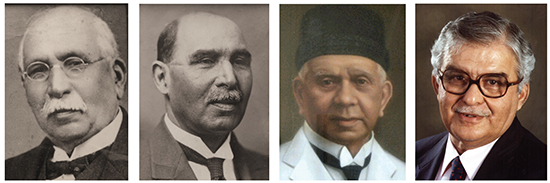
(L-r): Sir Bezonji Mehta; Sir Sorabji Mehta (photos: Ajit Singh Bhalla);
Sir Maneckji Byramji Dadabhoy; Dr Jamshed Jiji Irani;
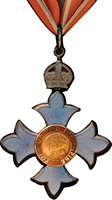
Medal of knighthood
She recalls that Sorabji was happiest when relaxing with the family. After dinner he enjoyed listening to his vast collection of classical Western music records or even better, hearing his sister Gul playing the piano. "The piano was custom made in London, keeping in mind the climatic conditions of Nagpur,” she shares.
Reminiscing about her childhood, Ghose says, "I was thoroughly spoilt as a child. I was an only child and very lonely. If I wanted something and did not get it right away, I threw a tantrum.” The name "Dhun baby” that the retinue of servants who fulfilled her every wish gave her, has stuck way past her childhood! "A new dress was brought for me every day by Khushaldas tailor who stitched for the British memsahibs. And new pairs of shoes were made by John the Chinaman, as often as I wanted them! On Sunday afternoons Papa, Mama, Gul Fui, Mum, Dad and I would drive out to some pretty picnic spot five to10 miles out of Nagpur. In a car following us would be the picnic basket with snacks and a bearer to spread out the goodies and serve us. There would be tea cakes and tarts, muffins and macaroons and sandwiches, all made at home by our two Christian chefs. Those were the days,” she sighs.
Bezonji was a self-made, self-taught man with little formal education. It is said he always carried an English dictionary with him, to look up the meaning or spelling of any new word he came across. At the age of 13, through the good offices of Dosabhai Karaka, then manager of the Bombay Times (original name of the Times of India) Bezonji was engaged as a clerk at a salary of seven rupees per month. At 16, to better his prospects he applied for the post of a ticket issuer of the G.I.P. (Great Indian Peninsular) Railway, now known as Central Railway. Through sheer diligence and hard work he moved up the ladder to become a goods agent in which capacity he caught the attention of Jamsetji Tata.
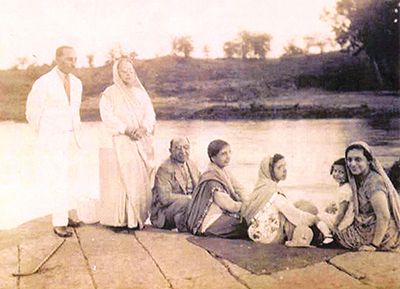
Mehta family picnic on a river bank Photo: Ajit Singh Bhalla
While travelling on the Bombay-Howrah Mail, Tata’s train stopped at Murtizapur station where he saw an official taking the loaders to task for not handling a consignment of perishable dates (khajur) properly. Being a shrewd judge of men and their capabilities, Tata approached the young man and asked Bezonji to join the Empress Mills (so named, on the day Queen Victoria was proclaimed Empress of India), which he had founded. After some persuasion, Bezonji agreed. Very soon he became Tata’s trusted right hand man, rising to the post of general manager, a position he retained till retirement. He remained a trusted advisor of the Tatas until he passed away in 1927.
During his tenure the Empress Mills became a flourishing, profit making concern and the largest, single employer in the region with over 7,000 workers on its rolls. The managerial staff was mostly Parsis from Bombay, Navsari and Surat, with workers drawn from all over Vidarbha. To house this huge work force, the central government sanctioned 97 acres of land on a 30-year lease (on expiry of the lease, the government handed over the land to the workers’ union). The management of the Mills, under Bezonji’s able guidance, built bungalows for officers, living quarters for workers, a post office, hospital and school. The remaining land was developed into a tree lined park named Bezon Bagh, as a tribute to Bezonji. All this was long, long before the phrase corporate responsibility had been coined.
The housing colony and Bezon Bagh gardens spread over close to 80 acres in the heart of Nagpur still exist though their history has been forgotten. "Ishwar Ramteke, a fifth generation resident of the area, said he had no idea how the colony got its name. And he is not an exception,” laments Ghose.
In 1912 the city, and specially the Parsi community, were abuzz with excitement at the news that a knighthood was to be conferred upon Bezonji in recognition of his dedication and hard work in making Empress Mills a successful venture providing employment to many. King George V and Queen Mary were on their way to Bombay when their special train made a brief stop-over in Nagpur. On the platform, under a red velvet canopy, Bezonji was knighted by the King, probably the first and last time such a ceremony took place on a railway platform!
To felicitations by various organizations, Sir Bezonji responded: "The honor conferred upon me by His Most Gracious Majesty the King Emperor, is too high for me, considering the humble merit and qualifications I possess but if it has pleased those who have recommended me, I cannot but feel grateful and pleased. I have no doubt though that they wished to honor all connected with the Empress Mills and it is as much an honor to all of you, as to me.”
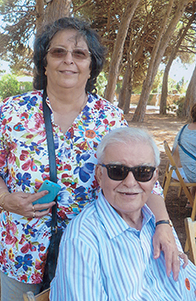
Daisy and Jamshed Irani
Bezonji’s son Sorabji, who was in government service, joined Empress Mills at Tata’s urging as a spinning master, rising to assistant manager and then taking over as manager when his father retired. "By nature he was very gentle and deeply moved by people’s miseries,” recalls Ghose. "Apart from yeoman service to the Empress Mills, he was a man with strong civic sense. He was a prominent member of the municipal corporation and Nagpur University senate.” In collaboration with the House of Tatas, Sorabji provided large funds for the establishment and administration of the J. N. Tata Parsi Girls High School and the Lady Amritabai Daga Women’s College. Both these institutions were among the first to recognize the importance of education for girls. He also played a part in the building of the impressive J. N. Tata Convocation Hall of Nagpur University.
An active member of the managing committee of the Nagpur and Kamthi Parsi Zarthosti Anjuman, Sorabji worked for the welfare of the community with interest and enthusiasm.
On June 5, 1920 it was announced that: "The King has been graciously pleased, on the occasion of His Majesty’s birthday to appoint Sorabji Bezonji Mehta, KCMG (Knight Commander of the Order of St Michael and St George) and KBE (Knight Commander of the British Empire).” Thus Sorabji followed in the illustrious footsteps of his father, Bezonji.
In 1938 Sorabji passed away suddenly while chatting with his grand-daughter Ghose. The Nagpur Anjuman passed a resolution to install his portrait in the Agiary and have his name said in the Anjuman prayers.
In a letter of condolence to Lady Mehta, Francis Verner Wylie, the British Governor of Central Provinces and Berar wrote: "All of Nagpur mourns the passing away of its most respected and beloved citizen. He will be irreplaceable in the life of the city.”
In 1925, Maneckji Dadabhoy, chairman-cum-managing director of Model Mills, was given the title of Knight Commander of the Order of the Indian Empire (KCIE) in King George V’s New Year Honors list. Born in Bombay, the second son of Khan Bahadur Byramji Dadabhoy J.P. (Justice of the Peace), the well-educated Maneckji came to set up and manage Model Mills, a public limited company incorporated in 1920. An old-timer who lived nearby recalled: "Model Mill na savar na poonga thi akkhu Nagpur jagi uthe (the Model Mills siren marked the start of the day for all of Nagpur).”
[My father, Darub Lalkaka, an MA in economics from Allahabad University, worked in Model Mills until his untimely death at the age of 54. I was not quite seven years old then but have vague memories of visiting the "Motta sahib no bungalow” with my mother. I remember being ill at ease and trying to hide behind my mummy’s sari as she expressed her gratitude to Sir Maneckji and Lady Jerbanoo (née Bhedwar) for their kindness and generosity to our family after my father’s demise.]
Dadabhoy resigned as managing director and part owner of Model Mills in 1950 and passed away three years later. In 1959 the once famous Mills closed its doors forever. It was alleged that a partner had siphoned off the profits. A court case dragged on for years.
When Dadabhoy died in 1953, there was a mild controversy when the then governor of Madhya Pradesh, Mangaldas Pakvasa came to pay his respects. The body had already been given sachkar (a purifying bath) after which no non-Parsi could see or touch it. Pakvasa’s first reaction was one of surprise and pique but he graciously acquiesced to the religious customs of the Parsis.
Jerbanoo continued to live in Nagpur until she died in 1964 at the age of 97. She was survived by two daughters, Lady Munizeh (Minnie) Kharegat, wife of Sir Pheroze Merwan Kharegat who lived in Bombay and Frenée Dadabhoy who continued to preside over Belle Vue, their grand home in Nagpur, for many years until her death.
Dr Jamshed Jiji Irani, KBE (affectionately called ‘Bablo’ as a child) was born in Nagpur on June 2, 1936 where he spent his formative years, growing up in the Empress Mills quarters as his father was employed there. He excelled in studies and sports, especially cricket. Graduating as a gold medalist from Science College, Nagpur, Irani left for post graduate studies at the University of Sheffield in Great Britain where did his Master’s and doctorate in metallurgy and was awarded a gold medal. On his return to India he was hand-picked by J. R. D. Tata to join Tata Iron and Steel Company (TISCO) in Jamshedpur, where he rose to the post of managing director.
Though he has lived most of his working life in Jamshedpur and travelled around the world, for Nagpurians he is still "Apro (our) Jamshed, a son of the black cotton soil of our city.” The Nagpur Parsi Punchayat and the Rotary Club of Nagpur have honored him for his achievements.
On October 14, 1997 Queen Elizabeth II conferred an honorary knighthood on Irani who felt it was it was "just the coincidence of being in the right place at the right time.” He recalled, "I was chairman of the CII (Confederation of Indian Industry) in 1992 when Narasimha Rao was Prime Minister. British Prime Minister John Major visited India and we shared the conference table at meetings. Both Major and I were avid cricket fans and that made for a friendly bond.” At dinner that night, as J. J. (as Irani is known among friends) sat at the round table with the Prime Ministers, ambassadors and business leaders of both countries, Major said to Rao, "We must advance trade relations between our two countries, and the first step will be to select a leader.” Pointing to the CII president he suggested, "I think Dr Jamshed Irani will be the right person.”
For the first five years after its inception, Irani was the chairman and moving force of the Indo-British Trade Partnership. "We worked hard to break down barriers against doing business with India. We achieved 75 million pounds (over Rs 740 crore) of bilateral trade. Of course I had the full backing of the Tatas at that time, and it helped a great deal,” he revealed. This partnership also allowed Indian industry to access British technology. Interestingly, the British side of the Indo-British Trade Partnership is currently headed by Lord Karan Bilimoria.
After he stepped down as chairman, Irani was conferred the KBE in recognition for working to improve commerce between India and Britain. "Bestowing of the knighthood was a simple, dignified ceremony at the British High Commission in New Delhi. Queen Elizabeth II handed me a scroll and put a ribbon with the KBE around my neck, making me a Knight of the British Empire,” Irani said. Only close family was present. "The Queen was gracious; she spoke to me for over 10 minutes. There is a lot of protocol involved in speaking with the Queen,” Irani explained. "The first time you address her as ‘Your Majesty’ and subsequently as ‘Madam.’”
In 2007 Irani was awarded the Padma Bhushan for his contribution to industry in India. Though he is semi-retired now, his presence and opinion continue to be sought and his schedule remains hectic. He is on the board of several corporates, both Indian and international. He is also chairman and on the managing board of prestigious educational institutes and was president of the Jamshedpur Parsi Anjuman.
The Iranis live in a beautiful home with a garden which "has won the Best Private Garden in Jamshedpur trophy for three years in a row,” says his wife Daisy with justifiable pride. The perfect helpmate for this busy and successful man, Daisy travels everywhere with him, helps him unwind and takes care of social obligations for which he has little time.
While being immensely proud of their identity as Parsis, the Iranis are not bound by chains of tradition. For the younger generation of Parsis, he advises: "There is a huge, big world outside your area of comfort waiting to be explored and conquered. Branch out into areas you are not familiar with. Move with the times. Shed the ‘won’t leave Bombay or won’t leave the baug’ mentality. Our ancestors moved with the monsoon winds from Bombay to China and back, to make their fortune. Today, young people are reluctant to move from Bombay to Bihar.”
* * *
"Too many memories”
Dhun (Mehta) Ghose, aged 87, died on July 6, 2016 at her Silver Oaks residence in Nagpur.
Born and raised in Nagpur, Ghose was the grand-daughter of Sir Sorabji Mehta and the great-grand-daughter of Sir Bezonji Mehta. She did her schooling at the J. N. Tata Parsi Girls High School.
At a young age she fell in love with and married her tennis and badminton partner, Biressor Ghose. He was the son of a professor of English at Prince’s College, Ajmer and later at the Nagpur University.
Dhun and her husband Nanu (as Biressor was always called) moved out of Nagpur, travelling within India and outside. Nanu rose to the post of district manager of CEAT in Calcutta where they spent some of the best years of their life. They returned to Nagpur after 40 years, to settle into her family home The Tamarinds.
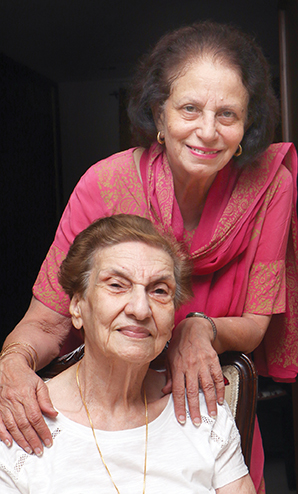
Dhun Ghose (seated) with Dilnavaz Bhagwagar
After Nanu’s death she felt she could not stay there anymore. "Too many memories and too many doors to close every night,” Dhun use to say. So she moved into Silver Oaks. An avid reader and writer, she kept neatly written notes on her illustrious family and the landmark events in her life.
She lived alone, and was looked after by her children (long distance) and her faithful retainers.
She enjoyed playing cards, loved dogs, kept an elegant home and enjoyed all things beautiful but surprisingly, abhorred flowers! She, was always well coiffed, well dressed, knowledgeable of current affairs and eloquent of speech even at the age 87.
Unable to recover from a fall in her home, she was in trauma though without pain for almost two months. A deeply religious person who prayed every day, she was cremated as per her wish. A uthamna ceremony was performed on the third day.
Ghose leaves behind her son Biren, daughter Anita, their spouses, her four grandchildren and a large number of friends. D. B.
◆ ◆ ◆
From the archive