
The committed educationist
The School that bears Jalbhai Bharda’s name produced some outstanding alumni
On the 100th death anniversary of Jalbhai Bharda in July this year, writer Marzban J. Giara pays tribute to the educationist. Columnist Berjis Desai, a trustee of the School and a past student pens at Parsiana’s request his recollections of Bharda. Parsiana also carries an extract from an earlier article, "Enlightened educationist,” written by US based academician Dr Ardeshir B. Damania that appeared in our August 7, 2012 issue.
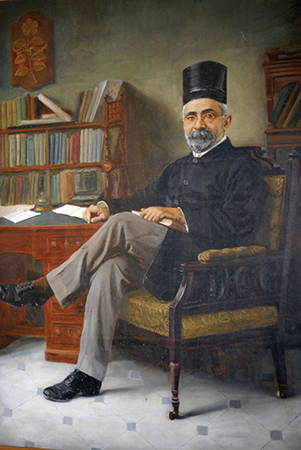
Portrait of Jalbhai Bharda by Manchershaw Pithawalla
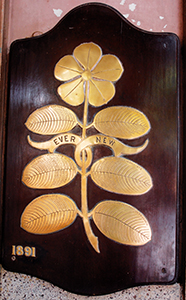
School emblem
At the young age of 27 years, Bharda devised a plan for the New High School along with Murzban who was a senior teacher. A visiting committee was appointed to give advice regarding this School’s administration. Considered an exemplary private educational institution in the whole of India, the School’s fame increased within a year and its education was lauded. Bharda who was the joint principal of the School was particularly interested in science and the School had a well-equipped laboratory. A combination of wit and wisdom, he was vivacious and jovial while being the epitome of high morality and discipline, and took great care of his students.
Before devoting himself to the New High School, Bharda had served the Fort High School as a senior teacher for four years. That was soon after he stood first at the Bombay University BA examination and bagged the Edinburgh Scholarship. An avid reader, he enjoyed English literature, had a good knowledge of Gujarati, and also studied Persian, French and German. He was awarded the Dakshina Fellowship for two years for Persian and science. His favorite subject continued to be astronomy which he studied till he passed away.
An honorary Fellow of the Bombay University, he was made a member of the University senate as also its joint examination board. His knowledge as an educationist was vast and his advice was constantly sought on matters pertaining to education. A fluent and fascinating speaker, he was invited to deliver public lectures from the platform of various scientific bodies. Despite his vast knowledge he had not the slightest arrogance.
He was connected with other educational institutions too, being a committee member of the Bai Avabai Petit Girls’ Orphanage that he had helped establish and Sassoon Reformatory. He conducted a class for teachers of the Zoroastrian Girls’ Schools Association and was an enthusiastic member of the committee of the J. N. Petit Institute.
A trustee and president of Udvada Anjuman and Daman Parsi Anjuman, he put in considerable efforts to better the conditions of Zoroastrians there. His father Dorabji belonged to one of the nine athornan families of Udvada. Jalbhai’s name at birth on February 16, 1864 was Bhikhaji which he retained till he passed matriculation with a high rank from the Surat High School. Thereafter he joined Elphinstone College, Bombay. He was married to Cooverbai (daughter of Manekji Cowasji Damanwalla) and the couple had a daughter Khorshed.
When he passed away at the age of 57, a condolence meeting was convened by the Udvada Anjuman at the sacred Iranshah Atash Behram in honor of the "Anjuman’s true guide.” A few days later at another meeting of the past and present students of Elphinstone College, principal Covernton described Jalbhai as "an ideal educationist.”
On September 19, 1921, Cooverbai donated Rs 50,000 to Bai Avabai Petit Parsi Girls’ Orphanage Fund to build a block in his memory and a similar sum for education of orphan girls. A marble bust of Bharda presented to the Bharda School by his grateful pupils, friends and admirers and unveiled by Justice Dinshaw Fardunji Mulla on December 1,1923 continues to stand in the School.
Marzban J. Giara
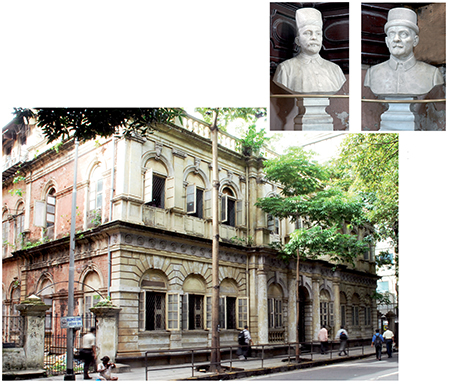
Teachers and the taught
The wonderful partnership between Jalbhai Bharda and Kekobad Murzban was made in some educational heaven. Bharda was the scientist, Murzban was the linguist. The former died young and his partner remained in charge till a ripe old age until his two sons, Behram and Rustom, both gentlemen to the core, became joint principals. Bharda’s daughter, Khorshed Masani, was not similarly included in place of her father and founded her own school, also called Bharda, which led to some initial confusion and ill feelings.
The main Bharda School was popularly called New High, to distinguish it from the pretender to the throne, which survived for quite a few decades. Murzban’s sons, both confirmed bachelors, were kind and dedicated. Later, they inducted their nephew, Adi Mulla, as the joint principal. Mulla sported a Hitler moustache and loved his nickname, Adolph. He too was dedicated though stentorian.
The family decided to convert the proprietorship school into a public charity and The Bharda Murzban Education Trust was established. Today its trustees manage the School.
The School had some great Parsi teachers; many were highly eccentric. None retired. There was an art teacher called Tavadia who during his 67-year tenure taught the late Mancherji Cama of The Bombay Samachar and also his grandson, his namesake. Our school teacher mother, herself a trained art teacher, was aghast to see her five-year-old draw bhoot and daakan (ghost and witch) and disbelieved that it was as per Tavadia’s directions.
There was a history teacher who consciously aped the mannerisms of Napoleon and also wore a white hard hat like a fire brigade man. Generations of students called him aagal thi bumbawalo, né paachhal thi Napoleon (a fireman’s façade and a Napoleon look-alike from the rear). One can write a tome on the teachers, students and staff of this School which will surely be dismissed as fiction.
The School had both English and Gujarati as medium of instruction and teachers often forgot which class they were teaching. Parsi, Gujarati and Bohri students did not mind but the stray Maharashtrian or South Indian gaped at these extraterrestrials uttering an alien language. When one such student protested about the constant slippage into Gujarati by many teachers he was rudely told that he had no business being there.
The New High produced some great alumni including statesman Minoo Masani and cricketers like Nari Contractor, Polly Umrigar, Vijay Merchant and Rusi Surti. There is not a single Parsi student or teacher at this school today. Berjis Desai
Enlightened educationist
For not paying attention in class and causing a disturbance, a wealthy Parsi student of the Fort High School was reprimanded by his tutor Dhunjibhai Gilder. During the lunch recess, the boy came from behind and gave a tapli (rap) to the master. After a brief chase the boy was caught and brought before the principal, Maneckji Bejanjee Cooper. All the teachers asked for his rustication but Cooper believed, "The good name of the school will be spoiled and other parents may withdraw their own children.” When Cooper refused to reconsider, Jalbhai Bharda with five other teachers resigned on the spot…
Bharda dressed simply in a soft silk long black coat and grey trousers and wore a soft, black mukhmal (velvet) Parsi skull cap. He sported a small goatee and was ever smiling. Although a strict disciplinarian, Bharda was neither severe nor vindictive in inflicting punishment to erring pupils. He had the uncanny knack of understanding the adolescent mind and the cases that came to him for adjudication were treated with fairness, winning him great popularity, much love, affection and admiration.
Bharda was born in Udvada on February 16, 1864. His father Ervad Dorabji performed religious ceremonies and rituals at the Iranshah Atash Behram along with his elder brother, Cawasji. A very diligent student, Jalbhai lost no opportunity to further his knowledge… He also took care of the education of the sons and daughters of all the mobeds in Udvada…
He succumbed to typhoid at the age of 57. His body was carried on foot from his residence at Gowalia Tank to Doongerwadi by pallbearers followed by a large number of mourners. At a memorial meeting held on August 14, 1921 Murzban declared, "From this day our school shall be called The Bharda New High School.”
Ardeshir B. Damania