
Comment
Parsis and prejudice
Historic records reveal that the community’s antipathy towards Islam and Muslims is misconceived
We Parsis have a reputation for liberalism and a modern outlook. Do we really deserve it? I for one find offensive the barely concealed prejudice (if not hatred) for Muslims in general among a cross-section of our community. For long it has been said that "the Muslims drove ‘us’ out of Iran,” that we were "hounded out” of "our homeland.” This grievance was voiced even at the time of the self-congratulatory celebrations of the community at the 10th World Zoroastrian Congress held in Bombay in 2013. I have searched the history books to find out to what extent this perception is true.
The Zoroastrian religion has an ancient and deep connection with the land and civilization of Iran. The earliest known Iranian language voiced the Gathas of Zarathushtra. The Achemenid empire had a strong Zoroastrian content and under the Parthians too Iran was by and large Zoroastrian. Under the Sasanians (AD 224 to 651), Zoroastrianism was the state religion. For instance, kings would on their accession have a new sacred fire or a new fire temple installed. The coins of various Sasanian kings depicted the fire altar. Religious texts were copied in Pahlavi and certain versions of them were decreed authoritative by the authorities. A close connection between faith and political control was possible because the priests or mobads were state functionaries working with the king, often influencing his policies in such a way that the Zoroastrian religious order became identified with the social order of the Sasanian empire. As Mary Boyce put it, "a single Zoroastrian church was created (under Sasanian rule) and together with this went the establishment of a single canon of Avestan texts…” The power of the priests grew so rapidly that by the time of Shapur II in the fourth century, the priesthood was independent, the head priest making religious appointments. This is not to say that the priesthood always dominated state affairs: there were also periods when its influence waned.
The Zoroastrian religion has an ancient and deep connection with the land and civilization of Iran. The earliest known Iranian language voiced the Gathas of Zarathushtra. The Achemenid empire had a strong Zoroastrian content and under the Parthians too Iran was by and large Zoroastrian. Under the Sasanians (AD 224 to 651), Zoroastrianism was the state religion. For instance, kings would on their accession have a new sacred fire or a new fire temple installed. The coins of various Sasanian kings depicted the fire altar. Religious texts were copied in Pahlavi and certain versions of them were decreed authoritative by the authorities. A close connection between faith and political control was possible because the priests or mobads were state functionaries working with the king, often influencing his policies in such a way that the Zoroastrian religious order became identified with the social order of the Sasanian empire. As Mary Boyce put it, "a single Zoroastrian church was created (under Sasanian rule) and together with this went the establishment of a single canon of Avestan texts…” The power of the priests grew so rapidly that by the time of Shapur II in the fourth century, the priesthood was independent, the head priest making religious appointments. This is not to say that the priesthood always dominated state affairs: there were also periods when its influence waned.
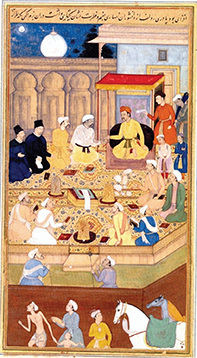
Mughal Emperor Akbar holds a religious assembly in the Ibadat Khana (House of Worship) in Fatehpur Sikri
Courtesy Wikipedia
In Sasanian Iran there lived many religious communities other than the Zoroastrians (in fact in Mesopotamia, the western province, Zoroastrians may never have constituted the majority). The state had to deal with Christian, Jewish, Manichaean, Mazdakite, and, in the north-east of the empire, also Buddhist, minorities. It dealt with them in different ways in different times. In a famous inscription the powerful mobad Kartir (third century AD) stated that throughout the land of Iran, Mazda worship had been established; the devas were driven out; and "Jews and Buddhists, Brahmans and …Christians and… Manichaeans were assailed in the land.” Cult idols overthrown, the "dens of demons” were thereby destroyed and fire temples established in their place, he claimed.
Sasanian history saw repeated persecutions of Christians. The Zoroastrian priests being a wealthy and ambitious class, they could manipulate insecure or weak kings. In some cases it was clashes with Rome that made the state suspicious of the loyalty of the Christians. Once, faced with financial problems, Shapur II ordered that the poll tax on the Christians must be doubled — this tax was the Sasanian predecessor to the infamous Islamic jizya that is the stick with which we beat medieval Muslim powers. (If you did not go out to fight with your king, you were obliged to pay the poll tax or jizya instead for his protection.) The Christian Catholicus who was ordered to collect this tax refused to do so on the grounds that this was not his work and that his people were too poor anyway. Together with five bishops and a hundred priests, this Christian was executed on the orders of Shapur. Later, in the reign of Yezdigird at the end of the fourth century persecution became so severe that Christians crossed the border into Roman territory as refugees; incensed, King Bahram declared war against Rome. Military campaigns against Armenia too were fired by a zeal to convert the Christians there to the religion of Mazda worship.
There were also members of the Manichaean faith whose founder was Mani (216-276), a Parthian-Iranian who enjoyed long years at the court of Shapur but then fell out of favor. On the orders of Bahram I he was seized, killed, his skin flayed and stuffed with straw, and his remains hung at the gate of Gundishapur. Actually in spite of this, his sect continued for centuries, its ideology moving closer to Zoroastrianism with the passage of time.
As for the rise of the charismatic Mazdak with whom Emperor Kobad (488-531) interacted, his teaching was radical — he believed in the equality of all men. Such thinking introduced a degree of social uncertainty and instability, and from AD 523 there was a massacre of Mazdakites which drove the movement underground.
The Babylonian Talmud was written in a period that coincides with Sasanian rule over Mesopotamia. (The Talmud is the second most important Jewish religious corpus.) There is indirect testimony here of the lives of the Jews under Sasanian rule. The government demanded taxes and laid down laws about land ownership. There are passing references to the disapproval by "fire priests” of the Jewish practice of lighting candles on religious occasions, and apparently candles were sometimes confiscated. Jewish and Christian practices of burial of the dead were also frowned on. After 400 AD, it was forbidden to observe the Sabbath. Isaiah Gafni writes about two major taxes that were exacted from the Jewish subjects of Sasanian Iran: the land tax and the poll tax — for the latter, the registration of subjects was required. This poll tax was not a token amount and it appears that it was occasionally paid by one person on behalf of another, at the risk of the ultimate servitude of the latter.
My purpose in presenting this information is not to demonize. Secularism is a modern concept, and more than one medieval state oppressed people on account of their religion. Yet the fact remains that Zoroastrians in Iran were often intolerant aggressors, and if we agree that we cannot be responsible for the deeds of our ancestors centuries ago, the same should apply to those whom we have been condemning. What is it that we condemn?
The Arab conquest brought about a reversal of fortunes in the land of Iran. After the Arab armies invaded Iran and besieged the capital of Ctesiphon, the last united stand of Persia against the Arabs was made at Nehavend in 641 AD. Thereafter the Sasanian monarch fled with his treasures and militia. He died in Balkh in 651 AD and this date is considered the end of the empire. Iran fell province by province to the Arabs, various towns or districts making their own negotiations for surrender. As The Cambridge History of Iran Vol. III states, the populace had little incentive for a prolonged defence of the motherland: the treasury was depleted, the elite known to be self-serving, and the leaders had fled.
The land of Iran did not become Islamic at a stroke — according to one scholar Iran became wholly Muslim only around 1300 AD. Other than religion, the major change that came was in language, Arabic replacing Pahlavi around the end of the seventh century. The Abbasids (750-1250) came from Khorasan, a region of mixed ethnic groups, and displaced the old Arab military aristocracy with indigenous Persian officials and landed magnates. One such family had been the hereditary custodian of the Buddhist shrine and monastery of Balkh. Actually Zoroastrians were numerous in the land even in the ninth century, says Boyce — and during this time the Abbasid Caliphate absorbed many Sasanian customs of administration and court etiquette. Certainly there was violence against the people, raids, abductions, blackmail, extortions and the destruction of some fire temples. Yet the Zoroastrian religion remained strong in Fars, Azerbaijan and Khorasan until at least the 10th century.
From the time of the conquest until about 1880, Zoroastrians had to pay the jizya tax in Iran. Says Boyce: "The Arabs took over the Sasanian tax system, with its land tax and poll tax (called by them jizya) …” It appears that in those states of the past where the ruler worked in tandem with the head of religion, discrimination was almost inevitable. Jizya, as stated above, was onerous and its protocol humiliating — in time many Zoroastrians converted to Islam because of it. According to Boyce they could thereby also escape the demands of the mobads. The Cambridge History of Iran ( Vol. IV: 19) writes, "the cupidity and corruption of the mobads and their interference in politics had raised hatred against them.” Both religious systems, however, enjoined on the people five prayers a day, both frowned on idol worship.
Did the first Parsis, then, flee Iran because of persecution by Muslims? According to Boyce, they were a small group who left a small town called Sanjan in Khorasan for the port of Hormuz on the southern coast of Iran, in the early 10th century. There they found a ship and sailed for India, ultimately to become subjects of the Shilahara kingdom. By the 10th century, says the Encyclopaedia Iranica, the center of the Abbasid Caliphate had lost control over eastern Iran including Khorasan. Also, by then Zoroastrians were losing wealth and prestige. Archeologist Rukshana Nanji has argued that the first migration could have been in the eighth century. As an Arab-Muslim governor was in charge of Sanjan in the early 10th century, she does not think religious refugees would choose to settle under Muslim rule, even though she suggests that the settlers were traders. This is to assume a flight for religious reasons. Besides, Nanji relies on a reading of the word Hamyamana in an inscription of the Arab governor as‘Parsi,’ which is contested.
Susan Stiles Maneck and Jesse Palsetia surmise that there was more than one early migration. Palsetia notes that the dates of these cannot be securely fixed. He suggests that a plausible inference is that a group left Khorasan for India along known trade routes because of loss of political clout and social prestige, and because of harassment. Maneck points out that western India was known to Sasanian Iran because of trade, military expeditions and royal interactions. She cites the opinion of Andre Wink that the migration was "not so much a flight as a readjustment of commercial patterns” — Arab merchants were beginning to challenge the Iranian domination of maritime commerce between India and Iran, and some Persians thus felt the need to move eastward. Maneck gives credence to the "trader” interpretation and says that more migrations followed the first one. Even if the first migration occurred in the eighth century, she says, it would have taken place "while Zoroastrianism was still the predominant religion in Iran.” There is "no reason,” she says "to assume that all Parsis came (to India) with the same motivation.”
Consider also this. From the late 15th to the 19th century Parsis sent emissaries to Iran seeking guidance about matters of religion. In return they received rivayats or epistles about the use of this or that equipment for ritual, how to purify a sacred fire defiled by non-believers, and so on. "Rulings continued to be sought from Iran and sent to India, never vice versa,” says Maneck. Iranian theologians were the "final court of appeal” when disputes arose about ritual and matters of belief. Does this not tell us that Zoroastrianism in Islamic Iran was robust enough for priests there to provide guidance to people here?
The grievance that "we” were expelled from Iran by Muslim intolerance may perhaps derive from later events in Iran. The Safavid emperor Shah Abbas (1587-1628) had a Zoroastrian head priest put to death alongwith his followers because of his own misunderstanding that the Zoroastrian scripture incorporated "the book of Abraham.” More terrible was the last Safavid king permitting forcible conversion: a Christian testifies to the slaughter of non-believers and the conversion of others at the point of the sword. There then followed another terrible event: in 1719, an Afghan invasion slaughtered thousands of Zoroastrians who lived outside the protection of the city walls of Kerman.
At the same time the history of Parsis in India was not one of victimhood. It is instead inspiring. A small group of immigrants had arrived, many of them perhaps illiterate, not carrying with them even a few pages of scripture. It is truly remarkable that they remained faithful to their ancestral religion even as they adjusted to the customs and practices (such as language and dress) of a strange country. There would have been severe challenges to their ability to integrate and simultaneously retain their identity or social distinctness. The Qisse-e Sanjan (written around 1600 AD) is not a factual history but a metaphor of the 16th century self-perception of the Parsis in India: the need to adapt to the local culture, dependence on the goodwill of the local polity, and the need to retain an ethnic and religious exclusiveness. Adjustment to life in western India involved a flexibility of occupations: over time Parsis became weavers, carpenters, shipbuilders, merchants, brokers and capitalist philanthropists. After about 1750 the Punchayet attended to conflict resolution and matters of religious identity — it "shaped the sense of community and group identity,” says Palsetia. A serious confrontation with a British missionary, John Wilson, who baptized two Parsi teenagers in Bombay in 1839 and disparaged Zoroastrianism as a religion spurred the community to scientifically study the scriptures and teachings. Thus a setback ended with a moral victory for our community. So there is a great deal to be proud of in our past, not least the story of Manekji Hataria, who was sent to Iran (1854) to look into the conditions of the Zoroastrians around Kerman. His life is one of exemplary initiative and courage. In Iran he helped with the restoration of fire temples, funded primary schools, and got the Shah to revoke the jizya on Zoroastrians who thus began to prosper. According to Boyce the fatal error was for large numbers of them to then convert to the Baha’i faith which was perceived as a threat to Islam, thereby inviting harsh persecution.
Are events of the last 400 years of Iranian history a logical reason for maligning all Muslims? First, let us note that the cause of the atrocities was not Islam. If that were so, we would have to blame our own religion for Sasanian persecutions of several minority groups. Second, a contemporary of Shah Abbas was the Muslim Emperor Akbar, who for his part showed a healthy curiosity about our religion and honored Dastur Meherjirana of Navsari at his court. Third, surely it is illogical to transfer the blame to the Muslims around us, 400 years later and hundreds of miles distant from Safavid Persia? Muslims are the poorest section of all religions in our country, a recent survey of the National Sample Survey Organization says. Muslims as a whole are poorer than the Dalits. Many of our community too were poor carpenters and weavers.
Perhaps, then, we should consider the possibility that like all communities, we believe in a glorious past but when see no glory around today, blame someone else. Many of us parrot a generalization only because we have heard it often. The point emerges that history is constructed according to the expediencies of the present. Since their trauma in 1857 the British portrayed Muslims as aggressive destroyers and Hindus as a gentle and non-aggressive people (see Shubh Mathur 2008). The colonial power had wreaked havoc on Muslim settlements in northern India in 1858, causing thousands of deaths and large scale Muslim displacement, as so eloquently described by William Dalrymple. Further, it was at the hands of British armies that the institution of armed Hindu sadhus was annihilated — sadhus who into the medieval period had formed militias for the protection of this or that ruling dynasty, who had policed pilgrimage routes and had protected temples. As a crisis of identity looms with falling numbers, our community seems to have fallen prey to propaganda in the mainstream about Hindu spirituality and Muslim violence. As Bipan Chandra has said, communalism is the false consciousness of the last 100 years.
While no one can condone atrocities like the Taliban vandalism at Buddhist shrines,there have been atrocities on the other side. Scholars across the universities of the world have pointed out the active role of the Hindu Right in riots in Bhiwandi (1979), Ahmedabad (1985), Meerut (1989), Bhagalpur (1989), Bombay (1992-93); and Rajasthan (1998 to 2003) — all, says Mathur, "forgotten massacres of Muslims,” occasions when popular terror and police terror came together. On June 4, 2014 The Indian Express reported the totally random killing of a Muslim youth by a "radical Hindu outfit,” the "Hindu Rashtra Sena” (HRS). The leader of the HRS has been questioned about the murder of the anti-superstition activist, Dr Narendra Dabholkar. There are also the "Abhinav Bharat” and the "Shri Ram Sene” and the "Sanatan Sanstha.”
As for the Rashtriya Swayamsevak Sangh (RSS) which was at the forefront of the 2014 Lok Sabha campaign and won the elections for its political wing the Bharatiya Janata Party, it periodically conducts marches through towns in which its men carry not only the customary lathi, but at times also rifles. If that does not sound an alarm for unthinking converts to their cause, let it be remembered what Madhav Sadashiv Golwalkar, the third head of the RSS (1940-1973) wrote in his We or Our Nationhood Defined (1939). He said minorities could remain in India if they were "wholly subordinated to the Hindu nation, claiming nothing,… not even citizens’ rights.” To my knowledge the RSS has never totally repudiated this statement.

Shereen Ratnagar was Professor of Archeology and Ancient History at the Jawaharlal Nehru University in Delhi.
◆ ◆ ◆
From the archive