
In Memoriam
Piloo’s primers
Died: Piloo Nowshir Jungalwalla, 101, educationist, researcher and author of Zoroastrian religious books, in Delhi on August 18, 2015.
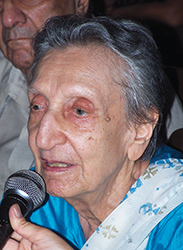 "She was a respected member of the Delhi Parsi Anjuman (DPA) and will be remembered for her contribution to the religious education of children for which she organized a curriculum and wrote simple books explaining Zoroastrianism. The Farohars, as this program is called, has been a success story in Delhi for over 25 years,” wrote DPA trustee Ava Khullar who, being her neighbor, had been associated with Jungalwalla for nearly 50 years. Khullar had enjoyed interacting with her "during her active years, when she was happily involved in her teaching and writing, and fruitful participation in the DPA as well as during her later years when she started nearing the century mark, with her faculties of sight and hearing getting weaker, and with her friends and colleagues slowly passing away. She lived in her spacious home alone, with a devoted family of servants.”
"Piloo aunty, as she was known to all of us, was first and foremost an educationist,” reminded Parzor director Dr Shernaz Cama. As the first principal of the Janki Devi Memorial College "catering to a first generation of women just emerging out of purdah,” she left a lasting impression on many of her students who came to offer tributes on her demise. Her first contribution was The Gathas which she wrote in her maiden name, Nanavutty, in collaboration with Dastur Framroze Bode. "Yet it is the little Fravarane: ‘I Believe,’ A Zoroastrian Child’s Confession of Faith which ran into five editions and her monumental book The Parsis published by the National Book Trust which will keep her memory alive,” believes Cama. Her magnum opus though was The Gathas of Zarathustra: Hymns In Praise of Wisdom that won her the Padma Shri Award for her contributions to Zoroastrian studies.
Although Fravarane sold even in 1987 for Rs 3 and The Parsis for Rs 13, "she donated every paisa that she earned all her life to further the cause of educating Parsis about their religion by her Book Trust set up at the DPA,” revealed Cama. Well-known author Russi Lala had once confided in Cama that of all the books on the Parsis he had read, Piloo’s was the most informative, a book which he used as a reference guide all his life. Her classes for the Delhi Parsi population where children and their parents gathered and learnt monajats, the meaning of prayers, and above all, the right to question the faith, its prayers and symbols are well remembered.
"She was a respected member of the Delhi Parsi Anjuman (DPA) and will be remembered for her contribution to the religious education of children for which she organized a curriculum and wrote simple books explaining Zoroastrianism. The Farohars, as this program is called, has been a success story in Delhi for over 25 years,” wrote DPA trustee Ava Khullar who, being her neighbor, had been associated with Jungalwalla for nearly 50 years. Khullar had enjoyed interacting with her "during her active years, when she was happily involved in her teaching and writing, and fruitful participation in the DPA as well as during her later years when she started nearing the century mark, with her faculties of sight and hearing getting weaker, and with her friends and colleagues slowly passing away. She lived in her spacious home alone, with a devoted family of servants.” "Piloo aunty, as she was known to all of us, was first and foremost an educationist,” reminded Parzor director Dr Shernaz Cama. As the first principal of the Janki Devi Memorial College "catering to a first generation of women just emerging out of purdah,” she left a lasting impression on many of her students who came to offer tributes on her demise. Her first contribution was The Gathas which she wrote in her maiden name, Nanavutty, in collaboration with Dastur Framroze Bode. "Yet it is the little Fravarane: ‘I Believe,’ A Zoroastrian Child’s Confession of Faith which ran into five editions and her monumental book The Parsis published by the National Book Trust which will keep her memory alive,” believes Cama. Her magnum opus though was The Gathas of Zarathustra: Hymns In Praise of Wisdom that won her the Padma Shri Award for her contributions to Zoroastrian studies.
Although Fravarane sold even in 1987 for Rs 3 and The Parsis for Rs 13, "she donated every paisa that she earned all her life to further the cause of educating Parsis about their religion by her Book Trust set up at the DPA,” revealed Cama. Well-known author Russi Lala had once confided in Cama that of all the books on the Parsis he had read, Piloo’s was the most informative, a book which he used as a reference guide all his life. Her classes for the Delhi Parsi population where children and their parents gathered and learnt monajats, the meaning of prayers, and above all, the right to question the faith, its prayers and symbols are well remembered.
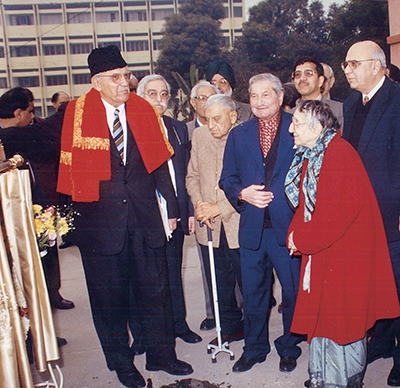
Piloo Jungalwalla (top and above) at the foundation stone laying of the
Dr Nowshir Jungalwalla Memorial Room with (from left) Lt Gen Adi Sethna,
Dadi Mistry, Sohrab Godrej, Jamshed Guzder and Dinshaw Tamboly
Describing her as a "diminutive bundle of intellectual energy and boundless enthusiasm… a loyal, steadfast friend,” London based independent researcher Farrokh Vajifdar commented, "To say that Piloo was single-mindedly driven by a strong work ethic is an understatement. We together explored anew the Gathas every summer for seven years when she visited her family in London… An uphill struggle to convince her that Zarathushtra, the sage, was emphatically not a mystic or fantasist almost wrecked our joint labors; perseverance however won out over stubbornness… And goodness! Could Piloo unflaggingly work long hours, leaving me ragged!”
Referring to their "long and fruitful association, very many moments of which I shall ever treasure,” Vajifdar added, "The best lesson I learnt from her during our collaboration was when we had reached an impasse in Yasna 43 where the nature of Zarathushtra’s Mazdaic inspiration, through Vohu Mana, arose in heated discussion over what constituted pairi.jasat. Piloo silently fuming, stared straight ahead for an eternity of minutes, determined to stick to her viewpoints. In desperation, I wondered aloud what we would say to Zarathushtra were he to be present. Her sharp retort was chasteningly to the point: ‘I would say nothing; I would just listen!’”
While she wrote on Zoroastrianism, "She had a deep interest in mysticism and religion and was well versed in Christian, Greek, Sufi and Tibetan Buddhist doctrines and mystical philosophy,” mentions her son Hoshang, a consultant psychiatrist, amazed at "her gifts of prophecy, some frightening in their implications and others, very amusing… She had numerous spiritual and mystical experiences that informed her faith. Her spiritual life was intense and she was close to the great Sufi Master Reihana Tyabji who is known as the Pir of Kanpur. All her life she spoke with passion and wisdom on the spiritual path to all interested and had a great love for children… She was a warm and loving person, motherly, forthright and compassionate.”
Born in Lucknow, Piloo had fond memories of her childhood spent in Lucknow, Surat and Poona. Her father Erach was a circuit judge respected by the Privy Council in England and her mother Collie (Cooverbai) was busy with her charity work and raising their four daughters — Piloo, Pareen, Naja and Dina. Piloo studied at Loreto Convent in Lucknow and later at a school in Hampstead, London, followed by Girton College in Cambridge. She earned her BA (Hons) tripos in English literature and anthropology, and thereafter MA, MLitt from Cambridge University. She enjoyed the honor of being a J. N. Tata and N. M. Wadia Scholar as well as Mary E. Woolley International Fellow in the US. For six years she taught English at the Wilson College in Bombay during which time she was literacy officer for Bombay University and Presidency, and appointed examiner for English at Bombay University for MA candidates. The firebrand rebelled against the British during the Independence movement and would wear only khadi and Indian weaves.
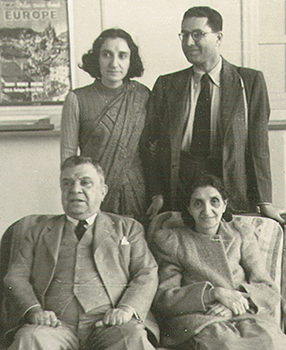
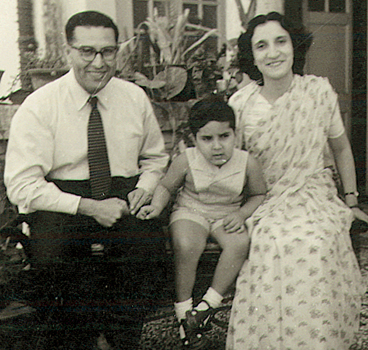
(Above, l): Piloo and Nowshir Jungalwalla with her parents (seated) Erach and Collie Nanavutty;
(right) with son Hoshang
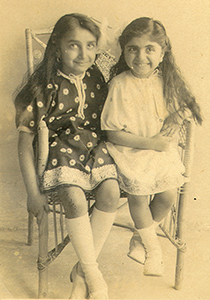
Piloo (l) with sister Pareen
Piloo had done extensive research on Oriental and eastern influences on the poet-painter William Blake’s prophetic work known as the Vala and had contributed several papers on the subject to national and international institutes. Other Blake scholars of the 20th century like Kathleen Raine and Desiree Hurst regarded Piloo as their peer.
After marriage to Dr Nowshir Jungalwalla she accompanied him on his postings including the one at Geneva, Switzerland when he was appointed director of the Public Health Division of the World Health Organization. She had also served on the board of directors of The National Council of Educational Research and Training and was a pioneer of the series "Founders of Our Living Faiths” that were supplementary readers at high school throughout India. Elected chairman of the Committee of International Relations, Indian Federation of University Women for several terms, Piloo was appointed representative of the All India Women’s Conference at the UN in Geneva. Nearly two decades earlier when Parsiana had asked her for a copy of her bio data, she had willingly obliged and even advised us to retain it saying it would come in useful when we wrote her obituary!
"It was Piloo’s donation of six lakh rupees which enabled UNESCO Parzor to initiate the Meherjirana Library Project which today is recognized as a center for Zoroastrian scholarship globally. It was not just in these external contributions that I remember Piloo aunty,” acknowledged Cama, adding, "She could find a nirang of healing for a sick friend, a quotation from the Zamyad Yasht for a paper I had to write, and all of this would come to me neatly typed out by her with special annotations to help me understand and learn.”
The scholar savant is survived by her son Hoshang and sisters Pareen Lalkaka and Dina Nanavutty.
◆ ◆ ◆
From the archive