
Books
Zoroastrian legacy
Joyous Flame — the Parsi Zoroastrians by Rukshana Shroff and Kerman Mehta. Published in 2011 by the Parzor Foundation, F-17, Hauz Khas Enclave, New Delhi 110016. Pp: 90. Price: Rs 500 (as donation).
His Holiness the Dalai Lama states in his Foreword: "Zoroastrianism, one of the world’s earliest religions, was also one of the first to develop the idea of a single uncreated God as the source of all things... Despite being relatively few in numbers, this community has been exceptionally active in their charitable and social work, especially in their provisions for the health and education of the poor.”
The Foreword sets the tone of the book published by the Parzor Foundation that is supported by the United Nations Educational, Scientific and Cultural Organization (UNESCO). The Foundation was started with the aim of recording and reviving interest in the Zoroastrian community in India.
The Foreword sets the tone of the book published by the Parzor Foundation that is supported by the United Nations Educational, Scientific and Cultural Organization (UNESCO). The Foundation was started with the aim of recording and reviving interest in the Zoroastrian community in India.

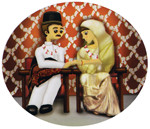
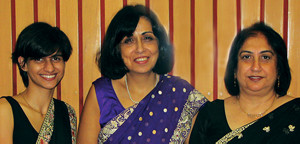
Far left and center: pictorial depictions of a navjote and a newly married couple. Above (l to r): Illustrator Naasha Mehta and authors Rukshana Shroff and Kerman Mehta
The book hopes to sow the seed of enquiry in youth. It starts with the historical background of Iran, the migration to India and teachings of the Prophet as recorded from the Bundahishn and the Shah Nameh. Rukshana Shroff and Kerman Mehta have been running Zoroastrian classes for children for over two decades. Both are teachers by profession — Shroff is an associate professor in the English Department of Lady Shri Ram College, University of Delhi while Mehta has been teaching music in the same city for the past 25 years. Oral traditions and the written word as evident in the bibliography constitute the foundation of their knowledge. Starting with the Kayanian rulers, distinguishable by their names of Kai Kobad, Kai Khushrow, etc the book proclaims Kai Vistasp as the first ruler to follow the Zoroastrian religion. The authors term Darius I as "the greatest administrator of ancient times” and also allude to the Sasanian kings and their contribution. They have factually ascribed to Alexander (called the Great!) the destruction of Persepolis and libraries containing our ancient religious texts.
History claims that Zoroastrians lived in the Khorasan Mountains for a century before making their way to India, tracing the migratory story from Sanjan to Navsari to Bombay. The scholarly Meherji Rana’s influence on the Moghul emperor Akbar, as also the shifting of the endangered Iranshah fire to Bahrot Caves as per the vision of Ardeshir Babekan are all alluded to. The myth of "sugar in milk” and the vow that Zoroastrians would not convert the local people to their religion are narrated as perpetuation of lore. This myth, which the purists still fall back on, is not to be found in the Kisseh-i Sanjan. In the chapter "Life and Teachings of Zarathushtra,” the authors narrate three miracles attributed to Zoroaster and then settle down to the truism "the best way to serve God is by serving humanity…”

The tenets of the faith are pithily placed on one page — there is one God; destiny is won as per the individual’s choice between good and evil; follow the path of Asha; active care for nature, animals and man; honesty, charity, justice and hard work should be the guiding values in life, and, follow humata, hukhta and huvarashta. To give a sense of pride to the youth, the authors highlight Zoroastrian achievements — whether referring to one of the founders of the Indian National Congress Dadabhai Naoroji or the Tatas who set up the first cancer hospital in India among their many contributions.
"Beliefs and Practices,” which comprises half the book is its backbone. Adar as the most important creation of Ahura Mazda, is classified into three categories and practices observed at a fire temple are detailed for the novitiate. Pictorial depictions of implements used in a fire temple make for easy identification, as do the symbolic explanation of the Farohar and a ses with its constituents. There are no photographs — only illustrations by the able Naasha Mehta.
Highlighting how the prayers are part Avesta, Pahlavi and Pazand, the book describes types of prayers — for protection, to proclaim belief and to seek blessings. Important ceremonies — jashan, yazashne, vendidad and visperad — are all covered. The Zoroastrian calendar with its presiding Yazads is informative and helps the young reader to identify with the thinking behind religious practices. The kharaptu — "a special design of four intersecting lines within a square,” the details of a Navroz table, muktad table are informative rituals. The reader is assisted in recognizing that the officiating priest is the Zaotar while his assistant is the Rathvi.
Translations of the kusti prayers, the declaration of faith at the navjote and the symbolism of the sudreh and the kusti are detailed for the layperson.
"The Zoroastrian Wedding” section commences with "Marriage is regarded as a religious duty among Zoroastrians and every member of the community is encouraged to marry.” The chapter on "ceremonies associated with death” is a ritual account of what happens during the geh sarana. Great emphasis is laid on the dakhma and the after death ceremonies. A map depicting a section of the Tower of Silence adds to the understanding of the well into which the body of a departed one is placed. The doctrinal disposal is said to "believe that finally, all creation will be purified by the triumph of good over evil. Even the souls of wicked people will be redeemed and saved and all creation will live in a state of happiness and joy, an ideal state of existence.”
The third and final section of the book deals with stories and legends which serve to teach values and ethics. Starting with the story of King Jamshed and how pride goeth before a fall in wanting to be termed God, it flows into the story of Zuhak where evil temporarily overrides good but good ultimately prevails. The stories of Zal and his love Rudabeh are recounted as is the legend of Zal’s son Rustam and his son Sohrab. The lesser known tale of the just king Noshirwan-i-Adil and how he meted out justice to an abandoned, starving cow is a lesson in compassion and justice. The last recounting is of Mushkil Asan, attributed to the beneficence of Behram Yazad, the by-now well-known story and ritual that accompanies it.
The book caters to a varied number of followers — the informed and the not so informed as well. The purpose (the Preface claims) is "to be able to inform children of all faiths about the Parsis and to give Parsi children a sense of pride in their heritage and culture.” MEHROO KOTVAL
Kindling the Joyous Flame
Rukshana Shroff told the audience at the launch that the genesis of this book lies in a conversation that took place more than two decades ago at a function organized by the Delhi Parsi Anjuman (DPA).
"Most of us at that time were mothers of young children and as we watched them together, we couldn’t help but contrast our childhood, when we felt so much a part of the Parsi community, with our children who felt so out of place among the Parsis. We had grown up imbibing the culture and basic religious tenets almost by an osmotic process, largely by watching others around us.
"Our children are growing up in nuclear families in multicultural environments. They find it difficult to connect with this part of their identity. I remember my youngest son coming home from school one day feeling very traumatized because a young Mr Know All in his class insisted that if Rushad was a Parsi, he had come from Paris and all his protests notwithstanding had convinced the rest of his class that this was true.
"We decided to organize regular gatherings for all the Parsi children in Delhi to familiarize them with their customs and traditions, provide a basic understanding of the religion and create a space for interaction with other members of the community. The DPA supported our initiative wholeheartedly.
"We called ourselves The Farohars — after an important Zoroastrian symbol — a symbol that is of ancient origin, but is extremely popular in recent times as car stickers, in jewelry, in publications and even on computer screens. The Farohar or guardian angel depicts the divine spark of Ahura Mazda in all created beings. Each individual has his or her own Farohar which is hence unique but is part of the larger collective divine power.
"We started as novices inviting eminent scholars initially to speak to the children, and then gradually created our own teaching materials and evolved our own methodology. Kerman and I found ourselves designated the teachers of the group — I suppose both being teachers by profession though neither of us has any claims to being scholars of Zoroastrianism or Parsi culture.
"We collected material from a variety of sources, both oral and written, and most importantly got valuable inputs from other people who shared willingly of their knowledge and their memories of songs and hymns. We in turn taught these to the children, with Kerman often improvising and creating new tunes for them. We put up little skits and taught them comic poems in Gujarati to allow them to pick up a smattering of the language in a fun filled way.
"As we became more confident, the children displayed their work in exhibitions and also became the performing troupe of the DPA, brought forth to sing, dance or act on every possible occasion. Our group travelled to places across the country — to Jhansi, Jamshedpur, Navsari, Surat and Bombay. People from other cities asked us for our notes and schools in Delhi approached us for basic information on the Parsi Zoroastrians.
"We were constantly being asked to bring out a publication of all our teaching materials. We toyed with the idea but never too seriously, till a combination of circumstances propelled us to write this book.
"Naasha, who had been part of our first batch of Farohars moved to Sheridan College, Toronto, to study illustration. As her final year project in 2007, she thought of compiling an illustrated book for children on Zoroastrianism, and started pestering us to compile our material as the text for her project. This was a long distance collaboration over the e-mail and that provided the first rough draft of the book. Subsequently, we started improving the text, doing more research, and sought professional expertise. Meanwhile PARZOR had been approached by the Gulestan and Rustom Billimoria Trust to bring out a children’s book on Zoroastrianism. We became co-partners in the project. Naasha became the illustrator and designer of the book on one condition — that the book would be entirely illustrated and we would not carry even one photograph in it.
"The title of the book, Joyous Flame, is a reminder of the sacred fire that also symbolizes light, illumination and knowledge and we hope this book will provide a little knowledge. Happiness and joy are celebrated as positive virtues in Zoroastrian thought. Leading a useful, productive life and following the path of virtue leads to happiness from the philosophic perspective. At the same time, the Parsi community is known for its joie de vivre, its celebration of the good things in life — food, wine, music, dance and, most importantly, humor.”
Rukshana Shroff told the audience at the launch that the genesis of this book lies in a conversation that took place more than two decades ago at a function organized by the Delhi Parsi Anjuman (DPA).
"Most of us at that time were mothers of young children and as we watched them together, we couldn’t help but contrast our childhood, when we felt so much a part of the Parsi community, with our children who felt so out of place among the Parsis. We had grown up imbibing the culture and basic religious tenets almost by an osmotic process, largely by watching others around us.
"Our children are growing up in nuclear families in multicultural environments. They find it difficult to connect with this part of their identity. I remember my youngest son coming home from school one day feeling very traumatized because a young Mr Know All in his class insisted that if Rushad was a Parsi, he had come from Paris and all his protests notwithstanding had convinced the rest of his class that this was true.
"We decided to organize regular gatherings for all the Parsi children in Delhi to familiarize them with their customs and traditions, provide a basic understanding of the religion and create a space for interaction with other members of the community. The DPA supported our initiative wholeheartedly.
"We called ourselves The Farohars — after an important Zoroastrian symbol — a symbol that is of ancient origin, but is extremely popular in recent times as car stickers, in jewelry, in publications and even on computer screens. The Farohar or guardian angel depicts the divine spark of Ahura Mazda in all created beings. Each individual has his or her own Farohar which is hence unique but is part of the larger collective divine power.
"We started as novices inviting eminent scholars initially to speak to the children, and then gradually created our own teaching materials and evolved our own methodology. Kerman and I found ourselves designated the teachers of the group — I suppose both being teachers by profession though neither of us has any claims to being scholars of Zoroastrianism or Parsi culture.
"We collected material from a variety of sources, both oral and written, and most importantly got valuable inputs from other people who shared willingly of their knowledge and their memories of songs and hymns. We in turn taught these to the children, with Kerman often improvising and creating new tunes for them. We put up little skits and taught them comic poems in Gujarati to allow them to pick up a smattering of the language in a fun filled way.
"As we became more confident, the children displayed their work in exhibitions and also became the performing troupe of the DPA, brought forth to sing, dance or act on every possible occasion. Our group travelled to places across the country — to Jhansi, Jamshedpur, Navsari, Surat and Bombay. People from other cities asked us for our notes and schools in Delhi approached us for basic information on the Parsi Zoroastrians.
"We were constantly being asked to bring out a publication of all our teaching materials. We toyed with the idea but never too seriously, till a combination of circumstances propelled us to write this book.
"Naasha, who had been part of our first batch of Farohars moved to Sheridan College, Toronto, to study illustration. As her final year project in 2007, she thought of compiling an illustrated book for children on Zoroastrianism, and started pestering us to compile our material as the text for her project. This was a long distance collaboration over the e-mail and that provided the first rough draft of the book. Subsequently, we started improving the text, doing more research, and sought professional expertise. Meanwhile PARZOR had been approached by the Gulestan and Rustom Billimoria Trust to bring out a children’s book on Zoroastrianism. We became co-partners in the project. Naasha became the illustrator and designer of the book on one condition — that the book would be entirely illustrated and we would not carry even one photograph in it.
"The title of the book, Joyous Flame, is a reminder of the sacred fire that also symbolizes light, illumination and knowledge and we hope this book will provide a little knowledge. Happiness and joy are celebrated as positive virtues in Zoroastrian thought. Leading a useful, productive life and following the path of virtue leads to happiness from the philosophic perspective. At the same time, the Parsi community is known for its joie de vivre, its celebration of the good things in life — food, wine, music, dance and, most importantly, humor.”
◆ ◆ ◆
From the archive