
Politics and Policy
Deliberating on disposal
Can unused doongerwadi lands be utilized for burial, enquire representatives at the Federation West Zone B meet
Several delegates at the Federation of the Parsi Zoroastrian Anjumans of India (FPZAI) West Zone B meet in Surat on August 2, 2015 at the comfortable Seth Kavasji Rustamji Tamna Ni Dharamshala which was undergoing extensive renovation, once again voiced their preferences for unutilized doongerwadi grounds to be used for burial. The delegates also voiced their disapproval of the stepmotherly treatment they allege they receive from the Bombay Parsi Punchayet (BPP) and how the internal squabbling of the BPP trustees was affecting their finances and hindering development.
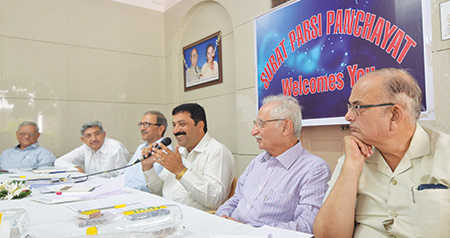
(From left) Aspi Vajifdar, Baman Cama, Farrokh Rustomji, Sam Chothia,
Jamshed Dotivala and Homi Doodhwala
"There are no vultures. There should be some changes,” said Marazban Marfatia, trustee of the Valsad anjuman.
"Sholapur closed down their dakhma and converted it into an aramgah,” stated Persi Buhariwala of the Vyara Songadh anjuman. "Everyone goes to the aramgah.” He noted that encroachments, including public roads through doongerwadi land, were taking place.
"Leave it open to the person who has died,” opined Baman Cama, president of the Baroda anjuman. Noting that the "dakhmas are surrounded by the city,” he asked, "How are you going to get birds? ...Today or tomorrow a situation will arise” when you will have to make a decision. He inquired, "What is an operational dakhma? …The BPP knows dakhmenashini nu soo haalat chhè (the condition within the towers of silence).”
Mahernosh Devgadhwala of Mandvi stated that in his town both a dakhma and aramgah co-exist. "We are not able to afford solar panels. We are not only discussing the issue but are on the point of making a decision. We are not willing to wait for anyone.” West Zone B vice president Sam Chothia recommended the Mandvi anjuman "call the local members and decide.”
Chothia noted the subject of alternative modes of disposal had been discussed at the West Zone B meet in Bilimora on October 19, 2014 (see "Dogma, dakhmas, defunct anjumans,” Parsiana, November 21, 2014). "Where the dakhma is operational we should keep using it.” He noted that the Ahmedabad Parsi Panchayat was examining the issue of creating an aramgah on the outskirts of the city. Rather than have encroachments or the government acquire the property, one should be practical, he advised.
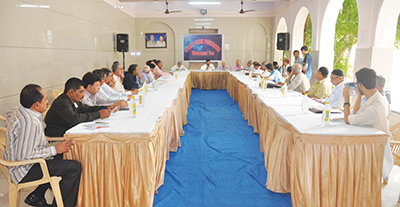
Federation West Zone B meeting in progress
The president of the Bilimora anjuman Marazban Baria reminded the gathering that at the Bilimora meet BPP trustee Khojeste Mistree had quoted Dastur (Dr) Firoze Kotwal as stating where a "dakhma is operational there should be no aramgah.”
Buhariwala observed that "every gaam (village/town) has its own laagni (sentiments).”
"What is the opinion of the house?” inquired Marfatia. Some others called for a vote on the subject.
"There will be no voting, only discussion,” interjected Chothia.
Dr Hosang Mogal of the Mahuva anjuman noted some may be in favor, some not. But he opined that if any candidate for the forthcoming BPP trusteeship election were to state "‘hu dakhma ni viroodh chhèv, é hari jasé (I am opposed to dakhmenashini, he would lose).” He conceded, however that improvements were required. "Forget vultures,” instead look for "scientific improvements.” He spoke of the aluminum panels instead of glass mirrors installed at Poona as mentioned in Parsiana ("Irani’s innovation,” July 21, 2015) and referred to by Buhariwala. Buhariwala had suggested the possibility of fitting additional aluminum panels inside the dakhma to generate more heat. The Poona innovation "is at an experimental stage,” noted Mogal.
Devgadhwala noted their anjuman "cannot afford a mobed. We require some donations for his salary. It’s a small request.”
Buhariwala lamented, "Our funds are lying with the BPP. Neither the money has been returned nor the interest paid for years. Nothing. (BPP trustee) Munchi Cama says the BPP has used the Gujarat funds,” for their own purposes. The once premier Bombay trust has been facing a cash crunch for almost the past two years due to their internal squabbles. The Charity Commissioner has passed a "status quo” order on all their property. The BPP largely derives its income from the transfer of flats.
Chothia noted the Udvada Behdin Anjuman had requested him to use his influence with the BPP to obtain overdue interest. For many years "regular nathi maltoo (not receiving),” they moaned. Chothia is close to BPP and the World Alliance of Parsi Irani Zarthoshtis (WAPIZ) founder trustees Mistree and Yazdi Desai.
Mogal interjected, "We are fully satisfied,” with the BPP’s disbursement of funds.
Chothia: "Many are not receiving the funds.”
Upset at the alleged shabby treatment being meted out to them, Buhariwala suggested voters from Gujarat registered with the BPP should exercise their franchise in the forthcoming trusteeship elections. Chothia noted there were around 600 registered BPP voters from Gujarat and the number could be increased to 2,000 to 3,000. A form had to be filled out and two photographs submitted.
Buhariwala opined they could not all go to Bombay and suggested instead "keep voting centers in Ahmedabad, Baroda and Surat.” Farokh Shaher from Gandevi added in jest they could take out railway passes!
Another delegate suggested that prominent Gujarat Parsis should stand for the BPP trusteeship elections and named Baman Cama, erstwhile vice president of West Zone B Areez Khambatta of Ahmedabad and Jamshed Dotivala of Surat. Dotivala, who is the chairman of the Surat Parsi Panchayat (SPP) and had personally borne the expenses of the zonal meet stated, "I don’t want to contest from anywhere!” The Surat trustees are nominated, not elected.
While welcoming the delegates that morning Dotivala noted the day was the auspicious Bahram roz and requested the delegates to "remain positive…you should always view the glass as half full, not half empty.”
Persuasion not compulsion
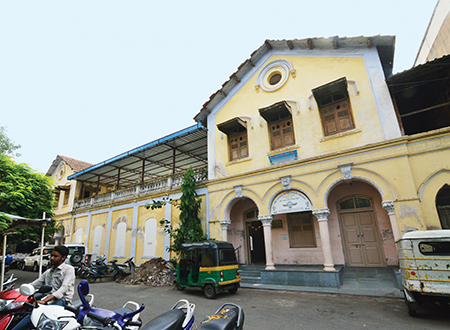
Tamna ni Dharamshala: venue of the meet
Chothia pointed out the need for anjumans to register their trusts with the local authorities. If the property was located in Gujarat but registered in Maharashtra, a Gujarat registration was also mandatory as ruled by the Supreme Court, he said. Large trusts such as the Swami Narayan Trust registered their property in every state as they have assets all over, the vice president noted. This suggestion gave rise to the rumor that the Gujarat anjumans were forming their own federation, which was baseless.
The vice president noted the FPZAI had agreed the controversial custodianship agreement would be "voluntary, not compulsory.” The proposed agreement states that when the local Parsi population falls below a certain number, the FPZAI would be brought on the local statutory records as a trustee/party. This would prevent the anjuman’s property and assets from being usurped by unscrupulous parties.
Instead of compulsion, the FPZAI could talk to the concerned trustees of defunct or small anjumans and acquaint them with the benefits of custodianship. At the Ahmedabad zonal meet in July 2013 (see "The dwindling and defunct,” Parsiana, September 7, 2013) a suggestion was made that a neighboring anjuman could become the custodian with the FPZAI’s sanction, if so desired.
The funds received from the sale of defunct anjuman assets could be used to assist the remaining Parsi population or even neighboring anjumans, in addition to the FPZAI. Chothia spoke of the need "to increase the corpus of the Federation” and noted Rs 1,25,00,000 may be soon realized from the sale of property at Junagadh. Former SPP accountant/secretary Sorab Katpitia had worked on the proposal and whereas the FPZAI was willing to sell the property for Rs 25,00,000, at one time, he had managed to raise the amount by a crore, he informed the delegates.
Several of the West Zone B delegates are critical of Katpitia as he is seen as BPP chairman Dinshaw Mehta’s man as versus WAPIZ founder trustees Khambatta, Mistree and Desai. Mehta had backed former SPP president Darayas Master for the position of West Zone B vice president against Khambatta. Eventually a compromise was reached and both held the post for a year each.
It was reiterated at the Surat meet that Katpitia has consistently refused to hand over the defunct anjumans files to Chothia stating they are his personal papers. Whilst Katpitia insists he has been working voluntarily, his critics allege he has made money out of the deals. He countered that when asked to fetch higher bidders they failed.
The elderly Katpitia pointed out that only the West Zone B vice president and delegates find fault with his work but "no other vice president objects” to my work.
Pervez Khergamwalla of Khergam claimed that "Katpitia is old. There is no new person. The BPP is not taking any decision. What are we to do?” Farrokh Rustomji, FPZAI joint honorary secretary and guest speaker at the Surat meet, noted Katpitia had been working on the defunct anjuman portfolio "for the past 40 years. Age is catching up. We cannot load everything on one man.” A defunct anjumans sub committee had been formed of which Rustomji was the convener.
Katpitia referred to his expertise in handling defunct anjuman properties. "I know where to start, where to go. He noted that while people criticized him, they themselves did nothing. "Karo, karo, koié kartoo nathi (Do the work, nobody is doing anything).” He alleged that due to the BPP trustees’ infighting and the subsequent factions in the FPZAI, he was facing "hairangati (trouble). You are stopping me from doing work…due to your internal problems; the property will be taken away.” He noted his assistant Jimmy Bacha was hounded out of his job and his salary payments delayed. Chothia claimed he had resigned of his own volition.
Shaher suggested the FPZAI "sideline” Katpitia. Rustomji noted, "Eighty files of the defunct anjumans are with the BPP. The committee is examining which files we should work on. We have enough work without or with Katpitia’s files…we are interested in getting the work done. No work is done.”
To be continued
◆ ◆ ◆
From the archive