
Religion
“A world view”
In India to teach Avestan, Prof Almut Hintze spoke about Zoroastrian contribution to religious evolution
The Yatha Ahu Vairyo prayer "encapsulates all of Zoroastrian knowledge,” believes Dr Almut Hintze, Zartoshty Brothers Professor of Zoroastrianism at London University’s School of Oriental and African Studies (SOAS) and states that she holds it in the highest esteem as it is "symmetrical in structure and has great significance in traditional Zoroastrian thought.” It helps to keep the demons at bay, she added. Hintze was in India to conduct a 10-day program titled "Introduction to Avestan” under the auspicies of the Bhandarkar Institute of Oriental Studies, Poona, jointly with Parzor and SOAS. She spoke to Parsiana on July 1, 2015, prior to delivering a talk on "The Zoroastrian Vision” organized by the Museum Society of India at the Prince of Wales Museum.
Hintze, who studied Indo-European philology at the Universities of Heidelberg and Oxford, earned her PhD in Indo-Iranian Studies at the University of Erlangen, Germany, and has held the professorship at SOAS since 2001, explained that it was the concept of free will that Zoroastrianism promulgates that attracted her to the religion. The concept of ‘judgment of the soul’ is another concept that found resonance with this academic who was raised Lutheran, with her four brothers in Erlangen. Overall, she says, "Zoroastrianism has made a tremendous contribution to the development of thinking and it occupies a significant place in the evolution and history of world religions.”
Hintze, who studied Indo-European philology at the Universities of Heidelberg and Oxford, earned her PhD in Indo-Iranian Studies at the University of Erlangen, Germany, and has held the professorship at SOAS since 2001, explained that it was the concept of free will that Zoroastrianism promulgates that attracted her to the religion. The concept of ‘judgment of the soul’ is another concept that found resonance with this academic who was raised Lutheran, with her four brothers in Erlangen. Overall, she says, "Zoroastrianism has made a tremendous contribution to the development of thinking and it occupies a significant place in the evolution and history of world religions.”
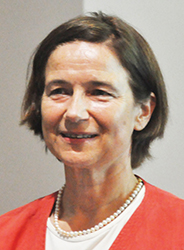
Dr Almut Hintze
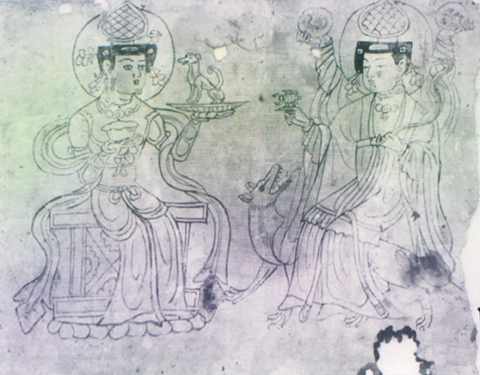
Image from a Sogdian Mazdayasni temple depicting Daena
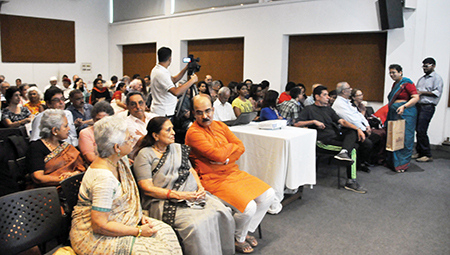
Audience at the Museum talk
On the future of the community in India Hintze, who is on her sixth visit to India, stated that "it is in the hands of the community to shape the future.” She mentioned that the immediate need was to address the lack of knowledge among priests in the community. She bemoaned the very low attendance at the Dadar and Andheri athornan madressas and said that families should be encouraged to send their children to be mobeds. "Forty years ago, Iran lost its last functioning madressa. It will be a shame if the ones in India go the same way.” The time to act is now, she said. The practice of the yasna rituals must flourish, she emphasized. The concept of lady mobedyars, as is followed in Iran, Canada and USA is not proscribed by the religious texts, she said.
Commenting on the debate raging in the community over conversions and the acceptance of children of interfaith unions into the religion, the academician, who has to her credit seven books and a number of papers on the subject of Zoroastrianism, said that "one cannot look for answers to this question in the Avesta.” The Parsis in India "probably had a fear of being assimilated into the mainstream and perhaps started this tradition.”
The talk at the Museum began with a recitation of the Yatha Ahu Vairyo prayer by Dr Anita Rane Kothare, head of the Ancient Indian Culture and Archaeology Department at St Xavier’s College. Introducing Hintze, Pheroza Godrej reflected on her three decade long association with the academician and said the professor’s father, who was a Lutheran minister, was the inspiration for this scholar to study Sanskrit, the culture of ancient Iran and religions in general. She mentioned that Hintze’s travel to India to conduct the Avestan course was funded by an anonymous well-wisher from France.
Hintze started the talk with an explanation of the concept of Daena in Zoroastrianism and referred to it as "providing a world view.” She defined this concept which represents insight and revelation, as thought, conviction or belief and likened it to "seeing with the inner eye.” The professor explained that the Avesta distinguishes between two groups of people: those who worship the Daevas or the false gods (the deuua-iiasna) and those who chose Yasna, or worship Mazda (the mazda-iiasna). Daena, she said, becomes visible after death. Before dawn on the fourth day, the soul is provided a resting place depending on deeds performed. One of the ways to achieve a good resting place is the recitation of the Atash Nyiash, she said.
Hintze referred to a form of Zoroastrianism practiced in China, promoted by Zoroastrian kings with the help of Sogdian merchants who travelled there via Samarkand. She used a reproduction of a 30 x 38 cm picture discovered in the early 20th century at a Sogdian Mazdayasni temple of the "9th or 10th century” in western China, probably in Duhuang. The image depicts two figures, has no text and is interpreted by various scholars with the help of iconography to illustrate that the concept of good and bad Daena is vital in Zoroastrian thought. Specially referring to the wide open eyes in the representation of good Daena, Hintze recalled the admonition from Zoroastrian texts to "look at choices with a clear mind, with eyes wide open.”
During the question and answer session, in response to a query about the timeline of Zoroaster’s life, she guesstimated it at about 1500 BC.
Hintze closed the talk by saying that "Zoroastrian tradition had suffered two major blows in its history, the first being the destruction of icons and temples by Alexander the Great,” and the second being the transition from the oral to the written tradition of passing down anecdotes and history, as many facts were possibly distorted during this transition.
Responding to Parsiana’s questions at the end of the 10-day Avestan course in Poona, Hintze said that "it was extremely successful, and surpassed the expectations of all of us.” Over 90 participants attended the course, of which, she said 50% were Parsis and added that 50% were Sanskritists and from other backgrounds. "I was very impressed by the dedication and commitment of the students in my course,” said the academic and added that there were plans to hold the course again next year. She expressed her gratitude to Rati, Nadir and Pheroza Godrej in Bombay, and Rati and Farhad Forbes in Poona for their support, and to Dr Shernaz Cama of Parzor for popularizing the course.
◆ ◆ ◆
From the archive