
The quiet catalysts
The century old Women Graduates Union was in the forefront of bringing about change for women in its early years, and continues with welfare activities for women continues with welfare activities for women
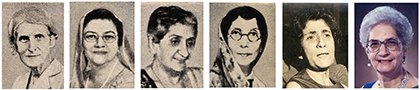
(L-R); Agnes McKenzie, Sehra Baria, Amy Rustomjee, Jerbanoo Mistri, Dolly Masani and Feroza Seervai
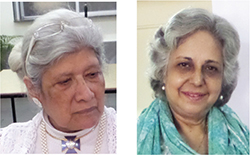
Roshan Wadia (l) and Nandita Singh
The WGU, which is in its centenary year, was set up to empower women through education and other career enhancing actions, and to "promote the moral, intellectual, social, physical and professional interests and welfare of women,” states a recent publication of the Union. Starting as honorary secretary at the age of 21, Rustomjee served as president for two tenures and was in fact the first Asian woman to be elected vice president of the International Federation of University Women (IFUW), a Geneva based body with which WGU is affiliated, states Usha Bhandarkar, a second generation WGU member.
In her keynote address at the inauguration of the WGU centenary celebrations on March 20, 2015 at the high vaulted convocation hall of Bombay University, Arundhati Bhattacharya, chairperson of India’s largest banking network, State Bank of India, lauded the activities of the Union, especially the hostel set up by them, and observed that comfortable accommodation in a city can "make or break a young woman’s dream.” Women, in her experience, left the work place only to fulfil family obligations and as she further commented, "For women today, there is no glass ceiling, only a sticky floor.”
Chief guest Prof Vasudha Kamath, vice chancellor of the SNDT Women’s University said she could identify with WGU, as SNDT was started by Maharshi Karve in 1916 when the literacy rate among Indian women was 1.6%. She suggested some projects in the area of education where SNDT and the Union could collaborate. Earlier, WGU president Nandita Singh recalled that the Union was set up on the initiative of the Association of (British) University Women in India by Dr Annette Benson, the then medical officer-in-charge of the Cama Hospital. It became affiliated to the Indian Federation of University Women’s Associations (IFUWA) in 1920 and to the International Federation a year later. The keynote speaker and the chief guest were introduced by WGU vice president Havovi Gandhi whilst joint secretary Dolly Sagar offered a vote of thanks.
Representation and regeneration
One of the early aims of WGU was to work towards representation of women in public bodies. Its efforts resulted in a member, Dr Tehmina Cama being appointed as the first woman inspector of factories as early as 1918. Bombay University nominated two members, N. D. Contractor and Kashibai Naoange to the Senate in the early 1920s. Three members, Elizabeth Turner Watts, Naorange and Bhikaiji Engineer, were made Justices of Peace in 1925. Over the years, this organization has contributed three sheriffs to Bombay — Mithan Lam, Gulestan Billimoria and Mahboob Nasrullah.
In the 1930s, education and social reform occupied the members of the Union who scrutinized curricula, reviewed the standards of teaching and kept a vigilant eye on text books. Rustomjee and Godavari Gokhale were members of the Adult Education Committee set up by the government in 1938. Activities of the Union were suspended in the war years. The 1950s and 60s were years of consolidation and educational activities continued to occupy the women members. Talks and seminars on women’s issues continued to be held, as they are today.
In keeping with its objective of providing opportunities to women, the first scholarships were distributed in 1934 to two candidates. In the current year, WGU has distributed about 115 need-cum-merit scholarships for research, undergraduate, graduate and professional courses. The Union has also instituted the Amy Rustomjee International Scholarship in her memory. This year, the WGU proposes a special Centenary Year Scholarship.
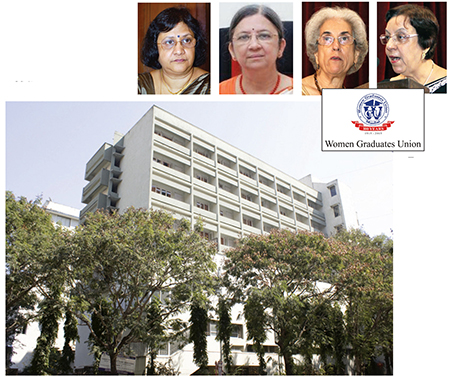
The pride of the WGU though, is the Sir Purshottamdas Thakurdas Hostel, started in 1974, that provides home and security to over a hundred working women from across the country. The hostel boasts illustrious alumni like Justice Sujata Manohar, journalist Sucheta Dalal, Amanda Cooper-Sarkar, who was involved in the discovery of the Higgs Boson at CERN, design consultant Elsie Nanji and advertising stalwart Roda Mehta. It is believed that doughty WGU members Dolly Masani and Feroza Seervai virtually laid siege to Mantralaya, the headquarters of the state government, to obtain sanction for the land on which the WGU built the hostel. They visited the offices daily and persevered for so long that a bureaucrat once reportedly asked them why they went home at all and suggested that they bring their bedding with them! When the necessary permissions were obtained, quite appropriately, two young women employees of Tata Consulting Engineers Ranjini Chinappa and Roshan Wadia designed the iconic building, states Bhandarkar. The Hostel stands on a road now renamed after the Union.
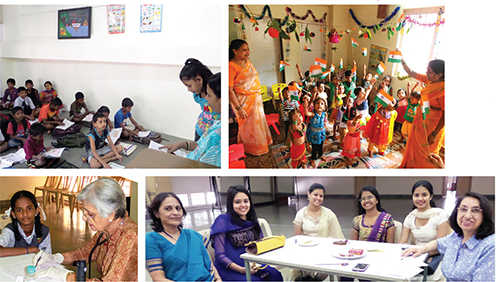
A balwadi (day care center) that caters to about 30 children in the three-five age group from financially disadvantaged families functions from the ground floor of the hostel. Called the Behramji Lalkaka Balwadi, it was started by the late sisters Freny Mehta and Seervai in memory of their father, and receives financial support from the Lalkaka Family Fund trust. Additionally, a study center for municipal school children was started about 30 years ago and runs in two shifts to help about 80 children with their homework. Yoga and aerobics classes are conducted by WGU for the socially disadvantaged people around the hostel as are computer literacy classes.
The Union currently has about 300 members, states Bhandarkar who convinces her daughter to volunteer at WGU whenever she is in India because she realizes "we need younger members.”
In its 100th year, the Union has planned various activities as outlined by coordinating trustee Suman Anand: a panel discussion on succession rights of women, seminars on alternative medicine, book readings by women authors, interaction with the police for women senior citizens. As reinforces Anand, "WGU will always be preserved as a place of learning and education for women in the very long haul.”