
Welfare
The wages of WIT
The Women’s India Trust strives to financially empower women
"The women whose lives we touch through WIT (Women’s India Trust) use the extra supplemental income that they earn for their families, especially in the areas of nutrition and education. It increases their self-confidence. They feel empowered and aware. More importantly, they act as change agents. We are very hopeful about WIT. Once women are educated, there is no stopping them,” says Dolat Kotwal, chairperson emeritus, who has been associated with WIT for almost 35 years now. Chairperson Dhanoo Khusrokhan echoes a similar sentiment. "When a woman earns money and is financially independent, the way people look at her changes. This income generation leads to empowerment. Once they get that confidence, there is no turning back,” she says.
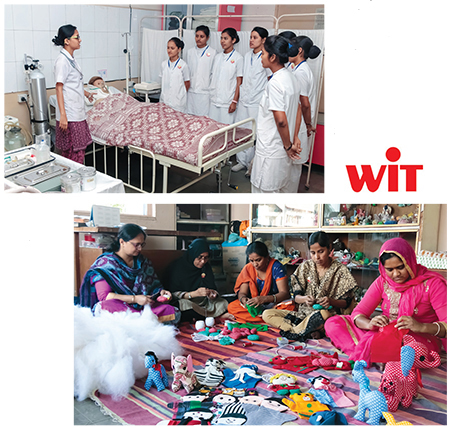
Empowering women: WIT’s nursing students (top) and (above) underprivileged women making toys
Kamila Tyabji started WIT exactly half a century ago. This year, 2018, WIT celebrates 50 years of existence. Coincidentally, the year also marks the 100th birth anniversary of the founder-chairperson Tyabji.
A nongovernmental organization with a clear and specific purpose — to equip women with vocational skills that will in turn enable them to become financially independent — WIT’s motto is "Helping women to help themselves.” Understandably this has led to many education-based and training-based programs for women at their center in Panvel, which is the heart of their activities. The offices at Mahim and Tardeo are bustling locations for administrative activities.
The training is provided at a very nominal cost. The courses offered include block printing, nursing, paramedical and teachers’ training. Some are affiliated to regulating bodies which is an added advantage. For example, the teachers’ training course is affiliated to and recognized by the SNDT (Shreemati Nathibai Damodar Thackersey) University. This gives the consequent diploma more weightage. The nursing course at WIT affiliated to the Maharashtra Nursing Council is very popular.
"Marketing still remains one of our major challenges, the other two being funding and finding good staff,” states Kotwal. Indeed, marketing the various products of WIT is challenging, especially in a digital era where people order online. The e-shop on the WIT website is their latest project. Their updated website is again in line with the times.
"We do keep a track of what our students are doing. We have found that beyond the in-house platform of WIT, our students also find employment outside. Our nursing students generally find jobs most promptly,” explains Kotwal. "They find employment almost immediately, not only in the urban but also rural areas, since the demand is very high,” echoes Khusrokhan.
"We see fewer women coming in for handwork now. Many women now prefer office jobs and hence the division of block printing or stitching, for instance, has fewer takers. Moreover, increasing profitability in terms of the products also remains a challenge,” says Khusrokhan. She also observes that several women who may want to work are prevented from doing so due to restrictions imposed by families. These women are not "allowed” to leave home for work. In fact, she mentions a few cases where women have come secretly to WIT, to become financially independent.
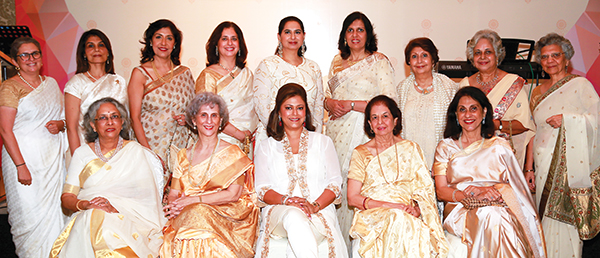
Golden anniversary celebrations committee members with Dhanoo Khusrokhan,
Vanita Bhandari and Dolat Kotwal (seated, 2nd, 3rd and 4th from l)
Some of the students are absorbed for work by WIT itself. The block printing training course absorbs students for fast-selling products such as table cloths, bed linen and so on. (WIT also runs a well-equipped food production unit at Panvel.) WIT produces top quality marmalades, jams, jellies, pickles, chutneys and squashes. All these products are marketed and sold by WIT through their own stores as well as through participation in a variety of exhibitions and fairs.
As a part of a corporate social responsibility (CSR) initiative, the WIT students are taught computer skills. WIT also holds regular community outreach programs.
The Trust has been quick to recognize the need for women to have flexibility in work schedules and provisions for childcare. This has prompted the team to introduce work-from-home facilities for many women (for in-house manufactured products) as well as open a crèche for other working mothers. WIT uses community outreach programs to actually go to families and initiate women into their fold.
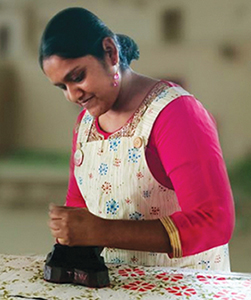 Chief executive officer Shyamla Nath steers the organization with a committed group of volunteers.
 "We have always tried to upgrade ourselves to keep up with current standards. For example, with the help of the A.H. Wadia Trust we upgraded the infrastructure facilities for the nursing hostel. In the course of our interactions with our students we realized that a working knowledge of English is a must for them to succeed professionally. Hence, we introduced teaching of English as well,” states Khusrokhan. WIT has had several links with the Tata trusts, the A. H. Wadia Charitable Trust and the Zoroastrian Charity Funds of HongKong, Canton and Macao. Several individuals from the community support the Trust either financially or by being involved hands-on with the working of the organization.
"It is an uphill process. We stick to our goal and find new ways of doing things. But, the vision remains. Our vision is to empower women from disadvantaged backgrounds. Once they get confidence, they can challenge the world! If a girl is awakened, there is no stopping her. When you help a woman, you help an entire family, and by extension the whole community,” says Khusrokhan.
◆ ◆ ◆
From the archive