
“You can’t have a sky without stars”
A panel discussion explores the potential of working women
Both panelists are from the service sector, Barretto reaching out to a cross section of Indians from every strata of life whilst Daruwala caters to high end clients and colleagues with professional qualifications. She believes that working on the shop floor is tougher for women and in that sense she has it cushier.
Daruwala noted how women make sacrifices, do not shy away from asking these days, are sensitive, hardworking and available both at home and at office. She pointed out that women mirror customer demographics and make decisions on the home front. Sales decisions are instinctive and women have that quality in good measure. She also said that men were better risk takers and both genders working together in an organization makes for a great blend.
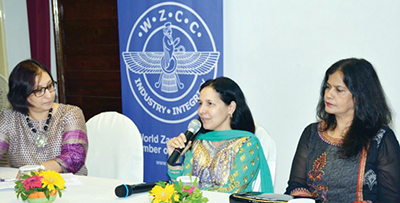
L to R: Benaifer Reporter, Zarin Daruwala and Dr Maria Barretto
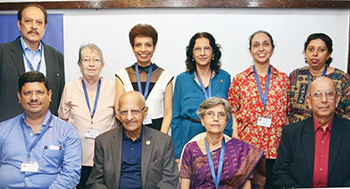
The WZCC and WE teams
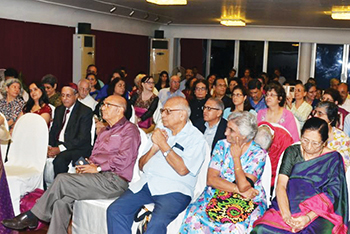
A section of the audience
The banker shared how her bank is encouraging of women employees. When her children were in the 10th standard she negotiated she would work half day for three months. She did the same for her daughter’s 12th standard exams and will do so for her son. She was grateful that her mother and mother-in-law both chipped in to tide over those days. She also accepted that when a woman comes home her husband and children bring her back to earth by treating her like any other wife or mother. No exceptions. "No ego. No place for ego with husband and children. When the kids had exams, I stayed away from social engagements,” she quipped.
The banker had had "a lot of women bosses. Emotional quotient is high with women bosses,” she felt. ICICI ensured that women working late reached home safely. Giving her example as a boss, she continued "…girls talk to me of home, mother-in-law problems, personal issues… the emotional connect is very womanly. Women are sensitive about things. (We) must have a blend of both. You can’t have a sky without stars or a garden without flowers.”
A question both the ladies responded to maintained there are natural, gender differences but each gender needs to draw on the stereotypical character attributes of the other. Women pluses were ability to multi task, empathy, appreciate differences and have different perspectives.
Daruwala chanced upon banking after being a rank holder in chartered accountancy and gold medalist in her company secretary exam. "I did not choose to be a banker,” she said. Looking out for a job, her mentor Yazdi Malegam told her to apply at ICICI Bank as it was women-friendly. She accepted the suggestion and never looked back. Of a total 60,000 staff, 25% are women at this private bank.
The executive countered how her bank gives time off for maternity leave - "Women are able to take off a year or two, without any repercussions on their career.” The bank extends adoption and fertility leave for women who find it difficult to conceive and it also aids in transfer of their women employees to their husbands’ place of posting. This manner of support has helped women overcome difficulties, she believed.
When asked what the seasoned professionals would advise those who undervalue themselves, Daruwala was taken by surprise as she said "no reason to undervalue yourself. Stay the course.” Barretto felt that "belief in self and what you do gives further courage and conviction to what you do.”
Flowing into the profession
Barretto, a doctorate in psychology, added that women "go with the flow of things. (They) keep commitments — professional and home based together.”
She said that in her field there are more women than men and she found "that men get overwhelmed with women.” Men are focused on "where should the organization go,” was Barretto’s observation. She believed that women did not have the sharp focus of where an organization should be steered and they often directed it as a person-driven agenda. Barretto stated that she has not had women bosses but the only time she worked with one in a junior position, she found decision making was not as sharp and the lady left a lot of grey areas of operation.
The clinical psychologist, who specializes in Parkinson’s disease, wanted a break from her last job at United Nations International Children’s Emergency Fund. Just as she was beginning to unwind, a friend asked her to get in touch with Dr Bhim Singhal, head of neurology at Bombay Hospital. Barretto modestly recounted how she shared a "few thoughts with him” and he promptly requested her to drive the upcoming governing council meeting of neurologists and gave her two-three days to think it over. She had jumped in. The recipient of several awards and accolades, the experienced lady has managed and developed the Parkinson’s society for 20 years. Her first support group was of three patients, now it is 15 groups of differing numbers.
Predictably, she spoke of extremely tight finances as donors were more generous with AIDS, cancer and other debilitating diseases. "Not that those inflicted with Parkinson’s disease do not have an immense challenge, but awareness of this neurological disease is little,” she educated us. This lack of early recognition was evident from the responses during the question-answer session. At the session, it transpired that two families did not identify the disease till the patients had reached an advanced stage. Barretto reiterated that "they know it is a progressive, chronic disease” which affects relatives and friends in regular contact. As a reaching out strategy there was a team of Barretto’s assistants at PDMDS giving out pamphlets and cards for assisting care givers and spreading awareness.
She stated how care is much more advanced in most parts of the world but thinking and socio-economic conditions differ in India. To add to that, there is no support from the Indian government at any level. In fact, her most urgent need in 2005 was to see the needs of the Society initially, educate patients and relatives with limited funds.
Barretto has always looked for challenges and opportunities, she mentioned. In the 1980s, psychology offered limited opportunities — the two choices were teaching or working in a clinic. The enterprising go-getter did both. She then combined the two at Seva Niketan by counseling school dropouts and street children. She "responded always to unmet needs and taking them over. I seem to be taking existing organizations into different directions.” And that is what she enjoys.
It was highlighted how PDMDS offers holistic services to patients in 14 centers in the city and if the disease is in an advanced state, the service provider goes to patients’ homes as restricted mobility renders them unable to come to the closest center.
A committee member of WE read out the curriculum vitae of Freyan Bhathena the third panelist, editor of the Parsi Times, who was unable to attend.
Women, not geishas
Minoo Shroff, WZCC global president suggested in his inaugural address that "we must train potential lady directors. Corporates are looking for good independent directors.” In fact, both the lady professionals sailed into their fields by chance.
Shroff cited the quota of women in corporates internationally saying in India it is mandatory for one third of a board of directors to be women, the highest women representation on boards is in the Scandinavian countries and in contrast "the most dismal is in Japan where they like geishas but not women.” Shroff went on to say that Japan was technically very advanced but "not in these things. We are mid-way… we are not bad in corporate governance.”
Adi Siganporia who heads the WZCC Mumbai Chapter welcomed the guests saying he had never prayed harder and appreciated the attendance as Bombay had been lashed with rains for three consecutive days. Commending women power, he recalled an old saying quoted by the ladies of his family, the gist of which is that the men’s large pugrees (headgear) have less akkal (common sense) than the women’s small mathabanas (scarf). He also gave the vote of thanks at the end.
Chairperson Homai Mehta of WE was forthcoming as this was the first joint program WZCC (in existence over the past 15 years) and WE (over three years) were effecting. Women are 50 % of the population she noted, and it was WE’s endeavor to help women reach their potential, raise economic standards and create a platform for the Zoroastrian woman. She warmly welcomed the audience on that rainy day.
The two panelists found it hard to pinpoint role models in their lives when moderator Benaifer Reporter, vice president — human resources of Greenlight Planet which manufactures solar lights and phone chargers, broached the subject. Reporter is herself a painter who taught drawing to monks aged seven to 19 in her personal time at Bir, Himachal Pradesh. Both panelists said they admired different qualities in different people. Daruwala admires ICICI ex-chairman Narayanan Vaghul’s ability to have a bird’s eye view of things and his qualities of head and heart. Barretto owed a lot to her parents who gave her a free hand and let her follow her heart and pursue psychology, despite getting excellent school results. The college principal, where she sought admission, deduced that she did "not want to do anything with her life” and take it easy, as it was the norm at that time that good results meant you pursued either science or commerce.
The two senior professionals agreed that society still judges a woman by how good a wife or mother she is. That is changing and women are allowed to succeed and feel good, they felt. The take-aways for the evening were "never give up your beliefs” and "passion with good knowledge and skills impact self and the work.”