
Cover Story
Accent on accountability
The country’s legal eagle Kairshasp N. Choksy won praise as Sri Lanka’s finance minister
"The budget doesn’t belong only to the government of the time; it belongs to the people as a whole.” President’s Counsel and Sri Lanka’s erstwhile Chancellor of the Exchequer Kairshasp Choksy enunciated his basic philosophy to the country’s pioneering business magazine LMD in the course of an indepth, free-ranging interview featured in its January 2004 issue. The cover of its January issue and the supplement associated with it traditionally focus on its choice of Sri Lankan of the Year — one who "has contributed most to the advancement of the nation in the year under review.” LMD’s choice for 2003 was Choksy.
Lauding the finance minister for his "vision and purposefulness,” the magazine states, "Sri Lanka — which had previously been in the doldrums, with a contraction of 1.4 percent in the economy — has enjoyed three consecutive quarters of growth in excess of five percent each — and it is set to achieve GDP growth of almost six percent for the calendar year 2003.”
With imaginative measures to address and bridge fiscal deficits, Choksy’s accent on accountability has led to the Fiscal Responsibility Management Law. By maintaining consistent policies since his appointment by Prime Minister Ranil Wickremesinghe in December 2001, he has earned investor confidence and his efforts to introduce "a modicum of transparency and accountability” reaped Sri Lanka a promise of US $ 4.5 billion aid loan from the international community. Indeed foreign direct investment in the country trebled since 2001, Choksy told interviewer Wijith DeChickera.
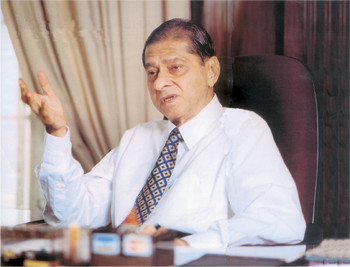
Choksy: "Economic disparity has always been the cause of civil wars” Photo: Media Services/LMD
"Economic disparity has always been the cause of civil wars within a country, rebellion and youth uprisings. We have experienced all three in the last half-century,” says Choksy. Bridging this gap between the rich and the poor would, he believes, promote common thinking between the country’s major parties and enable constitutional amendments to seal the peace in this country torn by civil war. "This is my major aspiration as minister of finance, for our people and our economy,” he told DeChickera. "The bold if not universally popular fiscal measures had (at least up to November 2003) achieved desirable results for Sri Lanka’s economic and investment prospects,” endorsed Ceylon’s Financial Times (January 5, 2004).
The years of strife have undermined Sri Lanka’s infrastructure. Repair, restructuring, modernization were all on the agenda, thanks to the international loan pledges. Better infrastructure would not only increase the efficiency of established industry but in Choksy’s words provide "greater employment and employment opportunities.” It would also help to foster small and medium industries in the rural economy for which regional training, initial capital goods and working capital requirements were being planned.
To promote the necessary environment, Choksy’s budget had reduced taxation levels at the upper levels, raised the exemption limits on income tax. "Revenue collection is highest in those countries where taxation is not high and there are certain uniformities of taxation. In such cases, money doesn’t go into the black,” he states. The desire to put a lid on corruption also prompted the minister to maintain the value added tax (VAT) at a uniform 15 percent. The earlier 10 percent and 20 percent levels had left room for discretion and hence, corruption, maintained Choksy. In the fields of customs and excise duties too, he was seeking to move the system, gently, toward simplification. Financial Times notes Choksy’s "flair for innovative and even revolutionary thinking that has won him admirers from many quarters.”
However, the simmering discord between Sri Lankan President Chandrika Bandaranaike Kumararungta of the UPFA Party and Wickremsinghe of the United National Party (UNP) boiled over. She dismissed the government four years ahead of schedule and called a fresh election (in April ’04) which is said to have returned a Parliament without a clear majority for either party.
The eldest son of Queen’s Counsel Nariman Choksy — the first Parsi to take to law in Sri Lanka — and his wife Khorshed, was born fourth in a family of six children. The three sisters and three brothers grew up in an atmosphere of love and friendship with their parents in Colombo, writes Savithri Rodrigo in her profile of "the enigmatic minister.”
School at S. Thomas’ Preparatory in Kollupitiya was followed by S. Thomas’ College at Mount Lavinia where Choksy confessed to being "constantly embroiled in disputes with the College authorities.” Nonetheless he won the Sir Stuart Schneider Scholarship and was part of the College’s debating team. Paternal discipline inculcated a measure of academic inclination that Choksy says he initially lacked: "I had to spend at least two hours in his chambers doing my own studies under his vigilance, every weekend and even during school vacations. It certainly gave me useful training in learning to concentrate on the job at hand and do it as far as possible to perfection.” "This ethic has been the foundation of Choksy’s success to date — one that he has stringently adhered to throughout his professional career,” adds Rodrigo.
During these compulsory stints in his father’s chambers, the young ‘Kasi’ as he calls himself (‘KN’ as he is generally known), overheard legal discussions. "That atmosphere drew me into the law.” He says he joined the Sri Lankan Bar in 1958, on passing out ("not with flying colors”) from the Law College.
Father Nariman, who believed that his own subsequent success in the profession was due to the early tough years he had weathered, believed there could be no better induction for his son. Also, by the time Kairshasp was ready to begin his career, his father had decided to retire. "And so, whilst I had access to his knowledge and to his methodical habits, I had to journey alone,” recalls Choksy.
Married to Freny (née Cooper), father of three sons [Jamsheed is associate professor of near eastern history and languages at Indiana University, Khursheed is a financial markets consultant with the United States Agency for International Development (USAID) and Vishtasp is a lawyer] the Choksys refused to heed relatives and friends who migrated from Sri Lanka after the ‘Sinhala Only’ policy was introduced in 1956. Instead Choksy found himself being "propelled into the political arena through the legal profession” in 1978, fighting constitutional cases and election petitions. "President J. R. Jayewardene and Prime Minister Ranasinghe Premadasa were my first political clients,” Choksy told Rodrigo. Other ministers were to follow.
"A gentleman to the tips of his fingers and renowned for his unruffled demeanor, the amicable and erudite lawyer has the honor of being featured in the Guinness Book of World Records for his having conducted the longest trial in history. ‘This is certainly my most memorable professional achievement. I appeared for President Premadasa in the election petition against him by former Prime Minister Sirimavo Bandaranaike, after the presidential election of December 1988. The hearing of the case, as required by the constitution, was before a five-judge bench of the Supreme Court. The trial lasted 525 days, with 911 witnesses testifying on both sides and typescript of daily court proceedings running into 26,000 pages. At the conclusion of the evidence, my final address and submissions to court took 52 working days. President Premadasa won by an unanimous judgment,’” chronicles Rodrigo.
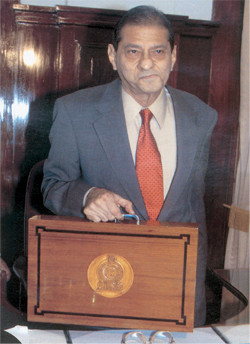
Choksy: "Innovative and even revolutionary thinking” Photo: Media Services/LMD
As his relationship with his politico clients matured, they consulted him on extra-legal issues. President Jayewardene and others had called on the professionals of the country to enter parliament and enrich its quality. In 1989 President Premadasa implemented the idea and Choksy was among those nominated as a UNP member on the national list. He has been there ever since. In May 1993 he was appointed Minister of Constitutional and State Affairs, a position he held until change of government in 1994.
Appointed President’s Counsel in 1981, chairman of the Law Committee of the Bar Association of Sri Lanka (1980-82), Choksy has represented diplomatic missions and foreign banks in Sri Lanka. He has also represented the government as senior counsel in arbitration proceedings and was a member of the Sri Lankan delegation to the United Nations in 1986.
Choksy rises early, works an almost 12-hour day from the time he leaves home in the morning. A physical exercise routine and time out with the family during court vacations, keeps the counsel on course.
Though he had initial doubts on being assigned the finance portfolio Choksy says, "It is certainly different to what I was used to at Hulftsdorp, but it has been most interesting. I do believe that we have achieved fair success in turning around the economy in a short period. It has been both captivating and rewarding, and I am happy that at the end of a fairly long spell at the Bar, I have had the opportunity of being able to integrate myself into this field and serve the state. There is a great volume of work still to be done, and I am not reluctant to spend my time and do a complete and successful job.”
The Zoroastrian connection
The negative turn of political events in Colombo provided the break that enabled Choksy to review the community landscape and share his opinions with Parsiana readers.
According to him, "integrity, discipline, education, ability, loyalty, dedication to work” continue to be the major attributes of the Zoroastrian community. "These are generally recognized as our outstanding qualities as a community,” he notes. More inclined towards the philosophy of the Gathas than rigid ritualism, Choksy believes a balanced co-existence and interdependence happily exists today as he feels some selected rituals are "necessary for the articulation of the content of the Gathas.”
Though distressed by the demographic decline among the Parsis of India, he notes, "Parsis have ventured into several countries outside India. Our presence has never been resented. We have enriched and contributed constructively to the host nations, in areas such as business, industry and the professions. There have taken place no conflicts with their social customs. Any decline in numbers is therefore a loss going beyond the boundaries of our own community.”
Regarding the worldwide Zoroastrian population Choksy argues, "It is possible... that rather than a decline in numbers, demographic shifts from one country to another have or are taking place. Sri Lanka witnessed this after the country’s political independence, with a fair exodus of Parsis to Australia.” He nonetheless advocates that "the community should explore relaxing certain prevailing rigid doctrinaire attitudes which are resulting in the shrinkage in numbers, and which could be relaxed without hurting our basics.”
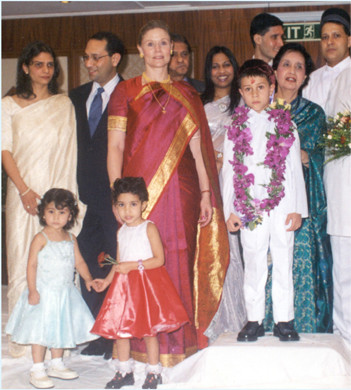
The family at grandson Darius’ navjote in December 2002
Shy of expressing any opinion about the resurgent Zoroastrians of Central Asia about whom he feels he is not sufficiently knowledgeable, Choksy feels that the Zoroastrian faith should only include those whose one parent at least is a Zoroastrian, "so that we could maintain those qualities that have contributed through the ages to making our community a distinct and recognized body.”
The legal eagle has no reservations about accepting the children of Zoroastrian mothers and fathers of other faiths: "Since we by and large accept the progeny of intermarried Zoroastrian males, the children of intermarried Zoroastrian mothers who express a desire for their children, could be accepted provided the mother continues to remain a member of our faith and is genuine in her wish. Our religion in its inception was a revealed religion, i.e. disclosed to the world by Ahura Mazda through his Prophet Zoroaster, who by his teachings won believers or converts, with history recording King Vishtasp amongst the earliest of them. Furthermore, women, more than men, serve as transmitters of faith, tradition and customs. Such limited extension, as against unrestricted conversion, would serve us well.”
From Choksy’s point of view, "a World Body could be considered, subject to resolving issues such as regulation of its functions. Such a body could be representative of the several anjumans and Zoroastrian organizations, and be an advisory institution on common problems faced by our community.”
◆ ◆ ◆
From the archive