
Business
The urban agriculturists
A young company wants to take hemp, an age old cash crop, places
"My dream, is to create a perpetual phenomenon,” says 25-year-old Jahan PestonJamas talking of his and his company’s involvement with hemp, "just as (Mahatma) Gandhi did with khadi earlier.” "Both Gandhi and Dadabhai Naoroji were affected by the poverty of Indian agriculturists; we all know what both of them did for the country as a result of that,” he says.
Hemp, our young entrepreneur explains, refers to cannabis varieties that are primarily grown as an agricultural crop for seeds and fibre, and for by products such as oil and seed cake.
Hemp, our young entrepreneur explains, refers to cannabis varieties that are primarily grown as an agricultural crop for seeds and fibre, and for by products such as oil and seed cake.
 The fervor with which PestonJamas and his 24-year-old co-director Delzaad Deolaliwala speak about industrial hemp finds an echo in the tag line of their firm, Bombay Hemp Company (BOHECO) Private Limited, which reads "Educate, Cultivate, Elevate.” They want to provide affordable products which they believe can be offered through industrial hemp. "We want to raise the standard of living for agriculturists and the common man in India,” says PestonJamas. "Take the case of Bhopal,” he continues. "The area that was affected by the disaster of the 80s is still barren,” this young man ruminates. "Since the soil and climatic conditions around Bhopal are ideal for hemp, "with industrial hemp we hold an opportunity to reclaim some of the soil and land many farmers gave their life towards, and in turn serve a national duty to provide a second chance to Mother Earth and all of her children,” he says.
"Industrial hemp is a high potential phyto-remediation crop,” he continues excitedly. Seeing our questioning eyebrows, he explains patiently, "Phyto-remediation is a process by which certain plants can extract and concentrate certain elements within their ecosystem without harming themselves. Hemp is one such plant. In this way, pollutants are either removed from the soil and groundwater or rendered harmless.” He gives the example of the Chernobyl site and points out that in 1998 several companies, along with Ukraine's Institute of Bast Crops, planted industrial hemp there to rejuvenate the soil.
Not very long ago, PestonJamas and Deolaliwala and a group of five other like-minded fellow students from H. R. College of Commerce were part of a solar energy based rural electrification project undertaken via Students In Free Enterprise (SIFE), a not-for-profit organization. As part of the project they undertook electrification of some villages in Jawahar near Bombay. They were revelling in the success of the project at Deolaliwala’s ancestral farm near Deolali where his grandfather Soli and father Cyrus are part-time agriculturists (in addition to being doctors), and were wondering about "how to do something new, something that has never been done before,” when they hit upon hemp. "It is a versatile, dynamic crop,” says Deolaliwala and waxes eloquent about the benefits of growing hemp vis-a-vis cotton. He reels off statistics and percentages on how much less water hemp needs and how it is a hardy crop and therefore more suitable to Indian conditions.
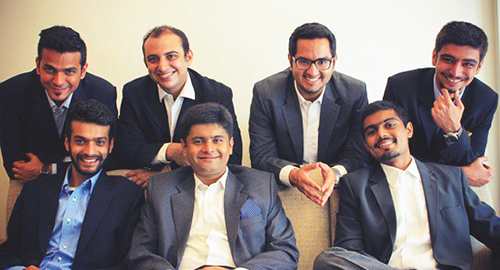
(Alongside, standing, from left): Chirag Tekchandaney, Jahan PestonJamas, Sanvardeep Oberoi,
Delzaad Deolaliwala; (seated): Yash Kotak, Avnish Pandya, Sumit Shah

BOHECO products
In parallel, PestonJamas, on a visit to his Australian-Zoroastrian relatives had the opportunity to visit some hemp farms around Perth in Western Australia. "There were vast green expanses of hemp,” he reminisces. "Entire communities owed their well being to this Margaret River Hemp Company,” he recalls. He was impressed by the fact that this company made everything from oil, building blocks, shoes and surf boards with hemp. The young man came back to Bombay, armed with portfolios of information on the wonder crop, and of course a head full of ideas.
All seven decided to garner some corporate experience after graduation in 2011, and before setting up a company to make their dreams come true. PestonJamas, with his love of Bombay, helped to set up a walking-tour company that undertook theme based ambling around the city. Deolaliwala meanwhile studied for his chartered accountancy and his law exams.
The seven dipped into their individual savings and investments to establish BOHECO in January 2013. You ask them why ‘Bombay’ is in the name and not the more contemporary version, and PestonJamas, ever the Bombay fan says, "Mumbai is a city, Bombay is an emotion.” The seven young men gave themselves roles in various areas of operations within BOHECO based on their strengths and skills. PestonJamas is Director of Strategy and Collaborations and Deolaliwala is titled Director of Accounting and Legal Affairs. Other team members look after other functions within the company. The Director of Research and Development Avnish Pandya’s work forms the basis of BOHECO’s vision to ‘educate’ Indian society about the crop and its versatile benefits. Sanvardeep Oberoi who garnered expertise in risk management in a Big Four is titled Director of Finance and Digital Technology. Operations and supply chain is headed by Sumit Shah who has spent many years in the field working with local hemp farmers. Chirag Tekchandaney, with professional experience in sales and marketing, is titled Director of Marketing and Human Resources. Yash Kotak heads Projects and Quality Management.
"You can do it right or you can do it fast,” states the Director of Strategy. The Director of Accounting nods vigorously. In addition to the above roles, the young company focuses on the following three verticals: scientific research and policy advocacy; commercial and finally machinery and manufacturing. You ask the young men if they see themselves as an agriculture company or a manufacturing or a trading company and they both smile shyly and say, all of it. "We have to focus on all of it,” continues Deolaliwala, and says that this is imperative if they have to fulfil their motto of ‘Educate, Cultivate, Elevate.’
The seven young directors of BOHECO are working hard to dispel the negative notions that are prevalent in our country around hemp, particularly as a recreational drug. Hemp, our duo is at pains to explain, refers to plant varieties that are low in THC (delta-9 tetrahydrocannabinol, marijuana’s primary psychoactive chemical). "THC levels for hemp are generally less than 1%,” states BOHECO’s website. "Industrial hemp or cannabis sativa comes from the Cannabacae family of plants. Similarly, the common narcotic plant marijuana also comes from the Cannabacae family. However marijuana refers to the flowering tops and leaves of psychoactive cannabis varieties, which are grown for their high content of THC,” explains PestonJamas fervently. "Industrial hemp is genetically different, and distinguished by its utility and chemical makeup,” continues their company website. "Why should an unfortunate misconception hold us back?” questions Deolaliwala.
As part of the Educate mantra in their motto, the team regularly talks at workshops and seminars in the fashion industry, for instance, about the uses that the hemp fibre can be put to. The duo point out that hemp fabric caught the fancy of several big-name couturiers at the India Fashion Week, 2014. BOHECO collaborates with the National Institute of Design (NID) to explore innovation opportunities with hemp. "Watch out for hemp at the next major Fashion Week,” says PestonJamas, stating proudly that BOHECO is currently collaborating with the National Institute of Fashion Technolgoy (NIFT) for sale of hemp fabric material, which the design students will turn into high couture.
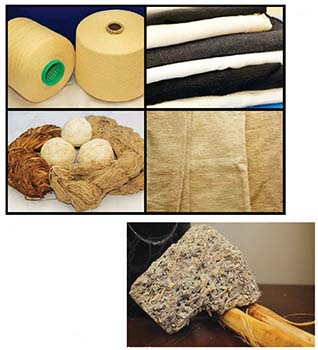
Four uses of hemp and Hempcrete;
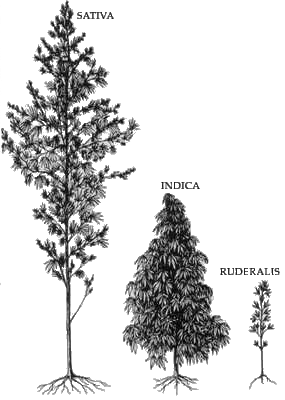
Plant comparison
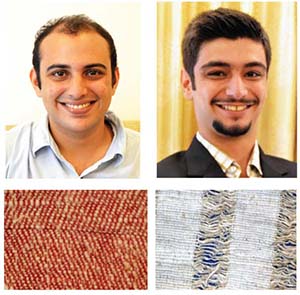
Above: PestonJamas (left) and Deolaliwala; yarn from hemp
As part of its focus on ‘Cultivate,’ BOHECO is lobbying for standardization of cultivable low THC hemp seed. This will be according to pre-determined agricultural zones, and with optimized yield of hemp fibre, stalk or seed. BOHECO has initiated collaboration with stakeholders within the local, regional and state-wide rural communities, particularly in Uttarakhand and Haryana, to establish a multipronged cooperative movement to facilitate the agricultural popularity of industrial hemp.
Although BOHECO does not grow hemp, the company has two full time agriculturists and technologists on their rolls, a plant breeder and a molecular biologist. They work with farmers and agricultural cooperatives who are already cultivating this crop. BOHECO’s focus is on the development of quality seeds for use in the future. They also employ agents to spread the good word about industrial hemp and currently work with four, one for each region of the country. How did the company select these associates, you ask. "It’s all about passion,” says Deolaliwala. "We look for people who are as enthusiastic as the seven of us,” says PestonJamas. They are also in talks with a company based in Nagpur for indigenisation of a decorticator, which is a machine to extract usable material from the stalk of the hemp plant, and which can be used in the production of hempcrete. Hempcrete, the duo believe, is the green building material of the future. Bricks made of hemp fibre are used for construction in Australia, New Zealand and France, says PestonJamas excitedly.
A selection of hemp products like hemp seeds, oils, fabrics, body care products, shirts and hemp material are available on the company’s website. They have chosen to outsource all work. Shirts are currently priced at about Rs 2,500. PestonJamas agrees they are high-priced but states, "Wait till we reap economies of scale.”
They see the next five years as the years of consolidation. "We will go heavily into seed breeding,” claims Deolaliwala. "We need our own seeds,” he avers, "if we need to have consistency of yield, quality and THC levels.” To this end, the company is collaborating with Indian Agricultural Research Institute (IARI) to ensure robustness and regular availability of hemp seeds in the future.
What holds the seven young men of varied backgrounds together? "Ours is a bond as strong as hempcrete,” avers PestonJamas who is an Overseas Citizen of India, and holds an Australian passport. He recalls having had his navjote done at age 11 and states he "would love to embrace my religion more.” He is currently reading up about the religion. The community has to grow, he states. Or we will be like that dying community in Mexico where only two members who spoke a particular language remained, and neither was talking to the other, he jokes. He recalls fondly how his mother Sarla calls him her "half blood prince.”
PestonJamas is the only son of the late Ardeshir, a Zoroastrian, and Sarla, who is part South-African Gujarati and part Irish. PestonJamas’ grandfather Pheroze was a businessman whose company Arphi Electronics was a reputed manufacturer of high quality speakers, amplifiers and equalizers in the 1970s and ’80s. Arphi Electronics today continues to make hearing aids, molds for hearing aids and audiometers. The community "needs more openness and needs to rise above differences,” he hopes. It’s all about "progressiveness,” concludes this feisty young man.
Deolaliwala affirms that he believes in good thoughts, good words and good deeds and in "a power that overviews us all.” He states he visits the Aslaji Agiary on special days with his mother Tanaz. He has a younger sister Nazreen, who attends a Bombay college.
"We need more Parsi entrepreneurs,” states PestonJamas. "What if all the head honchos suddenly were no more,” he asks, only half jokingly. "We want to leave a permanent legacy behind,” says PestonJamas. "We want to serve the next generation,” Deolaliwala reconfirms.
◆ ◆ ◆
From the archive