
Services
"Missing, believed killed"
A family remembers its young pilot killed in action 60 years ago
"Before you get this letter you must have received a telegram stating that your son is ‘Missing, believed killed’ from operational sortie over Kalwa area,” noted a letter addressed to Feroshaw Eduljee, father of 24-year-old Flight Lieutenant Dinshaw. As acknowledged the communiqué from Squadron Leader (presently Air Marshal) Arjun Singh, "Your son joined us about five months ago after a distinguished career all through. His achievements and ability in instructional work at Ambala earned him the Air Force Cross which is the highest honor one can get in that line and he was the first and the only officer in the Indian Air Force (IAF) to earn that decoration. From the operational training unit he passed out with credit. I was lucky to have got him in my squadron. He was doing splendid work in the operations. He was an excellent officer, unassuming but dignified. His sincere behavior made him very popular amongst his comrades.
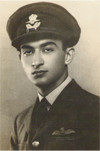
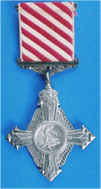
Flt Lt Eduljee and the Air Force Cross (below)
"We all express deepest sympathy in your great anxiety and pray that he is safe. Any further information, which we hope to obtain through various sources, will be conveyed to you immediately when it is received.” Apparently no news on Dinshaw was received after this intimation so the family had to assume that Dinshaw had died a heroic death. However even 60 years after his death the family has still preserved Singh’s note as a lasting memory as also the Cross which signified an act or acts of exceptional valor or courage and devotion to duty performed by officers, explains Dinshaw’s brother, Major Eric Eduljee.
As Singh had recounted, "Your son took off in a Hurricane at 0700 hours (on) November 27, 1944 for a reconnaissance over the enemy road from Shwegin to Pyingaing (south east Burma) which is just about 15 miles south east of Kalwa, near Imphal. The second pilot who went with your son in another Hurricane says that your son spotted a Japanese camp along the road and dived to machine gun it. This pilot followed him. In the meantime your son had pulled out and was in a position for another attack. After the other pilot had pulled out he saw a cloud of dust rising from the target area. He went low and saw a wing detached, lying apart from your son’s aircraft. Apparently while taking evasive action your son hit the trees with a wing and lost control of the aircraft. Except the wing no other part of the aircraft was visible from the air as it crashed in a very thick jungle. The pilot circled over the spot for some time but did not see any movement.”
Dinshaw had been affiliated with the Air Force from the start of World War II, when he was but 18 years of age. As recalls Eric, the government required urgent replacements of their pilots who were being depleted fast and requested the magistrate and commissioner of Faizabad, Uttar Pradesh, M. H. B. Nethersole to recommend five persons for training in the Auxiliary Air Force wing. The magistrate who remembered being impressed by Dinshaw’s conduct at a prize distribution function, included Dinshaw in his list of five. At that time a scholarship was offered by the aviation section committee of the Government of India for training pilot reserves. Dinshaw was among the first candidates to be selected from 88 applicants. On excelling at this course he was chosen for further training at the Royal Indian Air Force where in the final phase at Jodhpur he was awarded the Best Service Pilot Trophy. Because of his mastery in flying he helped out as an instructor and was soon appointed as the first senior flying instructor at the same academy where he had learnt the ropes. The rank of flight lieutenant was conferred on him. In his enthusiasm to serve the country further he applied for service in one of the operational areas and was posted to the No. 1 Squadron under Singh.
"His photograph along with eight other Aces (a person who has independently downed three planes) of the IAF hangs at the Palam Airport,” Eric has been given to understand.
Born in Lucknow on July 8, 1920 to Khorshed and Feroshaw Eduljee, Dinshaw, better known as Din to his family and friends, was the second of their five sons. As a child he never got into any mischief, Eric gives an insight into his formative years. Despite his cool and calm nature he had a very strong will and if he decided to do something, he would do it against all odds. Their dad worked in the railways and when the family traveled the tickets were invariably entrusted to Din. In school too he showed his leadership prowess and was in the forefront of different activities as monitor of the class or captain of the team. As the head boy of the school he was known to be strict but just. When the principal summarily suspended a master for making an unwarranted remark against Din which had an adverse effect on the debate program in session, Din with his other prefects went up to the principal the next day asking him to reconsider his decision. The teacher concerned was reinstated thereafter.
His sense of fairness and strong character was always in the forefront, observed the brother, later manifesting itself as sublime heroism, supreme gallantry, flying skill and determination above and beyond the call of duty.
◆ ◆ ◆
From the archive