
Braving the battles
Whether on the field or through relief measures, the Parsi contribution to World War I is recalled on its centenary
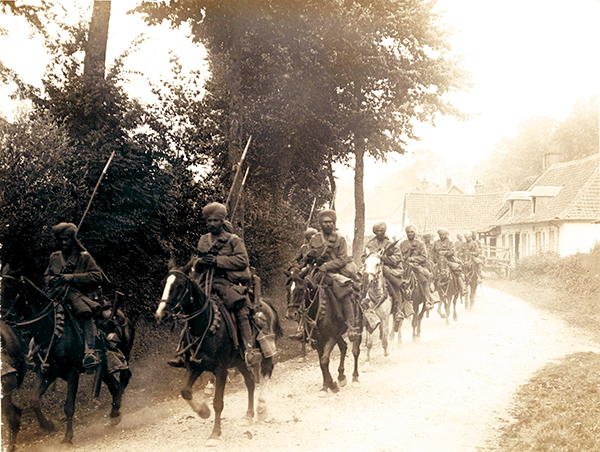
Indian Lancers in Crecqy, France Photo: The Girdwood Collection, British Library Board, UK
The event was convened by ZAPPG chair Lord Karan Bilimoria and secretary-treasurer Gareth Thomas, Member of Parliament, at the Strangers’ Dining Room of the British House of Commons on October 13, 2014 where members of both chambers of the Houses of Parliament were joined by nearly 100 representatives from the Zoroastrian community, academia, civil service, local government and interfaith organizations. The Parsi contribution to WWI, according to Deboo, could be divided into five categories: soldiers; doctors in the Indian Medical Service (IMS); use of Parsi property for treating the wounded; monetary and economic contribution to the war effort; and countering German propaganda.
Outstanding Parsis who had served in WWI were mainly in the IMS, observed Field Marshal Sir John Chapple in his keynote address. The former head of the British Army and chair of the Indian Military Historical Society, Chapple said that his interest in the Indian Army had started when he began to collect army handbooks from soldiers stationed in India from the days of the East India Company onwards. [One such war diary meticulously maintained by Ervad Jehangirji Vajifdar (see "Shipshape at War,” Books, pg 35) offers an insider view.] Chapple also referred to the archival importance of the Indian Army Memorial Room of the Royal Military Academy, Sandhurst. According to Chapple, the size of the Indian Army rose from 240,000 in 1913 to a force of 1,500,000 at the conclusion of hostilities in 1918. The religions and the ethnicity of those serving in the Indian Army were known because they were recorded but Parsis were not on the list. He was aware though that the Parsee Pioneers regiment had been formed in Bombay.
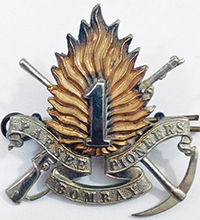
Badge of 1st Parsee Pioneers Bombay Photo: Sushil Talwar
The British permitted the raising of a Parsi Auxilliary Battalion (PAB) in 1805 during the imagined threat to Bombay from Napoleon, wrote Lt Gen Adi Sethna in his article "The Armed Forces: Spirited Patriotism” in the book Enduring Legacy, volume II edited by Nawaz Mody. He further mentioned that towards the end of WWI a PAB was raised as a special case. "This battalion was never on active service. Its members were drawn from Bombay, Surat, Ahmedabad and Poona. They trained in their respective cities but joined for an annual camp during the two years or thereabout when this existed, possibly up to 1922 or 1923.”
IMS was the first branch of the Indian army to open its doors to Indians as King’s Commissioned Officers. On the eve of WWI, many Indian officers were serving with IMS. Chapple referred to Maj Ratenshaw Nariman Kapadia of the IMS who served in Iraq from 1915-1918 and with the Egyptian Expeditionary Force in 1918, receiving the Croix de Guerre and the Military Cross. He had earned his MBBS from the Grant Medical College prior to WWI but did his MS and became a Fellow of the Royal College of Surgeons in 1924. As per information shared by his nephew Behram Kapadia, ZTFE vice president and social secretary, Ratenshaw died at the age of 41 when he was on sick leave in Frankfurt, Germany.
.jpg)
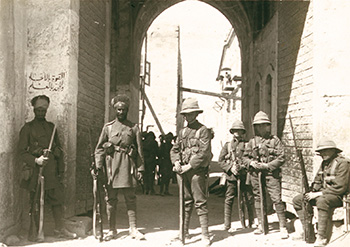
No. 1 Kashmir Mountain Battery in E. Africa Photo: Andrew Kerr
Col Phirozshah Byramji Bharucha of the IMS who served in Mesopotamia was the first Indian to be awarded the Distinguished Service Order (DSO), the second highest gallantry award of the Army. As gleaned from Crawford’s Roll of the Indian Medical Service (1615-1930) at The Royal College of Surgeons of England, Bharucha had obtained his medical education at Bombay University, the Middlesex Hospital and King’s College, London. In 1910 he joined the IMS as a lieutenant, becoming captain in 1913, major in 1922 and lieutenant-colonel in 1930. During WWI he served on various fronts and was often mentioned in dispatches. He was awarded the DSO in 1916 for attending to the wounded during the battle of Kut-el-Amara in Mesopotamia. His brother Kaikhushroo, also of the IMS, was the medical officer sent with the troops for the relief of Kut-el-Amara, stated Sethna. Phirozshah was conferred the OBE in 1920, the same year when he was appointed professor of anatomy at the Medical School in Lahore, and later became principal of King Edward Medical College there, a post which he held until the partition of India. He was also inspector-general of Civil Hospitals, Punjab, and after his retirement was in charge of Ganga Ram Hospital, Lahore. The partition of India brought him to Bombay where he served as superintendent of the Tata Memorial Hospital.
Yet another doctor to earn a DSO was Capt Hiraji Jehangir Manockjee Cursetjee who was conferred the honor in 1918 for gallantry and devotion to service when he attended to wounded soldiers despite being wounded himself on the battlefront in Gallipoli and Mesopotamia. He had served the 14th Sikhs regiment and as recorded in the Journal of Defence Studies "The Sikhs’ losses were staggering. Of those who took part — 15 British officers (including Capt Cursetjee, the battalion’s Parsi medical officer), 13 Indian officers and 450 sepoys, no fewer than 12 officers, 11 Indians and 371 sepoys were killed or wounded. The battalion suffered losses of 80%, most within a few hours. With Cursetjee wounded and evacuated, the battalion’s sub-assistant surgeon, Jemadar Bhagwan Singh took over until a new medical officer arrived…”
Another IMS officer was Capt Feroze Bapooji Chinoy who saw active service throughout the War and in 1918 was posted to Zenjan in the mountainous region of North Persia as officer commanding the 20th Combined Field Ambulance of the Mesopotamia Expeditionary Force. Shortly after the War was over, he died tragically at the age of 30, succumbing to typhus, writes Sethna. He further refers to Maj Gen K. S. Master who was the first director general of free India’s Armed Medical Service. He won a Military Cross in WWI and was much respected as a doctor and a man. "What struck us junior officers of the time was the way he flourished his gold cigarette case and offered Charminars, the cheap but strong cigarettes during conferences!” recalled Sethna in the Delhi Parsi Anjuman’s Dipanjali issue of 2001. Upon retirement he made a significant contribution as the architect of the aesthetically laid out city of Jamshedpur.
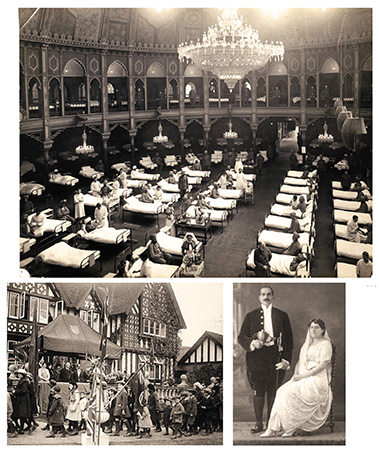
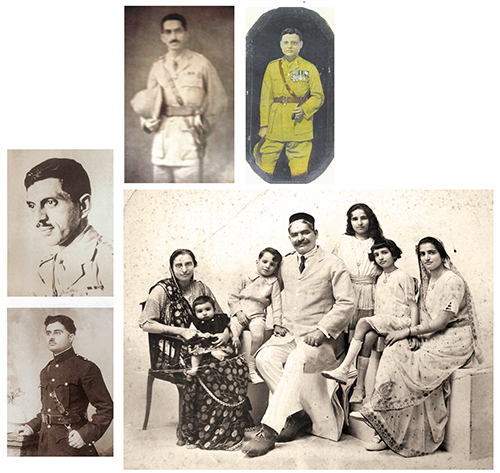
Photos: Enduring Legacy
;
Using material provided by Eastside Community Heritage Centre, Essex and Tata Central Archives, India, Deboo related how Dr Dadabhai Naoroji’s grandson Karesasp Ardeshir Naoroji, better known as Kish, volunteered in 1914 at St James and was enlisted as a Private in the Middlesex Regiment at the age of 21, along with a fellow Cambridge student Nasli Padamjee (see "Missing, believed killed,” pg 27, to read excerpts of the raconteur’s experiences).
Kish was appointed lance corporal the following year and promoted to sergeant the year thereafter. Wounded at the Battle of the Somme, he was honorably discharged in October 1916. He returned to Cambridge and graduated in 1917 after which he re-enlisted and was sent to an Officer Training Corps at Berkenstead. But just before he could complete his training in 1918, armistice was declared. The War Office declined to give Kish a commission stating he must undergo further training at Sandhurst which he refused, requesting instead to be discharged. Finally the War Office relented and Kish sailed to India, being amongst the first 50 Indian officers to join the Indian Army and was commissioned with the 106th Hazara Pioneers that served in Mesopotamia in 1920 and 1921. After leaving the Army, Kish joined the Tatas, retiring as one of their senior directors. He died in 1977.
The services of Lt Pherozeshah Dinshawji Sorabji Palamkote, surveyor of Bombay Municipality, were requisitioned by the War Department and in June 1915 he joined as divisional treasurer of Mesopotamian Force D representing Poona Volunteer Rifles, notes community historian Marzban Giara. During the siege of Kut-el-Amara that lasted 150 days, Palamkote, who had served for many years in the Parsi Ambulance Division and the St John Ambulance Brigade, assisted in the administration of the hospital, cutting hair and washing clothes. For three years he was held a prisoner of war by the Turks and on his release had won the appreciation of his officers as also King George. Father of five sons and five daughters, he passed away at the age of 78.
Serving as engineers in WWI were Jal Dhunjibhoy Irani and his brother Bob Dhunjibhoy Irani, recalls Jal’s grandson Rusi Sorabji of California. Bob later settled in Sukkur, Sind and was one of the engineers in the early 1920s involved in either the suspension bridge over the Indus, called the Lansdowne Bridge or the Sukkur Barrage, writes Sorabji.
Amongst the Parsi properties used to treat the War wounded was the large estate in Windsor of Lady Frainy and Sir Dhunjibhoy Bomanji Kt who were friends of Field Marshal Earl Haig, commander-in-chief of the British Armed Forces. As per information shared by Sorabji, Dhunjibhoy Kalfati (for that was the family name of Sir Dhunjibhoy Bomanji), the 6’6” shrewd businessman and philanthropist was a very large labor contractor and a coal loading contractor on steamships, first in Bombay and later in England. Known to be one of the wealthiest Parsis in UK, the family lived in opulent luxury on a large estate named The Willows along the banks of the Thames at Windsor. Besides giving generously to the war efforts, at the end of WWI Dhunjibhoy commissioned a bronze statue of Haig, on horseback. For years this statue stood at the entrance to the Edinburgh Castle in Scotland but was ultimately shifted inside the museum, to preserve it for posterity. A patron of ZTFE too, his charities were recognized with a knighthood but after Dhunjibhoy’s passing away in 1937, the British government requisitioned much of the family property during World War II and Lady Frainy moved out from The Willows.
.JPG)
The iconic Taj Mahal Hotel in Bombay owned by the Tata Group is also known to have temporarily converted their premises into a 600-bed hospital. Sir Ratan Tata who died in 1918, the same year the War ended, had also offered his properties for use by war casualties. The premises of the B. D. Petit Parsee General Hospital that was built in 1912 were made available for relief measures too. Bomanjee Dinshaw Petit after whom the Hospital is named, having passed away in 1915, this year happens to be his death centenary. (Whilst not directly concerned with WWI, Sir Pherozeshah Mehta, the father of the Bombay Municipality who had played a significant role in India’s freedom struggle had also passed away in 1915.) Besides the Petits and Tatas, the Jejeebhoys had contributed large sums to the War efforts as had the Bombay Parsi Punchayet (BPP).
Among the industrial organizations that earned fame for their War efforts was TISCO that had supplied over 1,500 miles of steel rail in Mesopotamia as well as steel for armaments. After the War when the Viceroy Lord Chelmsford visited TISCO in Sakchi, he announced the decision to rename Sakshi as Jamshedpur in honor of Jamsetji Tata whose vision and determination had led to the establishment of the first iron and steel works in India.
The booklet The Verdict of India authored by then ZTFE president Sir Mancherjee Bhownaggree, the second Indian to be elected British MP after Dadabhai Naoroji, was meant to counter German propaganda that the British were mistreating their Indian soldiers and they should instead fight for the Germans.
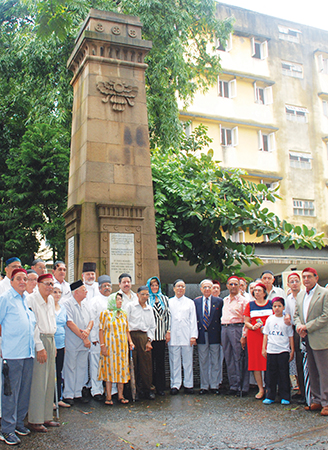
Prior to invoking the names of those Parsis known to have lost their lives in WWI at the ZAPPG meet, Deboo reported that in the 1921 census of the Government of India, the rate of growth of the Parsi community had dropped due to the war casualties. The Khareghat Colony war column has inscribed on three sides in Gujarati the names of 46 Zoroastrians, loyal to their British overlords, "who died doing their duty during the great war of 1914 to 1918.” Among the deceased were six who held the rank of a captain, four of a lieutenant and one of a sergeant. The list also features three doctors.
The following feature on the column: Capts Meherwanji D. Printer, Kaikhushroo H. Contractor, Rustomji H. Bharucha, Phiroz B. Chinoy, Pestonjee B. Doctor, Sohrab D. Ratnagar, Lts Darabshah R. Kharas, Gustasp S. Engineer, Manekji B. Patel, Framroz K. Desai, Sgt Navroji J. Mistri (Columbowala), Kaikobad K. Cawasji Mahableshwarwalla, Nusserwanji M. Mandroina, Kaikobad D. Khambata, Pallonji P. Tata, Framroze M. Chhapkhanawalla, Hormuzdiar R. Aga, Hormusji S. Writer, Sorabji P. Buchia, Edulji J. Batliwalla, Eruch Karanjia, Sorabji K. Karanjia, Firozshah D. Hansotia, Burjorji D. M. Aria, Rustomji S. D. Paymaster, Nusserwanji S. Pudumji, Muncherji N. Banaji, Phiroze B. Bhikhaji, Drs Ardeshir B. Engineer and Nusserwanji S. Parakh, Jijibhai M. Dubash, Bhikhaji A. Elavia, Rustomji K. Bhadha, Nadirshah B. B. Patel, Kaikhushroo B. Pocha, Sheriar K. Irani, Minocher B. Khadiwala, Hormusji M. Sopariwalla, Manchershah N. H. Nania, Feroze J. Mullaferoze, Ardeshir A. Sharaf, Eruchshah A. Gyara, Rustom J. Irani, Dr Kaikhushroo J. Bhamgara, Pallonji R. Bhesania and Sorabji D. Kanga.
When unveiling this column in 1926 Sir Jamsetjee Jejeebhoy, 5th Bart hoped "the memorial would teach future generations to stand by their rulers and be patriotic.” This Times of India (TOI) report of the inauguration was quoted by TOI correspondent Nergish Sunavala in her write-up on August 15, 2014.
At the 2014 muktad prayers at the Zartoshty Brothers Hall at Zoroastrian Centre, Harrow, ZTFE members recited an Ashem Vohu in memory of the departed who had served the Emperor during the War years. Likewise the martyrs were also remembered at the Fravardin mah parav at Brookwood, just as they are annually at the Cenotaph in Bombay under the auspices of the Bombay Parsee Association. The Bombay Cenotaph, with inscriptions in English, Gujarati and Avestan, was constructed by the BPP trustees with funds raised from the community by the Jarthosti Bhaibandh Mandali and Rathestar Mandal. The Cenotaph in London and the India Gate in Delhi, both monuments designed by the famed architect Edwin Lutyens, immortalize the sacrifices made by Indians for WWI.
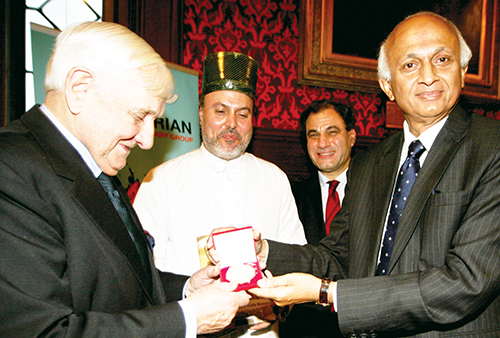
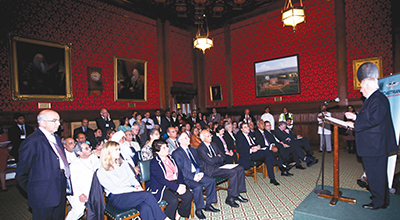
Photos: Paresh Solanki
The Zoroastrian Parsis are the only religious denomination who served in the British and Indian Army during both World Wars but are not represented at the National Remembrance Sunday service every November at the Cenotaph in London, observed Bilimoria. Whilst appreciating that the Government allowed them a single representation in 2012 on the occasion of the sesquicentennial celebrations of the ZTFE, he urged the authorities to permit a Zoroastrian representative in the next four years that will mark the centenary of WWI (from 2015-2018).
Meanwhile at the service of remembrance at the National Memorial Arboretum on March 9, 2015 to mark the centenary of the Battle of Neuve Chapelle when the Indian troops fought for the first time on the western front, wreaths were laid by the Indian High Commissioner Ranjan Mathai, Bilimoria and Deboo.
A song composed in Gujarati by Parsis of India during World War I to spite the German Emperor Kaiser is shared by Giara who has given its English transliteration and translation. He recalls his paternal grandmother, Jaiji Giara, a mother of 13 children, playing the harmonium and singing it to the tune of It’s a long way to Tiperary:
Kaiser naamna buchaji né thai aavyu bahu taan
Bandhya killa havaa maa né thai gayo mastaan
Britain, Belgium, Russia, Hindustan
Tuj motnaa samaan
Kaiser O paapee Kaiser
Poryo tu naadaan
Ghode chadyo dukto Kaiser Kasrevaj karpeen
Ghodo to bau adiyal téné modhé aavyu bahu feen
Aandhlo thai jai Kaiseré nahin joi koi khaai ke kheen
Ék bhuska ma bhaangi gayu ghodaji nu jeen
English translation:
A naughty boy called Kaiser had great stress/Built castles in the air and became boisterous/Britain, Belgium, Russia, India/Ammunition for your death/Kaiser, Oh sinful Kaiser!/You foolish boy.
The naughty boy Kaiser mounted a horse.
The horse was very obstinate, he had froth on his mouth./Being blinded, Kaiser did not see any ditch or valley./In one jump the horse’s saddle cracked.
In the compilation and presentation of this report, Parsiana would also like to gratefully recognize the cooperation of Cmde Medioma Bhada, Sq Ldr Rana Chhina and the Centre for Armed Forces Historical Research, Lord Karan Bilimoria’s office and Shernaz Cama.