
Cover Story
The banking pioneers
Odes were paid to the Indians who founded or headed Indian banks
"This type of work is pioneering in India and of immense value to our society. We have been generally lacking in a sense of history. I hope Mr Dadabhoy would oblige us and many of his admirers, with similar books soon.” So stated Dr Y. V. Reddy, chairman of the 14th Finance Commission and the former governor of the Reserve Bank of India (RBI), addressing a gathering on the launch of Bakhtiar K. Dadabhoy’s book, Barons of Banking, Glimpses of Indian Banking History at the Cricket Club of India on October 25, 2013.
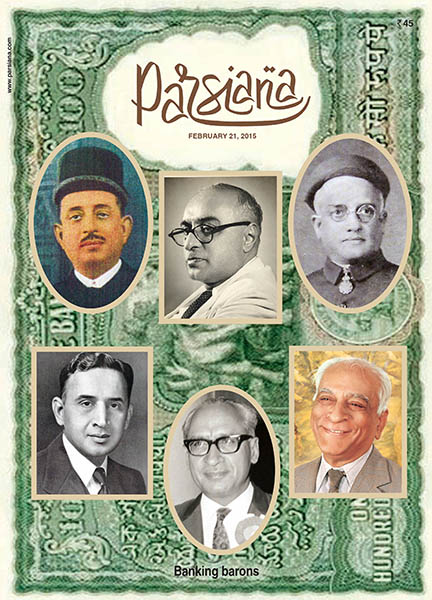
Cover: (1st row, l-r): Sir Sorabji Pochkhanawala, A. D. Shroff, Sir Purshotamdas Thakurdas;
(2nd row): Sir Chintaman D. Deshmukh, R. K. Talwar and H. T. Parekh
The 480-page tome was commissioned by the A . D. Shroff Memorial Trust and published by Random House India. The book deals with the six giants of Indian banking and finance, Sir Sorabji Pochkhanawala, Sir Purshotamdas Thakurdas, Sir Chintaman D. Deshmukh, R. K. Talwar, A. D. Shroff and H. T. Parekh as well as the RBI.
"Each of them performed different roles with a sense of dharma. These barons in the book were also human, with all the associated frailties and yet, they were great achievers and contributors” added Reddy.
He quoted from the Foreword in the book by "my friend” Yezdi Malegam, trustee of the A. D. Shroff Memorial Trust who, referring to Pochkhanawala stated, "In an era of foreign domination, and in the teeth of much opposition, he demonstrated that a bank owned and managed by Indians could successfully compete with, and even outperform, many of the existing banks which were under foreign management.”
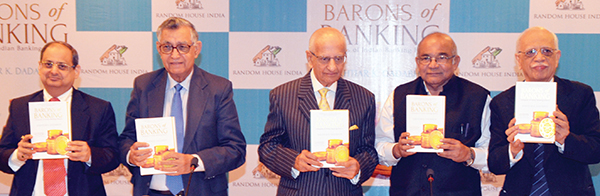
At the launch (from left): Bakhtiar Dadabhoy, Yezdi Malegam, Minoo Shroff, Dr Y. V. Reddy and Savak Tarapore
Reddy cited an advertisement in the newspapers under Pochkhanawala’s name: "A banker can render no higher service to his constituents and to the public than by teaching them thrift... The value of a rupee is never realized through earning it. Its value is appreciated through a systematic method of saving a certain part of it — no matter how small that bit is.”
In his Foreword Malegam who conceptualized the unique treatise remarked about the pioneers, "they were all men of extraordinary integrity, courage and conviction and as the pages of this book will show, national interest informed their every action.” Addressing the gathering Malegam noted, "The book is as much a treatise on institution building as about the personal struggles of the individuals contributing to the process.”
Minoo Shroff, chairman and managing trustee of the A. D. Shroff Memorial Trust noted in his message "all of them had the vision to look beyond their immediate horizon. Their sights were set high; their gaze often distant. They had the conviction to swim against the tide and during several critical periods of the last century they often ploughed a lonely furrow, while displaying courage and vision. Above all, they were men of great integrity whose principles and values were an inspiration to their peers and will continue to serve as a beacon for future generations as well.”
Speaking on the occasion, Savak Tarapore, former deputy governor of the Reserve Bank of India (RBI), referred to his first meeting with A. D. Shroff. "On glancing at my bio data he immediately offered me jobs in either New India Assurance or the Bank of India. When I demurred and said that I was joining the RBI, he frowned and said ‘Young man, you will starve, simply starve, and when you have starved enough, come back to me.’ Starved I did, but alas that was my only meeting with Shroff as he passed away shortly thereafter.”
Commenting on the book Tarapore noted, "Shroff and Malegam, as well as the author, could not have envisaged that the finished product would become the locus classic on India’s monetary and banking history. This book is a model for how monetary and banking history should be written.”
Addressing the gathering Dadabhoy, the only Parsi in the civil service to hold the rank of a joint secretary to the Government of India, currently serving as chairman, Railway Recruitment Board, Bombay, the largest in the country and an author of several books noted in jest, "Since the book I have inflicted on my readers is a rather bulky tome I will try and compensate by keeping my speech as short as possible.”
Confessing in the book’s Acknowledgements that "I know nothing of banking or banking history,” Dadabhoy told the gathering, "I have spent a happy three years in the company” of Pochkhanawala, the founder of the Central Bank of India, Thakurdas, business statesman, public figure and central banker, Deshmukh, civil servant who became RBI’s first Indian governor, Talwar, the redoubtable chairman of the State Bank of India, A. D. Shroff, economist, banker, industrialist and institution-builder, and Parekh, the man who pioneered retail finance for housing in India.
"Writing history involves organizing masses of facts into a coherent story and communicating the results in a manner which will interest more people than just the writer,” noted Dadabhoy before concluding "Even if you don’t plan on reading the book, please do buy it.” His wish was realized as Minoo Shroff noted, "It is so encouraging that 6,000 copies of the book have been sold out within five weeks of its launch.”
Maybe Dadabhoy’s next book should be on the Barons of Publishing!
Banking need not be boring
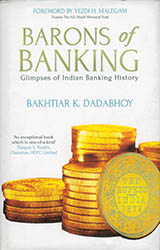 Barons of Banking: Glimpses of Indian Banking History by Bakhtiar K. Dadabhoy. Published in 2013 by Random House Publishers India Private Limited, Windsor IT Park, 7th floor, Tower-B,A-1, Sector 125, Noida 201301, UP. Pp: xxxix + 478. Price: Rs 599.
My career in banking in India was brief and unremarkable. I bring it up here only to make a point.
As a college student, during one Diwali vacation I signed on for temporary work as a cashier at a suburban branch of Union Bank. Presumably, I was filling in for a permanent staffer who was on a well-deserved holiday. For me, it was the lure of picking up a few rupees to spend. The interesting – and more challenging — part of the job was dealing with customers. The tedious part, which nipped in the bud any banking aspirations I might have developed, was staying back after the branch shut its doors to customers, when I had to laboriously tally deposits and withdrawals and undertake sundry other tasks involving entries in giant ledgers.
When I had signed on for the job, I had naively thought I would be home when bank hours ended, thus ensuring I would not miss cricket practice. So it was an annoying surprise to discover that bankers worked way past banking hours. I left the job a couple of weeks earlier than my tenure was to expire, though truth be told, my cricketing skills did not improve.
How did I get the job? I was one of several young men and women in our Parsi colony who were placed in holiday jobs at Union Bank by a fellow resident who held a leadership position in the Bank’s workers’ union. It was simple. He vouched for us. We filled in an application form. Perhaps the Bank saw us as trainees, potential future employees, and some of us did eventually make a profession of it.
As a college student, during one Diwali vacation I signed on for temporary work as a cashier at a suburban branch of Union Bank. Presumably, I was filling in for a permanent staffer who was on a well-deserved holiday. For me, it was the lure of picking up a few rupees to spend. The interesting – and more challenging — part of the job was dealing with customers. The tedious part, which nipped in the bud any banking aspirations I might have developed, was staying back after the branch shut its doors to customers, when I had to laboriously tally deposits and withdrawals and undertake sundry other tasks involving entries in giant ledgers.
When I had signed on for the job, I had naively thought I would be home when bank hours ended, thus ensuring I would not miss cricket practice. So it was an annoying surprise to discover that bankers worked way past banking hours. I left the job a couple of weeks earlier than my tenure was to expire, though truth be told, my cricketing skills did not improve.
How did I get the job? I was one of several young men and women in our Parsi colony who were placed in holiday jobs at Union Bank by a fellow resident who held a leadership position in the Bank’s workers’ union. It was simple. He vouched for us. We filled in an application form. Perhaps the Bank saw us as trainees, potential future employees, and some of us did eventually make a profession of it.
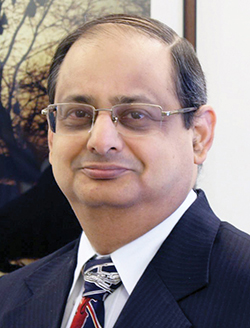
Bakhtiar Dadabhoy: writing history
This long ago episode in my life took on new meaning when I read Bakhtiar K. Dadabhoy’s Barons of Banking: Glimpses of Indian Banking History.
The book does not dwell on Parsis in Indian banking — or even only on barons of banking, as the book’s subtitle states. But as both the book and my youthful experience indicate, the history of modern banking in India is intricately intertwined with the history of Parsis in the field. In the heart of India’s financial capital, Bombay, in ways big and small, finance was once the domain of Parsis.
At least in the early days, the Parsi factor apparently was a mixed blessing. In one remarkable instance, Sir Sorabji N. Pochkhanawala, the founder of the Central Bank of India, felt impelled to "correct a wrong impression that seems to be prevalent that our Bank is a Parsi bank. We have three Parsi and three Hindu directors on the board and quite recently we have been fortunate in obtaining the cooperation of a valued Mohammedan colleague.” In that 1916 statement, with Central Bank in its infancy, he preferred that the institution be known as a Swadeshi bank.
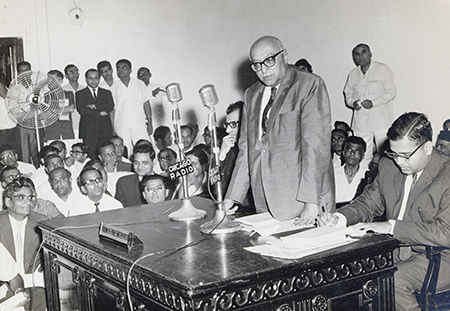
A. D. Shroff speaking at a meeting of the Forum of Free Enterprise
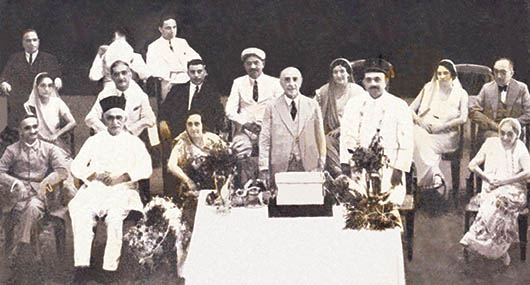
At a party given by the staff of the Central Bank of India to felicitate Sir Sorabji Pochkhanawala
(standing right) on his knighthood in 1934
As in other endeavors that began in response to the slights and wounds of colonial rule, modern banking in India owes its origin to individuals who had the cussedness and gumption to think they could do just as well as the British, or actually even better. This, at a time when they were hard put to earn the faith of even their fellow Indians. The top managers of the few Indian sponsored banks were invariably Englishmen. Indians, the unwritten rule seemed to be, were not to be trusted with the money of other Indians. This wariness was not unjustified. In that era, with banking in its infancy and regulatory scrutiny as we now know it absent, the trade seemed to draw many unscrupulous operators and runs on banks were common, ruinous and unsettling.
How, from this unfertile soil, sprang the Central Bank of India, is a heroic and almost miraculous tale, itself nearly worth the price of Dadabhoy’s book. Pochkhanawala, undoubtedly, was not the first Indian who chafed at the limits placed on his professional ambitions by an English boss simply on the basis of his nationality. He surely was not the first Indian to have the idea of a bank run entirely by Indians from top to bottom, not just at the bottom. Had he been, he would be barely a footnote in the annals of Indian banking. But ideas don’t transform into institutions just like that. They require action, backed by self-belief, sagacity, persistence, an iron will, the ability to think originally and create and inspire an effective team, and a willingness to risk all at critical turning points.
In these qualities, and the results they enabled him to obtain, Pochkhanawala was unparalleled in his day.
Had I read a book such as this one way back when I found parts of my long-ago bank job tedious, I might have thought differently of the profession.
For, interspersed in Dadabhoy’s accounts of the bureaucratic struggles over India’s wartime sterling balances and the creation of the Reserve Bank of India (RBI), and of the not-quite-independent nation’s efforts to make its voice heard over the big boys at Bretton Woods, are tales of intrigue, subterfuge, vendetta, jealousy, paranoia, conspiracy, back-stabbing and pettifogging worthy of any work of pulp fiction. Did I mention insider trading? Fairly common then, and at least one financial titan, heralded for his integrity, thought nothing of benefiting from it. Just a favor among gentlemen.
Banking, it seems, need not be boring.
A Parsi thread runs through much of the narrative. Parsis are among both, the heroes and the villains, though I use both terms loosely. Where there is a Pochkhanawala, there is also a Sir Dinshaw Wacha, an eminent economist in his own right, but at that stage of his life surprisingly crabbed and risk-averse in his views as a Central Bank director, at least in Dadabhoy’s telling.
To Ardeshir Darabshaw Shroff can be attributed the creation of one trailblazing financial institution, ICICI (Industrial Credit and Investment Corporation of India), and advocacy of two ideas that have, despite setbacks and transformations along the way, proved valuable — unit trusts to enable small savers to get a piece of the market and hire purchase. On behalf of his country, Shroff also stood his ground in a different context, earning the irritation of economist John Maynard Keynes. Later, by founding the Forum of Free Enterprise, Shroff provided a small but influential counterweight to the Nehruvian socialism of the early post-independence years.
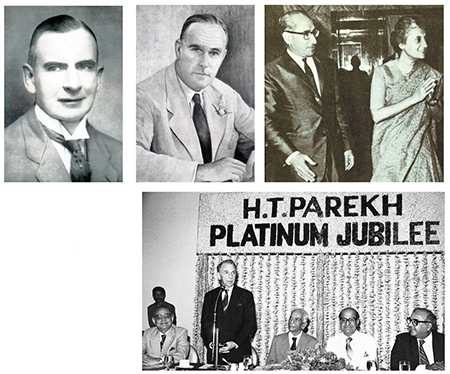
Above, from left: Sir Osborne Smith; RBI’s second governor Sir James Taylor; R. K. Talwar with Indira Gandhi
at the central board meeting in New Delhi on April 3, 1973; Alongside: J. R. D. Tata speaking at the function
on the occasion of H. T. Parekh (seated, center) turning 75. Nani Palkhivala is to Parekh’s left
Then there is the fleeting appearance in the book of the allegedly notorious Rustom Sohrab Nagarwala, who reportedly mimicked the voice of Prime Minister Indira Gandhi over the phone and persuaded a State Bank of India (SBI) cashier to part with Rs 60 lakhs in cash. The criminal fallout was quickly contained when virtually all of the money was recovered and Nagarwala died unexpectedly. But the political uproar that followed this enigmatic episode remains unresolved. Why would a bank officer so readily deliver the cash in a cloak-and-dagger fashion to a perfect stranger unless it was something he was accustomed to doing in response to known political masters?
That brings us to the one unalloyed hero in the narrative, Raj Kumar Talwar. Besides being a superb leader of the SBI, Talwar had the distinction of both entrancing and alienating Morarji Desai — and upsetting Indira Gandhi’s son Sanjay in the process because of his acts of probity and moral courage.
Two years before the Nagarwala episode Desai, who was then finance minister, was weighing whether to elevate Talwar to managing director at SBI.
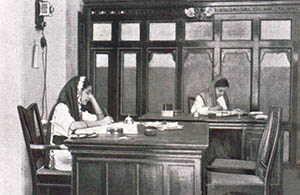
The ladies department of the Central Bank of India circa 1924
"The jute barons of Calcutta had found Talwar inconvenient as he had insisted on a measure of financial discipline. They attempted to sidetrack him by offering him the post of chief executive of the Punjab National Bank, then in the private sector, with a huge increase in salary and perquisites. Talwar, even though he was passing through a rough phase with his wife’s illness, did not oblige. (Ramnath) Goenka told this to Morarji with the aim of showing how inflexible Talwar was, but it had the opposite effect. ‘This is exactly the man I want,’ he told Goenka and approved of his appointment as managing director. One year later, in March 1969, he made him the chairman.”
By 1976, however, Talwar had alienated the powerful though unelected political actor Sanjay Gandhi by refusing to bend bank rules to favor his acolyte in the industry. Talwar, who was forced out, went to consult Nani Palkhivala, who advised him to drop the matter.
In 1977, when Desai became prime minister, some hoped Talwar would be recalled to a high position, but that was not to be. Ironically, Desai was nursing suspicions that Talwar had shielded Indira during the Nagarwala episode. The suspicions were unfounded, but Desai remained soured with Talwar.
Numerous other titans of finance stride across Dadabhoy’s narrative — Chintaman Dwarakanath Deshmukh, Purshotamdas Thakurdas, Hasmukh Parekh and, in the waning days of British rule, Sir Osborne Smith, the Australian national who was named the first head of the RBI and then became the object of machinations by his English deputy (who was not above contemplating blackmail) in part for his perceived empathy for the Indian side of things.
Dadabhoy, an experienced biographer with a background in economics, traces the long arc of Indian banking history in a voice that is generally both authoritative and engaging. While much of his book, perhaps unavoidably given its scope, relies on secondary sources, he also had personal access to people close to some key players, including Parekh’s niece and nephew, Shroff’s kin Minoo Shroff, and contemporaries of Talwar. Not surprisingly, those sections of his narrative are among the more vivid and the characters in them more rounded.
There are flaws. The reader will not know from this book just who this character Nagarwala was — there’s no mention of his military or intelligence background — or whether any effort was made to tighten banking procedures following this outrageous and improbable episode. There are other instances as well when one is left longing for more than what Dadabhoy tantalizes us with.
In the same vein, the reader is required to wade through a prolonged account of the machinations over India’s wartime sterling balances before he gets a clear explanation of why the issue mattered so much to India back then. At times, where it comes to the failings of some of the men he profiles (and they are all men), the author seems to be pulling his punches.
But it would be unreasonable to expect a concise history of a subject as sprawling as banking to be comprehensive or satisfying in every respect. Within the constraints of his mission – to provide "glimpses of Indian banking history” — Dadabhoy does a more than admirable job.
Given the nature of the subject, readers who are not banking professionals will have to traverse some lulls in the narrative. But they will be rewarded with fascinating insights into the birth and growth of an industry that is vital to the nation’s economic life, and the powerful personalities, often with strong nationalistic motivations, who have populated it at the highest levels from the beginning.
Dropping by the SBI cashier’s window will no longer feel the same.
The banking professional, especially one with ambition, should find Barons instructive and inspiring — essential reading, if not sufficient, because any one of the titans and institutions Dadabhoy depicts would merit a book unto himself or itself, and some already have that distinction.
PORUS P. COOPER
◆ ◆ ◆
From the archive