
Business
“An affirmative good”
One of the earliest proponents of private enterprise, the Forum of Free Enterprise pursues its core objectives with publication of thought-papers, public meetings and memorial lectures
"FICCI (The Federation of Indian Chambers of Commerce and Industry) had predicted that the Forum of Free Enterprise (Forum) will die a natural death,” reminisced president Minoo Shroff, speaking at a function to celebrate the diamond jubilee of the Forum on September 29, 2016 at the Tata Theater of the National Centre for the Performing Arts. Though the organization was critical of the socialist policies of the then Congress governments, he quipped "even politicians read the Forum’s publications and kept copies in their kurta pockets.” Quoting from a communication from Eugene Black, then president of the World Bank, Shroff said that the banker had sent the following message to the founders of the Forum: "People must come to accept private enterprise not as a necessary evil, but as an affirmative good.” The message in this communication became the credo of the Forum, he said.
A presentation from theater personality Alyque Padamsee, conceptualized by advertising and brand management guru Roger Pereira, scripted by Anita Sarkar and produced by director Raell Padamsee, quoted Rabindranath Tagore’s words "...into that heaven of freedom let my country awake” from his poem Where the mind is without fear. Was India really free in 1947? Alyque asked. Freedom in its truest sense came in 1991, he said, referring to the then government’s economic reforms. Alyque ascribed the reforms to work done by bodies like the Forum which "campaigned for awareness for freedom for all businesses from bribery and corruption which were throttling the Indian economy.” Alyque reminded the audience about the extremely well attended annual commentaries on the Union Budget presented by jurist Nani Palkhivala, who served as president of the Forum from 1968 to 2000. Industrialist Nadir Godrej read out a poem The guardian of liberty, composed by him on the history and achievements of the Forum, which was announced as the surprise of the evening. (Prime Minister) "Nehru had a socialist bent/And that’s the way the economy went./Heavy industry was prized./Some sectors were nationalized./The Government seized the commanding heights/Not much was left for lesser lights./And where they were allowed to play/Impediments came in the way,” he recited, giving the background in which the Forum functioned.
A presentation from theater personality Alyque Padamsee, conceptualized by advertising and brand management guru Roger Pereira, scripted by Anita Sarkar and produced by director Raell Padamsee, quoted Rabindranath Tagore’s words "...into that heaven of freedom let my country awake” from his poem Where the mind is without fear. Was India really free in 1947? Alyque asked. Freedom in its truest sense came in 1991, he said, referring to the then government’s economic reforms. Alyque ascribed the reforms to work done by bodies like the Forum which "campaigned for awareness for freedom for all businesses from bribery and corruption which were throttling the Indian economy.” Alyque reminded the audience about the extremely well attended annual commentaries on the Union Budget presented by jurist Nani Palkhivala, who served as president of the Forum from 1968 to 2000. Industrialist Nadir Godrej read out a poem The guardian of liberty, composed by him on the history and achievements of the Forum, which was announced as the surprise of the evening. (Prime Minister) "Nehru had a socialist bent/And that’s the way the economy went./Heavy industry was prized./Some sectors were nationalized./The Government seized the commanding heights/Not much was left for lesser lights./And where they were allowed to play/Impediments came in the way,” he recited, giving the background in which the Forum functioned.
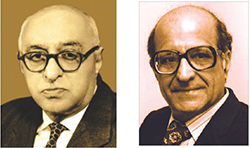
(L) A. D. Shroff, (r) Nani Palkhivala
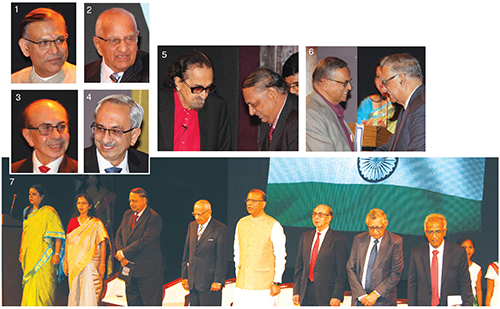
1) Jayant Sinha; 2) Minoo Shroff; 3) Adi Godrej; 4) Nadir Godrej; 5) l: Alyque Padamsee, (r) Homi Ranina;
6) l: Anand Limaye, (r) Yezdi Malegam; 7) Dr Amita Sehgal, Swati Kapadia, Ranina, Shroff, Sinha,
Adi Godrej, Malegam, S. Divakara
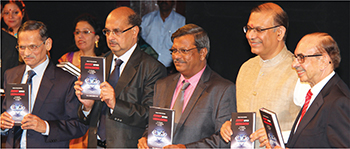
Sunil Bhandare, Dr Chandrahas Deshpande and Raghavendra Katoti,
Jayant Sinha and Adi Godrej; book cover
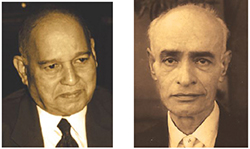
M. R. Pai and Murarji Vaidya
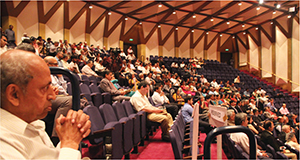
Audience
A self confessed admirer of the Forum, chief guest for the evening, minister for civil aviation Jayant Sinha of the pro-business Bharatiya Janata Party, said, "It is now India’s turn to be (a world) leader … (the country) would leave China far behind.” Delivering an address titled "India’s development model – a new paradigm for global economy,” the minister said that India’s development is "not at the cost of depletion of natural resources.” Sinha, who earlier held office as minister of state for finance, prophesied good growth rates for the Indian economy in the coming decade. Quoting that China uses 52% more energy per unit of GDP (Gross Domestic Product) than India, and three to four times more steel than our country, the minister added that India had a "healthy debt to GDP ratio as compared to other economies.” Appreciative of the e-commerce giants and various research and development bodies that have taken center stage lately in the Indian economy, Sinha highlighted the steps taken by the government towards financial inclusion. Now that the stage is set, he said, the focus will be on "last mile problems … to ensure seamless digital delivery systems.” It was the government’s responsibility to eliminate poverty, "and therefore the government supports free enterprise,” he said.
While introducing the minister, Homi Ranina, vice president of the Forum, highlighted the minister’s achievements, making reference to him being among the youngest graduates (at 21) from the Indian Institute of Technology, Delhi, and took the audience through his remarkable career with consulting firm McKinsey and company, and investment firm Omidyar Network.
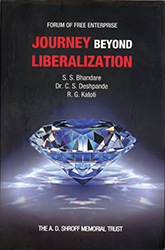
Journey beyond liberalization, a book authored by Sunil Bhandare, Dr Chandrahas Deshpande and Raghavendra Katoti comprising 250 pages and published by The A. D. Shroff Memorial Trust (ADSMT) was released on the occasion by industrialist Adi Godrej, vice president of the Forum. The book, said Adi, validates the Forum’s belief in the power of free enterprise. "The more free enterprise is introduced, the higher is the (economic) growth,” he stated.
The evening’s compere Dr Amita Sehgal, honorary secretary, All-India Bank Depositors’ Association traced the history of the Forum. She reminded the audience that the founding-president, economist and banker A. D. (Ardeshir Darabshaw) Shroff, convinced of the need to protect free enterprise in the country, played an important role in strengthening India’s democratic structure. "The launch of the organization on July 18, 1956 was hailed by many as India’s second freedom movement,” she said. The year 2016 also marks 50 years of the establishment of ADSMT, set up in memory of "India’s sage of free enterprise,” she informed the audience. Tributes were paid to Muraiji Vaidya who served as president of the Forum from 1965 to 1968 and M. R. Pai, the secretary of the Forum till 1976 and later vice president till 2003.
A vote of thanks was proposed by Yezdi Malegam trustee of ADSMT.
The Forum’s concept of free enterprise has been one with a social purpose, states their website. It has stood for every individual in the country having the largest scope to make a contribution within the framework of planned development through his/her initiative and enterprise, it continues.
A souvenir titled Historic landmarks published by the Forum conjointly with ADSMT states that "in the formative stages … the founding fathers increasingly came to realize the growing ineffectiveness of political parties in articulating the cause of liberal economic thinking and free market economy in India.” The Forum is among the first to organize public meetings with a view to educating the public and creating informed public opinion on the failure of the government’s economic policies, the souvenir states. Since the early 1970s, they have arranged over 260 programs pan-India for company professionals on taxation, company law and other legislations. A 25-member council of management set up for the period 2014 to 2017 manages the working of the Forum, with S. Divakara as director-general and Swati Kapadia as director.
The first body to prepare a Code of Conduct for business and industry in 1957, in recent years the Forum has arranged programs on this subject with a view to highlighting the need for companies to assume greater social responsibility and also with a view to creating credible corporate citizenship.
◆ ◆ ◆
From the archive