
Business
Houses in the hills
Nilgiri Herbs develops and builds premium properties in the Nilgiris
We are in the Nilgiri mountains, 6,500 ft up on the Pemberley estate above the cantonment town of Wellington and the scenery is spectacular. The regal, red-roofed structure of the Madras Regimental Centre, home to one of the oldest regiments in the Indian Army, lies in the direct line of vision below, its vast parade ground standing out as the single white space amidst the lush green of the tea gardens sloping down on all sides. Tall pines, eucalyptus and wattle stand silent as the sun slips away behind yonder blue mountain. The bane of urbania is far away, peace is pervasive!
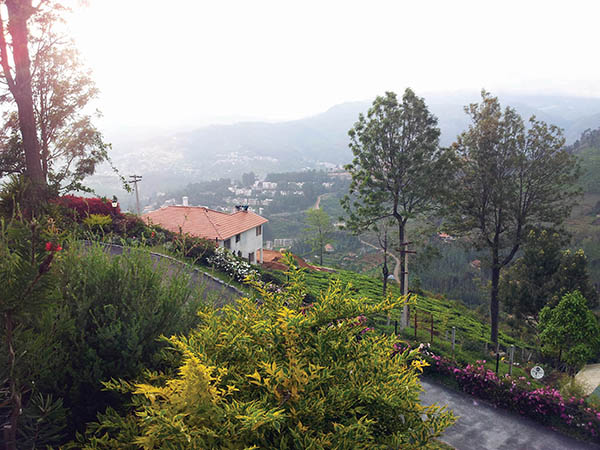
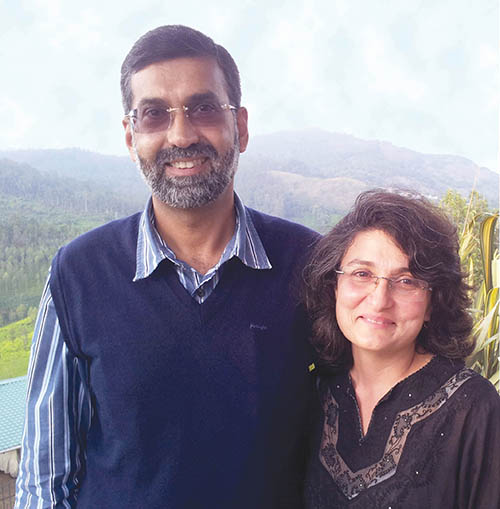
Kaiwaan and Binaifer Patel and (top) panorama from Pemberley estate
"Pemberley is my first and flagship project,” says Kaiwaan Patel, director of Nilgiri Herbs Private Limited, builders and developers, as he drives us, at our request while on a visit to nearby Ooty, around the steep slopes of the estate in which around 30 bungalows have been built for clients over the past few years and others are taking shape. "We have our own water system. Our wells feed our estate. All internal roads are laid by us. We built our own home here. I have a fairly large staff and every home is custom built. The bungalow plots belong to the owners,” he explains. Interspersed among the bungalows are small patches of tea gardens which he takes care of. Nilgiri Herbs builds quality homes in the region, taking care of the entire home buying process — from selecting a suitable plot to securing official sanctions and approvals, preparing the plan, completing and handing over the bungalows to the customers as per their requirement.
Originally from Bombay, Patel made the Nilgiris his home 18 years ago. "Our family’s connection with the area goes back to 1946-47. My grandfather Tehmasp Patel bought a house in Ooty which he owned till the 1960s. In the late ’70s, my father Rusi, though living in Bombay, bought a property in Coonoor as a holiday-cum-retirement home. He visited Coonoor frequently and thought he would get into the business of trading or growing of herbs to keep himself busy. So the firm Nilgiri Herbs was incorporated by him,” he narrates the background of the business. In 1995, Kaiwaan and his wife Binaifer came to Coonoor for a holiday from Nagpur where they had been living for a couple of years. "We were a little bored on the holiday. We roamed around as Dad was looking for land for a friend. We thought it was a nice idea to buy land, divide it into plots and sell. We did some rudimentary sums and all of a sudden things started moving! We asked Dad to do the deal but he said ‘No, I’m retired. You come and do it!’ so we decided to come here.” As Nilgiri Herbs already existed, the deal was concluded and the blueprint of business established.
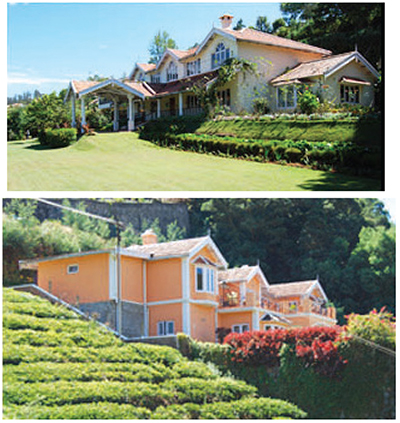
Nilgiri Herbs’ projects Photo courtesy www.nilgiribungalows.
"People have put their faith in us. Our first client was my childhood friend Feroze Shapurji from Nagpur. He had never been to Coonoor and did not even see the site selected for his bungalow! Pemberley was the first piece of land we bought. It is tougher to build here in the Nilgiris than in the plains. There are a lot of rules and regulations. The Nilgiris being an environmentally sensitive hill district, rules are strict in order to preserve the beauty of the place in the best way possible,” he asserts. "People from the plains come here and see land. Prices that we think are very high appear low to them. They buy acres and acres and chop it up into small plots. This has attracted the government’s attention. I anticipate things will get tougher.” While hotels have mushroomed, there are also a lot of "day trippers” who drive up just for the day. "They litter the place and are not bothered. They don’t give employment (to the locals) as other tourists do,” he adds.
Nilgiri Herbs seeks to blend beauty with green functionality. "As a social responsibility the organization is committed to replanting trees wherever the need to clear area for construction so demands. It is also committed to environment friendly products, including home lighting, water storage and external solar heating options wherever possible,” states their website. "Organized construction in the hill district is more imperative than in most other locations, largely because of environmental implications. The choice of location, its elevation, gradient and soil properties among others, is a critical aspect… With the Nilgiris’ enchanting topography, choice of land must also include scenic locales.” The firm’s ongoing projects are located at Attadi, 3.5 km from Coonoor and at Allakarai which is 12 km from Coonoor as well as Kotagiri.
The Patels’ own home encompasses a pretty garden and gracious living, in serene surroundings. "Yes, there is wildlife around. We have seen bison and bear,” says Kaiwaan matter-of-factly. "It took me awfully long to adjust to life here in the Nilgiris!” smiles Binaifer who was born in Ahmedabad, spent her childhood in Nigeria where her father was working as a textile engineer, then moved to Bombay. "Life was lonely, the evenings particularly were long and full of boredom. Our daughter Meher, now 22, was three years old when we came here and Tiraan, now 19, was just one. They did their schooling here. Meher is presently at university in the UK, studying international relations and history. Tiraan is in his first year at H. R. College in Bombay. But this is their home. They definitely consider this their home!” Among her other activities, Binaifer works as a volunteer at a free clinic for the poor in Coonoor run under the aegis of the University Women’s Association.
There are a number of Parsi-owned homes here (in the Coonoor area), more than in Ooty, the couple inform us. "Some have been inherited by Parsis living in Bombay and elsewhere and they are regular visitors. Field Marshal Sam Manekshaw’s house is here. I look after it,” says Kaiwaan. The permanent Parsi population in Ooty and surroundings is meager, the oldest being a 95-year-old lady. "We have two functions a year — on Jamshedi Navroz in March and Parsi New Year in August and we do try and meet. There is no formal jashan in the Parsee Zoroastrian Anjuman hall near the aramgah. Eddie Sethna or Yasmin Kothavala say the prayers or something is read out from the late Noshir Vajifdar’s book. The yearly membership fee of the Anjuman is Rs 1,500 and we are really in need of funds,” states Kaiwaan who is on the Anjuman committee. "I’m not dogmatic in my religious views. I believe we must move with the times and at the same time not sacrifice the various traditions and mentalities that make us what we are.” As we say goodbye and walk through the porch towards our vehicle, the fragrance of loban being taken around the Patel household every day at sunset accompanies us out into the night.
His cup of tea
"I loved every minute of it, in every way. My first base was Ooty. The plantation was 42 miles away, very wild and remote. There were no telephones, no electricity, just gas lights. We had a fridge that worked on kerosene. You had to trim the wick to perfection! The upper areas which had the tea factory had the HT (high tension) lines and generator. Our quarters were seven miles away and 1,000 ft below, at an average height of 3,500 ft,” describes Jimmy Kamdin, man of the mountains, who worked for 40 years on tea and coffee plantations in south India.
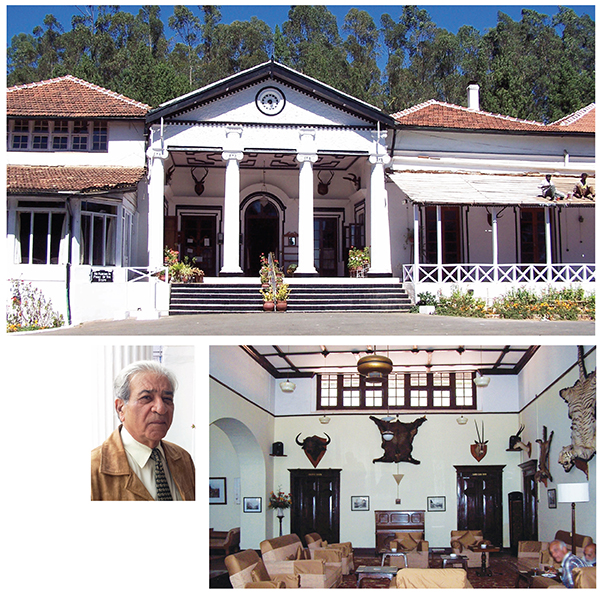
Jimmy Kamdin and exterior and interior views of The Ootacamund Club
Kamdin is presently the secretary of The Ootacamund Club, popularly known as the Ooty Club, having joined it in 2010. "I am very lucky and proud to work for an exclusive and old club like this, perhaps one of the oldest in the country,” he tells us as we chat on the Club premises while on a visit to Ooty. The 173-year-old pre-Independence Club has retained its colonial character. Treasured trophies — heads and skins of tiger, leopard, bear, sambar, nilgai, Indian gaur — stare down at us as we walk through the different rooms. Kamdin himself is a treasure trove of information! "Some of these trophies were presented to the Club 100-120 years ago. We even have an 1892 head of a Marco Polo mountain goat from the Andes. We have the original of a letter written in 1939 by Colonel Sir Neville Francis Fitzgerald Chamberlain (not to be confused with the British Prime Minister of the War years) who is said to have invented the game of snooker in 1875 while serving with the British army in Jubbulpore (Jabalpur). Chamberlain formally finalized the rules in 1884 while posted in Ooty. The original table is still with us as well as a spectator bench in showroom condition! Lord Macaulay made the first drafts of the Indian Penal Code in the Ooty Club.” Macaulay reportedly travelled the 400 miles between Madras and Ooty around 1834 carried on men’s shoulders in a palanquin! The building in which the Club is situated is said to have functioned as a hotel around that time and it was rented for a short period by Lord William Bentinck, governor general of India who was in the salubrious clime of Ooty at that time.
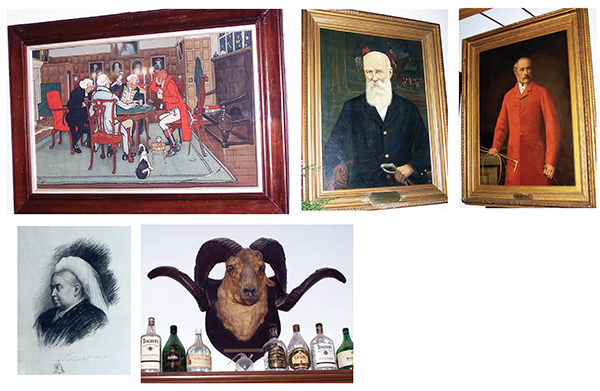
Above: Preserving the Club’s historical past
Reminders as well as a few rules of the Raj remain intact! The furniture is rosewood, walls are paneled, floor is parquet. All around are vibrant pictures of war and peace, the charge of light and heavy brigades, the horses, hounds and the hunt, bringing history alive for those who know little about the past. "Many members from affiliated clubs especially from England come here in search of their roots. There is a young lady from England who is going to digitize our old photos free of cost. There is loads of history here.” Kamdin points to an old matchlock musket on the wall and informs us that three people were needed to wield it!
The Ooty Club, he says, is essentially a social club, with no sporting facilities except billiards and table tennis. The membership profile is mixed. "The majority are outside members. We have affiliations with a few clubs in India like the Royal Bombay Yacht Club, Madras Club, Bengal Club, Royal Umaid Club (in Jodhpur) and, more recently, the Willingdon Club in Bombay. That is what we want to keep.” Facts on fingertips, Kamdin runs through the names of affiliations outside India — The Royal Overseas League, London, the Princeton Club, New York, The Ipoh Club, Malaysia, the Muthaiga Club, Nairobi, etc. "The Club is doing exceptionally well, not in terms of profit. We are a Section 25 (non-profit) company so there is no question of profit or loss. Accumulation goes into regular maintenance. This building has no cement. It’s all mud mortar with limestone. It has to be maintained. We have well appointed residential rooms which are fully booked, particularly during Dassera/Divali/Xmas…” The Nilgiri Parsis have had a close association with the Club. "Kaiwaan Patel is the present president. He took over at the last AGM (annual general meeting) in September. Feroze Chinoy and Eddie Sethna are on the committee.”
Kamdin recalls the Parsi planters of earlier days. "There were so many of us! Noshir Sethna, Siasp Kothavala, Ariez Kothavala, Chinoy, Homi Dhunjibhoy, Noshir Tarapore, Parvez Kapadia from Poona, Zubin Kothavala, Dinshaw Daruwalla, Hector Kothavala, Rusi Dastoor… The planters from three states — Kerala, Tamil Nadu and Karnataka — would meet at the annual UPASI (United Planters Association of South India) conference in Coonoor. That would be preceded by one full week of sports activities. I was a sportsman all my life. I played in the nationals in badminton at the time of Nandu Natekar, Satish Bhatia and other well-known players and represented central zone for badminton. I had a record seven years running as badminton champion at the UPASI sports. I was also on the executive committee of UPASI sports in 1968-69.”
Work was very competitive, he remembers, but they had a good social life. "Every planting district had its own club and it was mandatory to use the club during club days for sports, dances, exchanges from other groups, etc. I have worked with five British bosses. They would have loved to live here (in India) longer.” Labor trouble, if it occurred, would be against the company, never the individual, he says.
Having worked with the Bombay Burmah Trading Corporation for 36 years in different locations, there is little Kamdin does not know about tea and coffee! "I took my profession very seriously. When I joined Bombay Burmah, which has plantations in south India and Tanzania, I was posted to their property in Coorg. The best part was that in Coorg there were a handful of corporate plantations, the rest belonged to Coorg families. It was a very adventurous time. While I was with the Mudis group (the largest among the Bombay Burmah estates) we won two international coffee awards — for organic coffee and specialty coffee. The tasting was done in Chicago by a panel of world famous coffee tasters.” Bombay Burmah, which is a Wadia Group company, came into existence as far back as 1863 and is the second oldest publicly quoted company in India.
Kamdin retired from Bombay Burmah in 2006 and settled in Bangalore. "Within three months one of my friends asked me if I would help him run a nature resort called Jungle Hut in Masinagudi (in the Mudumalai Tiger Reserve). I was there for three-and-a-half years and very much enjoyed it!” Leaving the job in 2009, Kamdin was visiting his son in Dubai when a friend called him to ask whether he "would consider looking after the Ooty Club. ‘I’ll give it a try,’ I told him and that’s how I’m here, busy and active, seven years after retirement!”
Born in Jabalpur in 1943, Jimmy did his schooling and masters in English literature from Robertson College in that city. His father Tehmurasp worked for the Holkars but later settled in Mhow. His mother Kumi came from the Master family in Jhansi who were with the railways. "My aunt Dr Ala Kamdin lived in Jabalpur. She was the first lady doctor, a graduate from the Delhi medical college, to have come to Jabalpur to work in the cantonment hospital in 1925. My father died in 1964 rather young. Mother died at 95 and is buried in the Ooty aramgah. She was with me on the plantations. Since there was no priest, I prayed at her funeral.” Of his three children, son Zurath is an interior designer in Hongkong and also into the restaurant and catering business, daughter Turanz Martin Grace works and lives in Goa with her British husband who is an architect and young son Adrian Farhan. Younger daughter Katayun is a research student in Berkeley, USA doing her PhD in particle physics. "Yes, numbers are shrinking but a lot depends on acceptance and avoiding dogmatic rules,” he asserts forthrightly. The Parsis, he believes, will never disappear. "I am very confident we will never become a tribe. We are a community.”
◆ ◆ ◆
From the archive