
Business
Nilgiri flavor
Monkeys sleep in the surrounding trees at night and raid the fruit bowl in the dining room if the balcony door is inadvertently left open! A tawny cat pads in silently at teatime. The Kothavalas’ house, embellished with original Nilgiri stone, sits snug into the contour of the hillside at Kotagiri. The serene vista from the verandah sweeps the rugged Blue Mountain range (the Nilgiris), with its swathe of tea bushes, interspersed with tall silver oak and eucalyptus trees and dotted with small settlements.
"My plantation comes under the category of ‘small grower.’ I grow mainly tea, besides coffee and pepper which is an intermediate crop, a vine which grows on the trees (Grevilleas) which are planted in between the bushes for shade,” says planter Zubin Kothavala. "One has to love agriculture, love to be out all day. It is not paying, but very satisfying.” There is no guaranteed financial return like a salary at the end of each month, there is no tension either of being out of employment! A poor monsoon, damage by pests or wild animals can reduce income to a variation as high as 70 percent, he explains. "The tea leaves are sold to factories which pay us weekly or monthly on a fluctuating market rate,” he adds.
Kothavala is a man to the mountain born! Originally from Poona, he left his hometown in 1964 straight out of college to join Malayalam Plantations, a British company that had the largest planted area in south India, with estates ranging from 600 to 3,000 acres. "The company had mainly tea and rubber and my first 13 years in ‘God’s own country’ (Kerala) was an experience where I grew from nothing to what I have today,” he says. "I am the fourth Kothavala in the plantation line; one more did join after I did, but now I’m the only one. I could never imagine myself doing a nine to five desk job and that was the main reason why I took to outdoor life. There were a number of Parsis in those days, now there are less than five.”
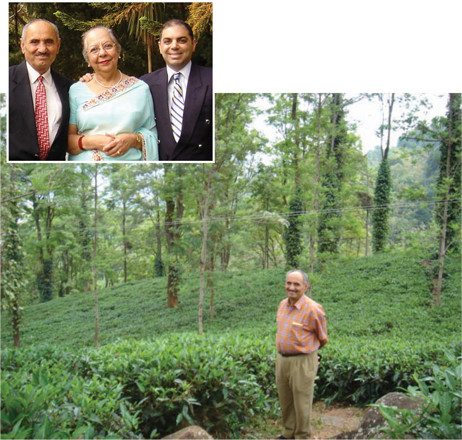
Below: Zubin Kothavala in his tea estate and (alongside) with Yasmin and Zavareh
"Zubin and I are the only Parsis in Kotagiri. We came here 31 years ago!” smiles his wife Yasmin. "We are very lucky to be able to live in the Nilgiris. Kotagiri is supposed to have the second best climate in the world. It is pollution free. No houses have fans as none are required at any time of the year.” Fully involved with the local people in citizen’s forums and NGOs (non-governmental organizations), Yasmin says the "warmth, hospitality and friendliness of the people is remarkable. They have accepted us, as they do all who come here, irrespective of community or religion.”
The march of civilization has not, however, left Kotagiri untouched. In the late ’70s, purchasing vegetables meant the rustic hustle and bustle of the Sunday ‘shandy’ (market)! "Now there are plenty of shops all over. Earlier after 8.30 p.m. there were very few people or vehicles on the road. Now after 10 p.m. one finds hardly anyone on the road and the vehicles are mostly lorries transporting tea leaves to the factories,” she explains.
Taking a trek through time, Zubin relates: "We were married in 1968 and the wife, who was from Bombay, found it very difficult initially adjusting to plantation life. But she did well very soon. Our son Zavareh was born in 1969 and we had to send him to boarding school from the time he was four — first to Lena School, then to Lawrence School, both at Lovedale, a few miles out of Ooty.” Three months at home and nine months at school for a period of 14 years trained the lad to stand on his own. At 17, he worked towards scholarships and entrance to Trent University in Canada entirely on his own, narrates the father. "I still had to raise Rs 50,000. With the Canadian dollar at Rs 10, it was very difficult,” he recalls.
Zavareh went on to do a PhD in atmospheric earth science from Macquarie University in Sydney, Australia. He then worked at Yale University in the US and is currently a research scientist at the University of Montreal, Canada and tries to meet his parents once a year. "On my visits, I am still allured by the lush green vegetation, the mild climate and the unpolluted air of the Nilgiris,” Zavareh told Parsiana on the e-mail.
Zubin’s estate is situated about 14 km from his house and the planter uses the town transport to get there and back every day. Maneuvering mountain roads for a trip to Ooty, Coonoor or even Masinagudi, 35 km away (where a branch of the Kothavalas have run the Bamboo Banks Farm for decades) is all in a day’s work, even if rain and thick mist are traveling companions! "Zubin is very adept with his hands. He did the electrification, plumbing and some of the carpentry for this house himself,” says Yasmin. Having put in place a rainwater harvesting system, Zubin lifts a lid in the floor of his workroom to show us a large water storage tank below. Water shortages do not affect them. "When the town water supply had broken down for over a month, I never had to transport water. For six months, I turn off the town supply, using only rain water,” he states.
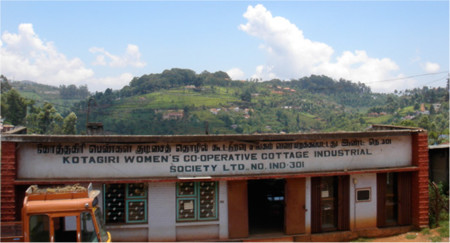
Family welfare at the Kotagiri Women’s Co-operative
The plantation trail has made the Kothavalas hardy and independent. "Earlier, it was lonely living. Though we had big, furnished bungalows, marketing was once a week. Kerosene-run fridges had a habit of stopping without warning. So you had to eat up all the meat or feed it to the dogs!” the planter reminisces. The mini generators were allowed to be run only from seven to 11 p.m. Newspapers arrived in bunches every four days, there was no telephone or TV; the transistor was their ear to the world!
"Our job as young assistants was to be out by seven a.m. to organize the labor force for the day, then supervise that it was done, irrespective of the weather,” Zubin describes. Clerks were available to do the number crunching for calculation of wages, but the assistants were made to do it as part of the learning experience. "It was one of the jobs I hated because of the long method of calculations… Today computerized programs do specialized jobs.” Fieldwork, law, factory engineering, purchase and sales — all round training ensured that the young men were turned into true brew planters! "It was the last years of the British raj lifestyle that we were fortunate to experience. Today planting has completely changed. No more solitary living, depending directly on interests like reading, gardening, hunting…”
"Social life in the Nilgiris consists mainly of meeting friends and of course going to the various clubs,” Yasmin states. For 11 years she was honorary vice president of the Kotagiri Women’s Cooperative, an NGO that helps the Toda tribal women as well as other poor women supplement their family income by taking orders from the Cooperative and working in their own homes. "I enjoyed it as it gave a sense of satisfaction knowing that one can give something back to society,” she says. Yasmin is also on the committee of INTACH (Indian National Trust for Art and Cultural Heritage). "This society helps to preserve and restore heritage sites and was successful in renovating the Fern House in the well-known Ooty Botanical Gardens as well as saving the Ooty Court house (a heritage structure) from being pulled down and being replaced by a modern concrete monstrosity,” she narrates. Honorary secretary of the Kotagiri Citizens Forum for the past 18 years, Yasmin feels "life here is quite fulfilling, never dull.” The NGO, a non-political, non-sectarian voluntary organization that deals mainly with civic problems — water, roads, garbage clearance — brings to the notice of the state or central government deficiencies or needs of the area. "Now with the Right to Information Act 2005 in force, it helps to get things moving,” she asserts.
Life in a metro arrives each winter when they visit Bombay and Poona. "My father had a motor car workshop and petrol pump at the place where the Wonderland Complex stands today on Main Street in Poona. Dad had a house in Koregaon Park, one could cycle on the roads without encountering any traffic. All these bungalows have changed to multi-storied housing complexes. I have a sister in Poona besides several cousins whom I meet once a year. My father was the youngest of seven siblings. The Kothavala family was very united,” Zubin recalls the early gateposts.
◆ ◆ ◆
From the archive