
Education
Academic aspirations
The recently launched “Seekho Parsi” initiative aims to give a boost to education for youth in the community
A new effort to inculcate academic excellence amongst Parsi students tentatively titled "Seekho Parsi” (SP) was launched at a meeting in the Bombay Parsi Punchayet (BPP) boardroom on the afternoon of December 11, 2014. Formed by various community activists and those associated with education, SP will conduct a professional, sociological survey amongst Parsi youth to ascertain their educational and occupational requirements and aspirations.
In the past coaching classes launched by the BPP to prepare students for the government and military services came a cropper, noted BPP chairman Dinshaw Mehta. Hence the need to first ascertain what the students want rather than offer them coaching in areas they are not interested in pursuing. Farzan Mazda of Dahanu, who teaches at the N. B. Mehta College of Science and Commerce in Bordi and the Symbiosis College of Arts and Commerce in Poona, claimed that Parsi students "don’t want formal coaching classes.”
In the past coaching classes launched by the BPP to prepare students for the government and military services came a cropper, noted BPP chairman Dinshaw Mehta. Hence the need to first ascertain what the students want rather than offer them coaching in areas they are not interested in pursuing. Farzan Mazda of Dahanu, who teaches at the N. B. Mehta College of Science and Commerce in Bordi and the Symbiosis College of Arts and Commerce in Poona, claimed that Parsi students "don’t want formal coaching classes.”
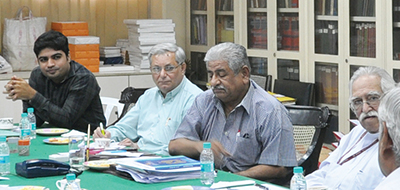
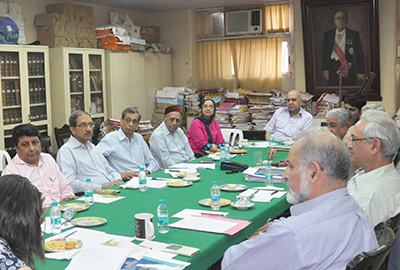
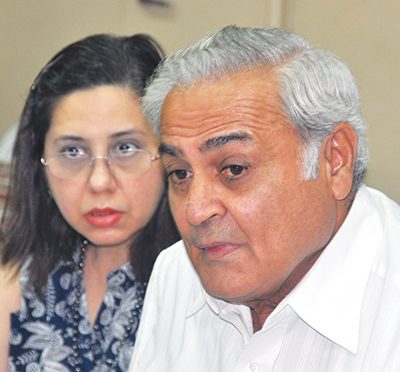
(From left, top): Farzan Mazda, Cawas Panthaki, Dinshaw Mehta and Dadi Mistry;
(above) other dignitaries in the BPP boardroom;
Dr Zinobia Madan and Noshir Sabawalla
Mehta told the gathering of 14 representatives that the trust will fund the initial cost of the survey. But implementation of the program will be left to the SP committee headed by Farrokh Rustomji, chief executive officer of the R. D. Sethna Scholarship Fund, Adi Engineer, former managing director of Tata Power, and others.
"We (BPP trustees) are busy fighting amongst ourselves… don’t depend on the BPP for implementation…The committee should function independently of the BPP,” Mehta counselled. Let independent persons serve as convenors.
The subject of reservations in Parsi funded institutions was raised and author Marzban Giara prepared and distributed a comprehensive list of such institutions. He felt the community should seek legal counsel on obtaining reservation for Parsis in these establishments. Dadi Mistry, the Parsi representative on the National Commission for Minorities said they could approach the government "with firm projects.” Dinshaw Tamboly of the World Zoroastrian Organisation Trust Funds and a former BPP trustee recalled that in 2005 four seats were reserved in a dental college in Mangalore through the efforts of Dr Porus Turner. The BPP offered to finance 50% of the four lakh rupees fee. Around 20 applicants along with their parents met the trustees, he recalled. The mothers did the talking, voicing their concerns over sending their children so far away. "Not a single child went,” lamented Tamboly. Similarly, in 2006 no one availed of the offer though in 2007, some did.
Tamboly noted the number of students applying to the joint educational trusts committee to study abroad had shrunk from 70 to 80 in the past to less than 20. BPP trustee Khojeste Mistree believed this was on account of the high costs, ranging from 30 to 40 lakh rupees per annum, for overseas studies. The funds allocated by trusts were not sufficient to cover the costs, he observed. Tamboly said funding was basically required for the first year after which students managed to avail of assistance by working, teaching and/or bagging scholarships. Rustomji noted that the Sethna trust gives "10 lakh rupees (US $ 15,835) maximum to Parsis” for overseas studies. Noshir Sabawalla of the Gharda College in Navsari noted that students still want to go abroad while Rustomji added one reason for this was they "want to migrate and settle down… They don’t want to work hard for (Indian college) entrance exams.”
Publisher Maneck Davar remarked that young Parsis today had few intellectual interests. Unless a love of learning was inculcated from an early age "by the 10th standard they would have lost the race.” Another participant pointed out that most baugs and anjumans do not have libraries, not even a book case or even a shelf of books. Mistree noted that the religion classes "don’t take priority” as children are so pressured with homework, private tuitions, etc.
Sabawalla said that from an early age children should be identified as having potential or not: "Hiro chè ké kiro chè” (is he/she outstanding or not). Sabawalla noted that in colleges that are self-financed and not dependent on government grants, Parsis "can buy seats.” One could negotiate rates. Parsi trusts could help to finance students in such colleges.
A suggestion that Parsis should build schools and colleges on the property in their possession was dismissed by Mehta as "being theoretical.” When it was pointed out that Parsis were the pioneers in female education and should once again take the initiative to create new institutions, Mehta was unmoved.
Engineer noted that the mindset of students has to be changed. Sometimes "parents discourage enterprise,” he observed.
Others present included Pearl Mistry and Dr Zinobia Madan of the Jiyo Parsi scheme and BPP senior executive Cawas Panthaki.
◆ ◆ ◆
From the archive