
Education
Training the trainers
The Bombay Parsi Punchayet invites the community for a brainstorming session on education and youth policy
Mentoring, networking and counseling to improve the communications skills, grooming and attitudes of Parsi youth emerged as the key areas of work for the Bombay Parsi Punchayet’s (BPP) youth committee at a meeting hosted by BPP trustee Jimmy Mistry at his Della Tecnica boardroom on December 30, 2008. Participants at the day-long brainstorming included BPP trustees, principals and some teachers of Parsi schools as well as volunteers of Mistry’s Parsi Resource Group (PRG).
The creation of a database of Parsi-Irani Zarathushtis has been recognized as the starting point of the exercise. Enunciated by Mistry during his electoral addresses, such a directory is expected to be posted on the internet. A subset of this exercise is another database of Parsi school-going children to be created with the help of school principals. This listing could be matched with another one consisting of persons willing to mentor/volunteer in various fields for the benefit of the community. This has been accepted as the PRG’s field of endeavor.
Simultaneously the BPP trustees are expected to meet with CEOs and other influential people of the community on a regular basis — monthly breakfast meetings have been suggested — to ascertain their feedback and promote cooperation with suggestions of apprenticeship in various facets of the economy. The BPP as well as Parsi schools are expected to encourage children to avail of the information on the forthcoming websites.
Once the potential beneficiaries and trainers are short-listed, the glaring lacunae in the language skills, sense of etiquette, behavior and grooming that have been jointly identified will be addressed. It was noted that Parsi children from middle and lower middle class homes often reach school poorly attired, that they have no idea of appropriate dress demanded by the occasion and are generally unmotivated.
That the community lacks "fire in the belly” to compete at the many levels that today’s environment necessitates has been noted before. It was stated that students were not even motivated to attend the coaching classes started by the BPP in the past. This laid-back attitude that has percolated to the youth of the community is now sought to be countered by aptitude tests and motivational training. The fact remains however that there are not enough motivators to do the job and professional training is required to "train the trainers.”
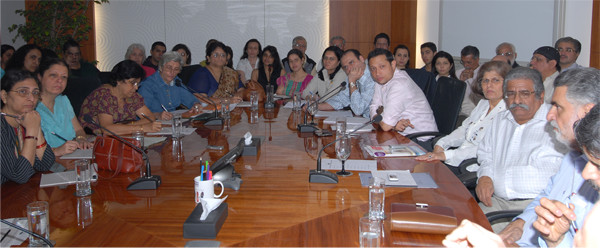
Brainstorming in the Della Tecnica boardroom
To rev up a sense of purpose it was suggested that motivational seminars be held in the baugs, community achievers be awarded, career options and role models provided, new opportunities and emerging work fields showcased. Leadership camps and vocational training including plumbing, construction and electrical engineering were also suggested.
Underscoring his perspective that community identity needs strengthening, BPP trustee Khojeste Mistree blamed a "very divisive Press (for making) young people feel it is not good to be orthodox.” He noted the need for a database and mentors "willing to commit themselves to community work.” Critiquing the large sums of community funds that enable the cream of the community to go abroad for specialized education but who fail to later respond to community needs, Mistree said, "We have become a community of takers.” He cited the example of people enjoying large accommodation in the baugs who left him aghast when they resisted an increase in rental charges of Rs 15 — a complaint made over and over again by BPP trustees over the years.
In his presentation Mistree gave full support to the idea of BPP inputs into community sports and felt that sports and academics have to be balanced. As his Zoroastrian Studies regularly holds classes in religious education in Parsi schools, Mistree could speak with firsthand information that the backwardness of Parsi parents was reflected in their children: "We have to ask some of the children to come cleanly and properly dressed.” They lack grooming and good manners. "We need programs and projects for children from the younger age groups. By the time they reach the college level the kids are wild if not properly trained.” Promoting the need to counsel children as well as parents, Mistree said, "My work is counseling for premarital education. They don’t realize what marriage is all about!” Admitting that other communities also have problems, Mistree emphasized that unlike them, "we do not have the luxury of numbers” and declared that as far as our community is concerned, secularization as a concept is "passé.”
Comparing the Parsis to the British, both relatively affluent communities, Mistree noted, "British youth today is not half as motivated as their forefathers were when they built the empire…Most of our young people don’t know our history, our social habits. In poorer schools they know, but the knowledge is lost thereafter. We must make young people understand the whys and wherefores of religion, why the jashan rituals, why the sudreh-kusti;” develop in them a sense of responsibility to carry community traditions forward. He criticized the older generation for moving away from Parsipanu and declared that the Punchayet is willing to spearhead programs to develop it. "Not for a moment am I suggesting fundamentalism. What I am saying is, recognize ethnicity not as a racist statement but as our very being. Parsis and Iranis are the only two groups who have preserved Zoroastrianism and pursue it.”
According to BPP trustee Noshir Dadrawala one aspect missing in the day’s deliberations was substance abuse in the community. "I personally know of many cases of agonized parents. (BPP trustee)Yazdi Desai is dealing with this area.” Endorsing everything Khojeste Mistree said, Dadrawala noted, "It will need will and enthusiasm to implement and resources — both human and financial. It is a myth that the BPP has all the resources. What it has is land with so much value. Other trusts have the financial resources. There could be partnerships but people feel that the BPP is not acceptable, transparent or credible. It talks of partnership for progress but the donors are (treated as) cash cows. We need to involve them as partners in social change. There are potential donors who’d like to help.”
Jimmy Mistry immediately asked for guidance on task-oriented funding, and Dadrawala who deals with all-India corporate philanthropy suggested: "clear budgets and time frames, proper proposals with a businesslike approach” and volunteered to work with Mistry.
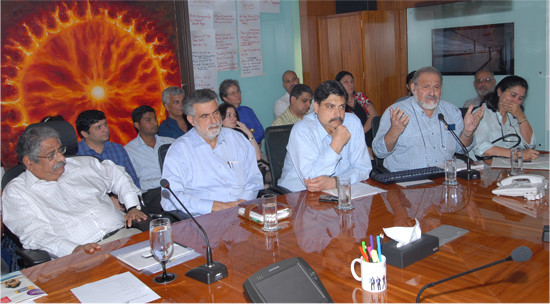
Round the table (from l): Dinshaw Mehta, Rustom Tirandaz, Noshir Dadrawala, Khojeste and Firoza Mistree
Community activist Phiroze Amroliwala felt that the problems arise in the home and must be addressed in the home: "Parents are too involved with their work to have time for their wards.”
Susan Chowdhry, who described herself as a vocational education provider noted, "Give me space in the baugs — all it takes is two rooms between 3 and 9 p.m. I will run the programs you want — you name them. There is no shortage of education in terms of human resources.” Jimmy Mistry urged her to "identify a program that fits the psyche of lower middle and upper middle class families.” Then he stopped to ask the big question — one that has baffled generations of BPP trustees: "We will do our jobs, but will there be takers?” Undaunted, he continued with his suggestion to Chowdhry: train and develop a team of trainers to set up a small finishing school of our own — one of the most important criteria for high school and college going kids — and motivate them.”
Marzin Shroff who is chief of Eureka Forbes’ direct sales recounted how they take ordinary people from Bihar and Orissa and create overachieving winners who go out to sell the company’s products directly to the customers. Some have even started their own companies, he noted. According to him what goes on in a young person’s mind can be documented under four heads — earning, learning, pride and fun. One principle for recruiting a guy is how hungry he is for achievement. "Today’s (Parsi) youth is not hungry. You have to engage with the youth in his language, at his level of thinking (as epitomized by internet sites) Facebook or MSN.” Shroff said that the youths today are "not bothered about what they are going to do when they grow up” but peer pressure, one upmanship, can drive them more than straightforward competition. They are "not willing to work to get up there. What is important is how to impress the opposite sex. Their knowledge of sex is way above what ours had been when we were young! And everybody wants money!”
In this roundabout of fun, friends, opposite sex and a fancy lifestyle, parents are not the influence they used to be, continued Shroff. The role models are the successful relatives of friends. They look up to such persons. The question is "how do you get such influencers to influence the influenced?” posed Shroff and suggested that film and media personalities and even some commercials like those of Pepsi could provide the answer.
Shroff gave short shrift to overprotective mothers and noted that very few parents were qualified to give advice to their progeny: "Nobody wants to go off the beaten track. They want to clone copies of themselves.” It is better to let professionals explain the different career options like environmental engineering, robotics, biotechnology, animation, disc jockeys and "fuel the youths’ ambition to be different,” advised Shroff, adding that the programs need to be sustained over time: "One seminar will never be enough.”
To be arranged over the summer vacations with a dance party at the end of the day, the program would generate camaraderie, it was pointed out. It was also noted that any program provided free of charge has no value. A pilot project in any one baug would be a learning experience for the organizers as well.
Jimmy Mistry was enthused at the prospect of a "youth mela” of three to four days during the coming vacations, open to all youths above standard VII. He was also hopeful of collecting a database on Parsi Irani youth across the country during the Holiday Programme for Youth, the BPP’s prime program for those who had just finished school and were ready to go to college, normally held in the month of May. Mistry who was keen on simultaneously providing guidance and training to parents felt that four months would be enough time to plan and pool in resources.
Jimmy Mistry: "identify a program”
Kaizad Mistry whose London School of Commerce is said to send 500 to 600 students annually for study abroad noted that hardly five or six of that number are Parsis. "Parents don’t realize that studying abroad is not so expensive. But it opens up the mind to entrepreneurial and career options.” While Jimmy Mistry asked for guidance on how to go abroad and where to get resources, Kobad Zarolia of Toronto noted that North Americans were looking at Indian education with respect and that people who had settled abroad were choosing to return to India. Shroff however put it in a different perspective: "It’s not about academics; it’s all about exposure.”
Prof Faredoon Kapadia, a management theorist, spoke about changing win-lose situations into win-win ones as exemplified by relating the hare and tortoise story with a modern twist: The hare wins on land but is stalled by a water body. But when the two decide to synergize, the hare carries the tortoise on land and the tortoise returns the favor when they reach the river by carrying the hare across on his back!
Freyaz Shroff, a social activist and PRG member from North America, noted that the organization had begun by creating a database of mobed’s children from Bombay and were now working on extending the same to include those outside Bombay. They will later extrapolate it to the whole community. The object of the exercise, she noted, was to establish who gets how much funding so that there is no duplication — a source of considerable dismay as unscrupulous people tended to seek aid for the same reason from a variety of sources. PRG founder Jimmy Mistry explained that the listing would incorporate detailed criteria to ensure that the money goes only to the children’s education. In the context of extending the facility to the community he sought a certified list of people living on a family income of less than Rs 10,000 per month. He wants a listing in the database that would indicate "sponsorship in progress” once a person is taken under the wing of an assisting individual or organization. It would indicate to potential sponsors that that a particular individual did not need further assistance.
Navroze Siganporia who said he had been organizing summer camps for children since 1963, suggested the holding of five to six such camps a year, each with kids of a homogenous age-group. "You would have a captive audience for confidence building, inculcating discipline, punctuality, etc along with fun, friends and food.” One of his favorite activities was to give them the ingredients and ask them to make the breakfast.
Siganporia also had a trenchant question for the school principals: When the trend today is for elitist schools, why are Parsi schools at the SSC level? he asked, noting how the Birlas had taken over the New Era School and upgraded teacher remunerations.
While Jimmy Mistry noted that commercial establishments don’t give money for community schools, Diana Marfatia of Dhirubhai Ambani International School raised the counter question of the quality of Parsi children and whether they would be able to meet the criteria of the more advanced academic standards. Also, she pointed out, so many were availing of free education. BPP chairman Dinshaw Mehta made a revealing statement in this context: "We asked for a meeting with the trustees of the school trusts. They were not interested.”
◆ ◆ ◆
From the archive