
Books
Ramayana retold
The Mighty Tale of Hanuman by Saker Mistri and Mamta Dalal Mangaldas. Published in 2013 by The Mehrangarh Museum Trust, Mehrangarh Fort, Jodhpur 342001. Pp: 108. Price: Rs 650.
Take a bow, ladies.
This is an age old story from the Ramayana, told with a difference. It is the story of Sita’s kidnapping by Ravana and how Ram and Lakshman rescue her with the help of the monkey god Hanuman and the vanars (monkeys).
Hanuman was the most powerful of the vanars, yet also the most humble. And he was blessed by the gods with the ability to change his shape and size at will, becoming as small or as large as he wanted and taking on any form he desired. An ability he used to great advantage in helping Ram and Lakshman rescue Sita.
What makes this retelling different is that the tale of the hunt for Sita and her eventual rescue from the clutches of Ravana is narrated in the first person by Hanuman. He narrates the story to the other vanars and we listen in. It gives one the feeling of actually being part of the story.
This is an age old story from the Ramayana, told with a difference. It is the story of Sita’s kidnapping by Ravana and how Ram and Lakshman rescue her with the help of the monkey god Hanuman and the vanars (monkeys).
Hanuman was the most powerful of the vanars, yet also the most humble. And he was blessed by the gods with the ability to change his shape and size at will, becoming as small or as large as he wanted and taking on any form he desired. An ability he used to great advantage in helping Ram and Lakshman rescue Sita.
What makes this retelling different is that the tale of the hunt for Sita and her eventual rescue from the clutches of Ravana is narrated in the first person by Hanuman. He narrates the story to the other vanars and we listen in. It gives one the feeling of actually being part of the story.
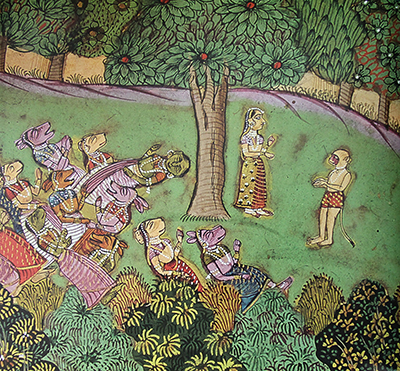
An 18th century painting from Mehrangarh Fort Museum illustrate the book and its cover.
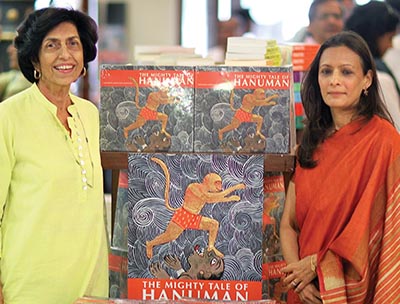
Authors Saker Mistri (left) and Mamta Dalal Mangaldas
Though we may have heard the story of the Ramayana as children, and subsequently read it when we were older, there is much of it that we may have forgotten. Like the story of the vanar brothers Sugriv and Vali. They were close, very close, until because of a misunderstanding Vali, the ruler of the vanars, banished Sugriv from the tribe to return only on pain of death. Sugriv left Kishkindh with his followers and set up his own kingdom on the Rishyamukh mountain.
When Hanuman finds Ram and Lakshman wandering in the forest, searching for Sita he takes them to Sugriv. They tell Sugriv who they are and about their search for Sita. Sugriv promises to help them find her. In return, Ram promises to help Sugriv in his fight against Vali. Ram eventually kills Vali and, as the latter is dying, Ram informs him that the enmity with his brother was due to a misunderstanding. Vali bequeathes his kingdom to Sugriv, designating him the new ruler of Kishkindh.
Sugriv reiterates his promise to Ram and sends his vanars to the four corners of the land for news of Sita.
The story of how Sita is eventually traced to Lanka, how the vanars cross over the wide expanse of water and how the unarmed vanars battle the rakshas of Ravana is simply and enchantingly told. The battle scenes are vivid and exciting. The appearance of Ravana’s brother, Kumbhakarna, called by the former to fight on his behalf, is scary and if one does not know the Ramayana, can have one biting one’s nails. For Kumbhakarna is a giant — the most enormous one in the world. And he is greedy. So greedy, in fact, that the gods are worried that he would eat up everything on earth. So they send him off to sleep, to be woken up every six months. Kumbhakarna is eventually killed by Ram shooting an arrow that pierces his heart.
The eventual rescue of Sita, the death of Ravana and the triumphant return of Ram and Lakshman to Ayodhya are the stuff that stirring tales are made of.
What makes this book even more charming is the clever use of the magnificent 18th century paintings from the collection of the Mehrangarh Fort Museum in Jodhpur to illustrate this ageless story.
For children and adults who do not know the story, this book makes a wonderful introduction to the timeless Ramayana.
To quote from the back cover of the book, "It is an epic tale filled with daring adventure. Meet gods and demons and witness the devastating battle between good and evil.”
The authors are well qualified to write this story. Saker Mistri is a speech pathologist, a museum educator and published author. She has headed the volunteer docent program at the Museum Pusat in Jakarta, developed children’s cultural programs in international schools and led the Docent and Children’s Gallery programs at the Asia Society Galleries NYC.
Mamta Dalal Mangaldas has an MBA from the London Business School and has participated in courses of the Harvard Graduate School of Education. She is passionate about making art accessible to children and has conducted workshops to introduce Indian art to them.
The book, a definite asset to any library, has been published by The Mehrangarh Museum Trust, Jodhpur and can be ordered from www.kahanitree.com, www.mehrangarhmusuemshop.com or amazonindia.com
R. M.
◆ ◆ ◆
From the archive