
Readers' Forum
“We are seven”
My sister, Dr Perviz Kavarana, daughter of late Freny and late Rustomji Andhyarujina and the youngest of five siblings, passed away in the early hours of March 16, 2014. It was the day I returned from a holiday in Spain where I had been with members of my Rotary Club. I had last spoken to my sister on March 1, shortly before my flight.
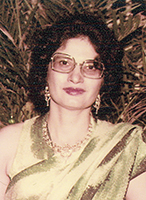
Dr Perviz Kavarana: confident and carefree
Those who live alone will understand the feeling when one is setting out on a trip. It is one of the many moments filled with memories, a reminder of earlier trips with the family when the last hour is spent in reminding each other of things to be done. I had done my packing with a checklist in hand. The packed bag stared at me. There was still an hour to go. I needed something to divert my mind. A chat with Perviz would lift the mood. I picked up the phone and we chatted for nearly an hour. Chats with her were always long. She could talk on inconsequential things, gossip, if we were in the mood, all this interspersed with advice. Perviz could not resist giving advice to all, young and old. We concluded the call with her advice not to wear any jewelry including the earrings which I insisted no one would notice. "They will only cut off your ears!” she warned. Guessing my mood, she did something about it. In quick succession my other two sisters and brother phoned to wish me, and the hour passed.
On the way to the airport one niggling thought continued to disturb me. Perviz had asked me how many were on the trip and I had answered 13. "Including the travel agent?” she asked. "Yes, including the travel agent,” I replied. I knew that ever since she had been admitted to hospital on November 13 about two years earlier and had almost died, she had become superstitious about that number. I pushed the thought away. As it turned out, our talk had been a farewell. She was admitted to hospital on March 13 with discomfort in the stomach and died three days later.
Strangely, my brother Tehmton who resides mostly in Delhi had come to Bombay to meet his children and attend a concert at the National Centre for the Performing Arts. I was scheduled to return on that day. He was fortunate to see her alive; I was not.
Perviz had come into the world when our family’s circumstances had improved vastly. She did not have to experience what we did — often foregoing things we desired badly. Perhaps that explained her carefree, confident attitude. She went through her medical studies in the same happy way, just ensuring that she passed her exams while enjoying life to the fullest. She met her future husband Nozer Kavarana, a cancer surgeon, while she was studying medicine and they married soon after they passed their qualifying exams. They have a daughter Minaz and a son Minoo, a surgeon who was featured in Parsiana about a year back.
Perviz fitted her medical career into her life as wife and mother. While in Scotland with her husband, who was studying there, she did two internships, one in ophthalmology and the other in dermatology. On her return to India she started her private practice and simultaneously worked for the Indian Cancer Society as a doctor on its panel. She also worked for the US Consulate on the panel of physicians for examination of Indians intending to visit the USA. Her colleague at the Consulate related to me an incident which illustrates her warm and helpful nature. The colleague’s husband had been critically ill and she was compelled to stay away from work for long periods of time. Aware of the extra burden that fell on her colleagues, she told them she would be happy to give her salary to them for the extra burden they had to shoulder on her account. Perviz was furious. "What do you take us for? Are we so ghoulish that we would accept extra payment because you are in distress? You can ask the staff to pass on your patients to me.” The colleague related this to me while we were reminiscing about Perviz.
While in school I had studied William Wordsworth’s poem We Are Seven. I remembered it better than most other poems because it fitted my own family — we were five siblings, and two parents. The poem is about a little village girl aged eight and narrates the poet’s conversation with her: "Sisters and brothers little maid, how many may you be? How many, seven in all she said, and wondering looked at me.”
It turns out that they were actually five as two had died, according to the girl’s own tale. The poet remonstrates: "But they are dead, those two are dead. Their spirits are in heaven/ T’was throwing words away, for still,/ The little maid would have her will./ And said, Nay, we are seven.”
Modern psychology and medicine would probably call this being in denial. I would call it nature’s way of cushioning the cruel blows it deals us. In the stilly night when memories bring thoughts of happier times, my mind and heart conjure up the picture of us as a family — my parents in the forefront and the five of us in the background, each at their favorite occupation. We are seven, never six or five (as we have been for over 15 years) or four (as we are today).
KHORSHED R. JAVERI
javerikhorshed@gmail.com
◆ ◆ ◆
From the archive