
Observation
How best to cope
Thoughts on coming to terms with the passing away of a beloved mother
It is over six months since my mother Manijeh Patell passed on and I still don’t know what to do with my mornings. Dr Rajdev Naik, her physician has stopped coming to the house; there are no ayahs swishing about the house in anklet-heavy feet; there are no heavy-duty drugs to order from the chemist anymore. Her Fowler’s bed has been given to a charity wing in a hospital; nurse Mangala has taken away a lot of her things for other more needy patients. The prayers for her soul have been said and the priests have left; her last mortal remains laid to rest amidst some of her friends in a cemetery. My sisters Jena and Diana have been through her cupboard. Each one of us has taken a set or two of her salwar kameezes, her "Bombay wear,” her shawls and woollies for when she was in Panchgani, her favorite home. We’ve kept for ourselves what we thought would be keepsakes, things that would remain with us as precious possessions but would always be hers.
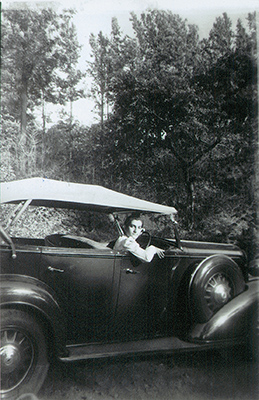
Manijeh in her Chevrolet,
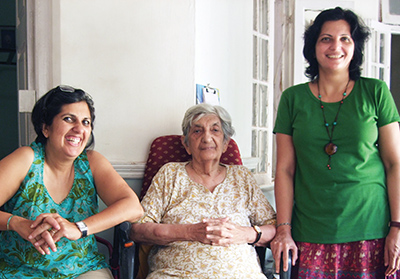
Jena, Manijeh Heta

Diana, Boman and Dhunrumi
Her clothes and sheets have been given away to the poor. Her collection of 4711 brand lotions, soaps, eau de cologne, shower gels and sprays of lavender are now scattered amongst her friends to use liberally and not ferret away in cupboards like she had done. Gardening gloves and garden tools, fresh in their original packaging, untouched because they were too minty to be soiled, are now in the hands of friends and gardeners. Long lost keys with labels that read, in Gujarati, "Ai saani chaavi chhè (where does this key belong)?” have found their homes in the right Godrej cupboards. Photos of cousin Perveez in her swaddling clothes in our great grandmother’s lap; another of her cousin Nergish harnessing a pair of bullocks on their family-owned farm and another at her son Kersi’s navjote have been made copies of and given to their children and grandchildren.
Boman’s room became my room when dad passed away nine years ago. Mum’s cupboard has been moved to my room with all its old stains and marks polished out of memory. A smiley sticker saying "So I ain’t neat… but I’m sweet” escaped the polishwala’s perfections and so did the asho farohar and embossed miniature figure of mum’s favorite St Anthony. Dad’s rolled top desk and mum’s cupboard stand side by side in one corner of the room. I am reminded of my parents in conversation; my parents dancing the waltz, doing the tango and the fox trot; having an argument. Her cupboard will soon pick up other marks and stains, the handles will soon lose the memory of the nursing ayahs, the shelves will have been relieved of their burden of diapers, underpads, sponge cloths and face towels.
We pride ourselves at home for having staff from all over India. We had Suhasini and Viju — Hindu ayahs from Maharashtra’s interior as well as the Konkan coast; one Christian ayah Renuka from Karnataka and Manu from the hot plains of Uttar Pradesh. Our cook Saleha is a Muslim from Bengal and our maid Prabha is from the masoor dal lands of Karnataka. I took great pride in the fact that mum, even in her state of illness and near-inertia had not stopped teaching her staff. Manu learnt how to take mum’s temperature, Renuka learnt how to read and write from scratch; the others learnt how to sing and dance to her favorite songs. When she passed away, it was my turn to learn something new. The Hindi-speaking ayah Manu said that, "Mummy parlok sidhaar gayé” which meant that she had passed on amongst others, not one of us. Marathi-speaking Suhasini said that "Mummy ché nidhan zaalé” which is another way of saying that she had lost all her material possessions (nir-dhan) and we said that "évan gujri gayaa” which simply meant that she had become one with a time past. Our Muslim cook Saleha used the word "inteqal” or one who was part of a yesterday. So many ways of expressing an inevitable transition from a living, breathing, vibrant personality to a fond memory!
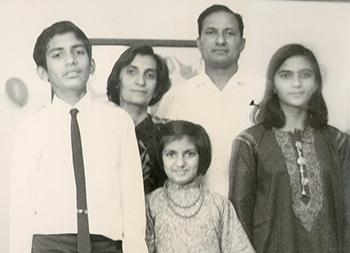
The Patell family in 1970 (l to r) Dhunrumi, Manijeh, Heta, Boman and Jena
I keep hearing the phrases "coming to terms with my loss” and "moving on” a lot of times these days. Are we all at that peculiar age when we all seemed to have dedicated a good part of our lives to the care-giving of one or both parents, an aunt, an ailing husband? Or am I naturally veering towards single friends and relatives who are in the same vacuum as I am? I look around me to see how best they cope. There is one friend who has not changed a single thing in the house since his mother passed away. The upholstery, the sheets, the beads hanging on the mirror and the telephone directory are all where she left them when she died. Another keeps changing things around all the time. She has the house painted and re-painted, tosses out curios and buys new ones and decorates and re-decorates the houses and flats that she has inherited from both parents. There is one who has not let the ayahs and maids go but has retained them all "just in case.” Another who has begun to take music lessons and another who watches movies one after the other like it’s going out of fashion.
Whose example should I emulate? I wonder. Should I rush to the aid of the sick and the needy that I am tempted to invent? Should I infuse new ideas into the two businesses that mum and I had set up decades ago so that they look like the management has changed? Or, should I just catch up on the many hours, nights and days of sleep lost during her complex mire of several illnesses? I think that while I try and figure out how best to cope, I shall just carry on breathing some life into her thought processes, the interlacing of words and the generosity of action that death brought to a halt. And spend my mornings toying with the idea that death, like life, is but an illusion.
◆ ◆ ◆
From the archive