
Books
Far from imperfect
Imperfect Fragments by Deenaz Paymaster Coachbuilder. Published in 2014 by the author, 7429 Breckenridge Drive, Riverside, California 92506, USA; email: deenazc@gmail.com. Pp: 138. Price: Not mentioned.
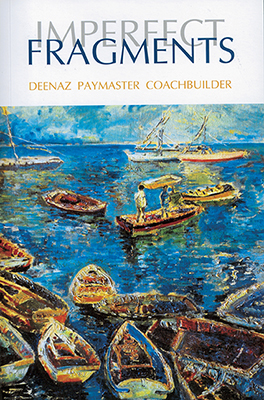 At a time when there are relatively very few Parsis publishing poetry, Deenaz Paymaster Coachbuilder’s Imperfect Fragments is a very welcome appearance. Her biography at the end of the book describes her as an educator, artist, poet and environmental advocate. She should have included wife, mother and grandmother as well; these are very important factors and constitute a recurring theme in this collection. The poems are divided into five segments and each is prefaced by a short introduction, which places them in context rather than offer an explanation. The headings of the sections: The Human Predicament, The Continuum of the Spirit, The Gift of Time, The Nature of Love, Reflections on Faith sound daunting and philosophical, but the poems are intensely personal and often embody simple observations which illustrate Coachbuilder’s concerns.
In the introduction to The Human Predicament, Coachbuilder refers to the unfair "accident of birth (which) etches the outcome of life in stone.” In "The green hedge,” she creates an atmosphere of opulence and peace using sensuous imagery of the setting sun which "drenches the tips/of balconied skyscrapers.” The garden is a "quiet emerald oasis” in the dust and the heat of the city. There is no doubt that the children who, under the watchful eyes of maids, scamper in their "muddied designer shoes” across the "manicured terrace” or play with their expensive video games come from wealthy families. They are watched from behind the green hedge by a young girl with "scarred knees” tapping her "scabbed fingers” and keeping time with the "infectious jingle of pop tunes.” She is the daughter of an uneducated, homeless woman who begs at the city’s traffic lights. Though the young girl does not seem to care about her poverty and alienation, Coachbuilder dreams of a more equitable future "where her shouts and laughter” might mingle with that of the children from wealthy families. "Two women” describes the encounter between an affluent woman dressed in her "soft silk shalwar” making her way past a ragpicker with her "faded choli and worn sari” who has lodged herself on the pavement claiming it for her own. In "Desert rose,” we see the environmentalist in Coachbuilder as she wonders if the desert rose rock, which has been present for centuries, mourns the disappearance of the grasslands, the dandelion and forests, which are now being replaced by telephone poles and fences.
Coachbuilder’s sensitivity to her surroundings, birds, animals and nature is the predominant theme of the second segment. In "The singer,” the poet/author evocatively describes the song of the mockingbird which shares her cup of tea in the morning and sings yet one more song for her "under the watchful moon.” She dislikes crows and describes them with violent imagery: "Raucous…belligerent…defiler of innocent nests.” However, it is when she accidently runs over a crow on her way back from work, the cawing now reminds her of "its brother’s twisted wings.” In "King cobra” she describes the snake with gentle imagery picturing him as he patiently watches from the leafy undergrowth with his "smooth long olive body… hooded head… strong elegant neck and hypnotic eyes.” One is unprepared for the last line, which is short and concise with three stressed syllables in five words: "With forked tongue, he strikes!”

The Coachbuilder family (L to R): Pheroze and Deenaz (standing) Sarvin,
Shaumika with baby Barjor, Shahrukh
In The Gift of Time section, Coachbuilder is preoccupied with the transitory nature of time and many of the poems are concerned with death. In "A compulsion with death” she expresses her horror of life lost futilely on battlefields. In "Grief on a spring day,” she regrets the passing away of her aunt Rutty who dies on a spring day; Coachbuilder contemplates the passage of time, the singing of birds, the blooming of flowers, the sun which continues to shine and, eventually, takes consolation from the fact that the elements now gently move "each molecule that was herself/into eternal life.” There are sensitive poems dedicated to her mother ("Without my mother’s warmth,/the wind is cold”) and her brother Sharukh who died young.
In The Nature of Love section, Coachbuilder contemplates the different aspects of love. Though she craves for strength and invulnerability in "Hostage,” when she looks at her sleeping son with his:
"Rose-lipped smile, fringe of darkened eyelash,/Baby fingers curled in sunlight dreams,” she realizes how impossible this is for her.
Occasionally, the poems deal with an absence of love as one sees in "The evening meal” where a couple come in together, he, a bit older than his companion who is fashionably dressed. They order their drinks and their meal and merely say one word to each other as they clink their glasses together. While they eat, they are busy with messages on "their state-of-the-art electronic devices.” They leave eventually and drive back: "She/sat on the passenger seat, reflective, demure./He/ drove, in profile, striking./Both replete, detached.”
In the final segment on Reflections on Faith, Coachbuilder describes "The journey to Sanjan” with lush images of Sanjan’s markets replete with coconuts, chikoos, rice and levta (mud fish), bullocks pulling ploughs, and borders of babul trees. Her thoughts go back to the advent of the Parsis and Jadi Rana welcoming the Zoroastrians after a journey from Fars which is fraught with danger and storms. In "The Zoroastrian odyssey,” Coachbuilder’s theme is the Zoroastrian search for identity. Whereas some stayed behind in Independent India: "they built bridges, hospitals and schools,/sheltered and cared for the destitute and/joined in the long struggle for India’s freedom,/becoming icons of the Parsi community,”/others looked for new worlds to conquer migrated to Australia, North America and Britain: "creating/a new mythology/all over again.”
What strikes the reader in Coachbuilder’s poems is her honesty, her thoughtfulness, her passionate verse coupled with a sensitive and imaginative use of language and meter. It is Coachbuilder’s modesty that has termed these poems as Imperfect Fragments; my only criticism is that the title certainly does not justify the content.
◆ ◆ ◆
From the archive