
Zoroastrians Abroad
Chinese claims
Whilst the origins of the Zoroastrian religion continue to be a matter of debate, new speculations have come to the fore with the reported unearthing of nearly 2,500-year-old ‘Zoroastrian’ tombs in northwest China’s Xinjiang Ugyur Autonomous Region, according to CCTV.com (China Central Television).
Archeologists who found "a typical wooden brazier (a container for holding burning coals) in the tombs” reported that "Zoroastrians would bury a burning brazier with the dead to show their worship of fire. The culture is unique to Zoroastrianism.” Yet another find among the polished stoneware was an eyebrow pencil which is believed to be an indicator of the civilization’s pursuit of beauty, creativity and a better life.
Archeologists who found "a typical wooden brazier (a container for holding burning coals) in the tombs” reported that "Zoroastrians would bury a burning brazier with the dead to show their worship of fire. The culture is unique to Zoroastrianism.” Yet another find among the polished stoneware was an eyebrow pencil which is believed to be an indicator of the civilization’s pursuit of beauty, creativity and a better life.
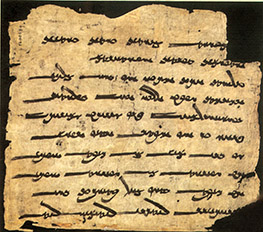
Ashem Vohu in Sogdian
"All the evidence leads to one conclusion: Zoroastrianism originated in the east on China’s Pamir Plateau,” declared Wu Xinhua, Xinjiang director, Archaelogical Institute, Chinese Academy of Social Sciences which according to its website is "the highest academic research organization in the fields of philosophy and social sciences as well as a national center for comprehensive studies in the People’s Republic of China.” Xinhua added, "Here we have found the earliest and the largest scale of Zoroastrian ruins, with all the typical symbols of this religion. Of course, there’s the possibility that there are other undiscovered ruins elsewhere in the world. But at this moment, it’s a logical conclusion that the origin of the religion is here, not in Persia.”
According to independent researcher Farrokh Vajifdar of UK, "One cannot be dismissive through categorical denials, but instead proceed with caution. The dating of the supposed ‘Zoroastrian tombs’ seems fair — 2,500 years ago is assured through carbon dating of the organic remains. But why are they peremptorily construed as ‘Zoroastrian?’ There were other civilized groups in western China at the time...
"Whilst the languages of the Pamir region bear certain links with the main Iranian-speaking family to the east and northeast of Iran, the Avestan speakers were to the west of Xinjiang. The region was not Chinese then.
"For the enthusiastic Chinese excavations director to affirm that the tombs and effects were Zoroastrian is stretching credibility somewhat. Fire was not a Zoroastrian invention or sole medium of worship. The physical fire was a valued, treasured and respected essential for both nomadic tribes and settled clans... The artifacts alongside the excavated skeletons certainly exhibited a fair degree of manufacturing skill, and that again was not exclusively a Zoroastrian development.”
Prior to the recent revelations, there have been several references to the east Iranian Sogdian merchants who lived in the area around Samarkand in modern Uzbekistan and Tajikistan. By the early fourth century AD the Sogdians were well established as traders and there is written evidence in Dunhuang of a Zoroastrian temple which was flourishing until the 10th century, as mentioned on the Online Gallery of the British Library that houses a 10th century Ashem Vohu in Sogdian, considered the earliest surviving Zoroastrian scripture. The Sogdians served both the Chinese and the Turks and were said to be responsible for diplomatic affairs and translation work. "Their native religion was Zoroastrianism. In Chinese historical sources and documents, however, they appear as disciples and propagators of the three great religions of redemption — Buddhism, Christianity and Manichaeism — because they translated the basic texts of all three of these religions,” reported Bridging Eurasia, November 2012. "Sogdians seem to have played an outstanding role as cultural and social mediators,” stated the article. A seventh century bronze figurine of a Sogdian dancer, housed in the Shandan Municipal Museum in China, conveyed that "The Sogdians were avid dancers with a zest for life… They even danced in the courts of the Tang Dynasty (618-906 CE) and were sought after by royalty for their dancing skills… The large nose was a defining feature of Sogdians and indeed a large number of Aryans. Even today, the Parsis and Iranis of India are distinguished by their large noses,” according to K. E. Eduljee, author of Zoroastrian Heritage and Immortal Cypress whose research is reproduced on the Zoroastrian Heritage website.
There is a detailed narration of the tomb of Wirkak, supposedly a religious leader of the Sogdian community, which was opened in 2003. The tomb chamber contained a stone sarcophagus with a bilingual inscription in Sogdian and Chinese. On the stone panels of the sarcophagus were depicted various scenes from Wirkak’s life such as hunts and rich banquets, trading caravans and journeys into distant countries, as also Zoroastrian symbols and themes. Yet other sixth century Sogdian funerary couches in China depict Zoroastrian scenes like a priest with his face covered with a padan, a sagdid dog (that confirms death) and deceased souls crossing the Chinvat Bridge to the next life.
Eduljee refers to one more document in the British Library possession where Princess Jun Zhezhe of the Guangzhou Uyghurs writes to her friend Madame Sikong, mistress of the North House, about "lighting a fire in the Zoroastrian fire temple in order ‘to bring prosperity along the road.’” These could be indicators that Zoroastrianism in China was not limited to the Sogdians.
◆ ◆ ◆
From the archive