
Observation
Projecting a Persian past
In Central Asian republics pre-Islamic and Zoroastrian associations are being used to try and forge a national identity
Today, some nations of Central Asia, freed of the atheistic rule of the former Soviet Union, are harking back, nostalgically, to their pre-Islamic heritage. UNESCO declared 2003 to be the "3000th Anniversary of Zoroastrian Culture” and funds the Delhi based Parzor Project to compile history and record Zoroastrian traditions. In nations like Tajikistan, old customs like Navroz are actively promoted, links to Persian history emphasized, and Zoroastrian associations formed. It is a search for cultural identity. But others say that these are transparent attempts to counter resurgent Muslim fundamentalism in the region, prop up authoritarian regimes, and are tainted with the rough politics of the region. How should Parsis/Iranis, the keepers of the ancient flame, view these developments?

Tajikistan president Rakhman
The search for a cultural identity
Following its Islamization around a thousand years ago, the Central Asia region was ruled by a variety of empires and khanates, including for brief periods those of Genghis Khan and Timurlane, until the Tsars expanded Russia southwards from the mid 1860s onwards. The Russians completed their conquests in 1881, having reached the border of Afghanistan, although it was not until the Communist era that Russian administrative control of civil life was effective.
Today, the region is predominantly Muslim, and no Zoroastrian religion or practice remains except in "folk rituals” sometimes incidentally associated with Muslim rites. A few stray individuals may call themselves Zoroastrian, but this is no more than an affectation by a handful of intellectuals, or those whose political agenda is to counter Islamic fundamentalism. However, throughout the region, there is some interest in its pre-Islamic heritage, such as the celebration of Navroz. This is especially the case in Turkmenistan, Tajikistan and Uzbekistan, whose governments mobilize public employees, and students, to put up banners and fill stadiums with choreographed celebrations on a scale befitting a USSR May Day pageant.
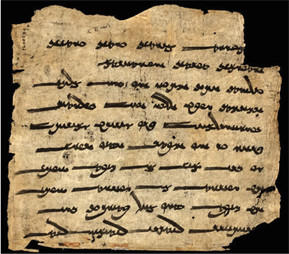
The Ashem Vohu written on a ninth or 10th century manuscript found in Dunhuang, China Source: The British Library
For Central Asia as a whole, most of the nations are Turkic in culture and language, with heroes like Timurlane. But with many languages, and a small minority ethnic Russian population, the Russian language is often used as a lingua franca. All the states have an issue with, or worries about, an Islam that is resurgent and fundamentalist, now that the lid of Soviet atheism and control has lifted. Many of their governments (typically autocratic in character) try to use pre-Islamic or secular symbols, folklore and heroes, as a counter to radical Islam.
In modern Central Asia there are four cultural models or magnets. The first is a modern vision of secularism and international business based on energy resources, foreign investment with Russian or English as a common language. The second is a Turkic identity, and language evoking Turkic heroes of a glorious past such as Genghis Khan or Timurlane. The third is a strict and fundamentalist Sunni Islam. The fourth cultural model is association with a "greater Persian” and "Aryan” past.
The use of Navroz and Zoroastrianism as markers of cultural identity are a particularly sensitive issue in Tajikistan, a country where the region’s divisions appear to be the most acute. This is because the nation is governed by Tajiks, descendants of Soghdians, a Persian people who speak a language related to Farsi. But only 55 percent of the population is Tajik, mainly in the south of the country. Twenty-three percent are Uzbek (predominantly in the north), while 10 percent are ethnic Russian. With the loosening of Soviet control in 1987, a so-called "cultural,” but actually political, movement called Rastokhez was set up by the Tajik-speaking faction, to glorify pre-Islamic Soghdian symbols, including Zoroastrianism, and links to a "greater Persian” past. (This is not to suggest an association with the current Iranian regime. On the contrary, the Tajik leadership views Iran and Shiism with great suspicion and distrust as fomenters of radical Islam.) They replaced a statue of Lenin with one of Firdausi in the middle of the capital, Dushanbe. (Firdausi may or may not have been a devout Muslim, but he is the towering literary figure of the middle Persian language as the poet of the pre-Islamic epic stories in the Shahnameh). This was the first political attempt to link Tajikistan with a greater Persian pre-Islamic identity.
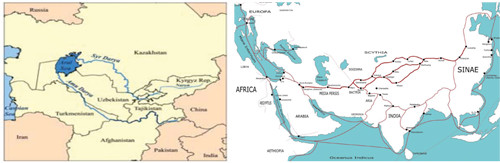
Far left: Map showing Amu Darya and Syr Darya Alongside: Transasia trade routes Source: http://commons.wikimedia. org/wiki
But so great were the divisions with the Uzbek north and the rest of the population that, following independence and the sudden withdrawal of Soviet control in 1991, a brutal five-year civil war sprang up. Many Tajik government figures associated with the movement were murdered by fundamentalists. The war ended in 1997 with an uneasy compromise, with the Tajiks under president Rakhman(ov) (in a further renunciation of the Soviet era, the President later changed his name from the Russified Rakhmanov to just Rakhman) dominant, but sharing 30 percent of power with an Islamic renaissance party and a communist party. But brutality and occasional murders have continued since. At the same time, a new movement, called the Aryan Project has been started, and President Rakhman was instrumental in having UNESCO declare 2003 to be the "3000th Anniversary of Zoroastrian Culture.” As before, pre-Islamic and Zoroastrian associations are being used to try and forge a national identity, but also for partisan purposes.
How should Parsi Zoroastrians view these developments?
For a religion first proposed 3,000 years ago, Zoroastrianism is still ahead of our times in several respects. While its genetic carriers, the Parsis/Iranis, may be dwindling into physical near extinction, the ideas of Zarathushtra will continue to amplify and ricochet upwards into mankind’s globalized future with gathering force and recognition. As the inheritors of a glorious weltanschauung and theology that has significantly influenced both Jewish and Christian thought, Parsi/Irani and Zoroastrians naturally wish to further the recognition of its contribution to human civilization, by supporting multilateral initiatives such as the UNESCO project and scholarly work.
However, the Prophet clearly enjoined his followers to avoid evil and hypocrisy. Nay, even more than most religions, Zarathushtra recommends active opposition, in thought, word and deed, to evil and evil doers. "For he who looks upon evil with tolerance is no other than evil.”
— Yasna 46:6 (Translation by D. J. Irani)
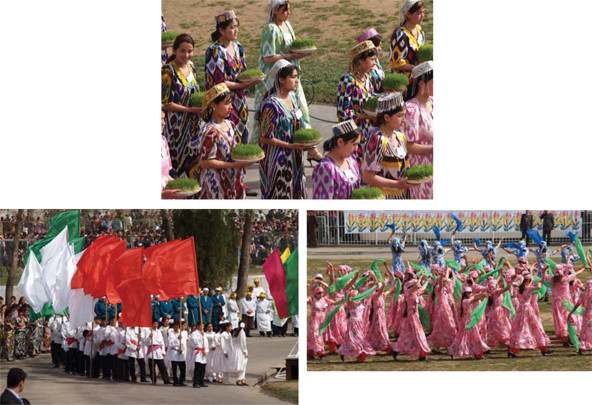
Navroz day celebrations in Tajikistan
Mixing religion with the state, or politics, is seldom beneficial. The Sassanians, who made Zoroastrianism the state religion and then intermittently persecuted non-Zoroastrians, set a terrible example for the Muslims when they took over after 651 CE. The former Reza Shah Pahlevi, who wrapped himself in an "Aryan” pre-Islamic heritage invited even greater vituperation from the mullahs and fundamentalists. Iranian Zoroastrians who were promoted by the Shah suffered an even greater downfall and exile than others associated with his regime. The Rastokhez movement in the late 1980s in Tajikistan was followed by murders, terrorism, and then a civil war that may have killed as many as 50,000 and displaced a half million.
Most facets of human life present a mixed picture. But Zoroastrianism prescribes active un-mixing. It urges its followers to actively eschew evil and promote good, and thus to engineer a better existence for mankind and the universe. It was the first to suggest a universal progression for humankind and a glorious destiny.
"O Ahura Mazda, … Spirit of Truth and Right! … grant me and my followers such authority and power through Truth, That with the Good Mind, we may bring the world peace and happiness, of which, Thou, O Lord, art indeed the first possessor.”
— Yasna 29:10 (Translation by D. J. Irani)
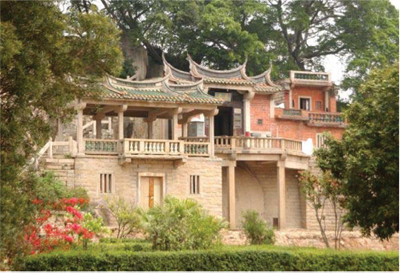
Manichaean shrine on Huabiao hill near Quanzhou Photo by M. Wilson, 2004
Source: Manichaean and (Nestorian) Christian remains in Zayton (Quanzhou, South China) by Prof Sam Lieu and Dr Ken Parry (http://www.anchist. mq.edu.au/doccentre/Zayton.htm)
Spread of Zoroastrian ideas
Attempts by rulers to interfere with religion, or use it for political ends is nothing new. For a significant portion of his life, Zarathushtra appears to have incurred the enmity of powerful rulers. Often persecuted, and driven from place to place, he felt keenly the injustice and deception practiced by persons in power. In the Gathas, Yasnas 48 and 49 are a cry to Ahura Mazda to deliver Zarathushtra out of the hands of evil rulers, or Kavis, and Karapans (corrupt priests) who, "…through their perverse intellect… delude the evil rulers of these lands”
— Yasna 48:10 (Translation by Piloo Nanavutty)
In Yasna 49:1, he specifically mentions one "…Bendva (scholars are unsure whether Bendva is an actual ruler’s name or a title suggesting defiler or deceiver), of evil intent, long since oppressed me because I tried to help the downtrodden through justice due to them. O Mazda, come to me as a great blessing. Help me.”
Despite persecution, the ideas of Zarathushtra took root in receptive hearts in his homeland (the border region straddling Persia and the trans-Oxus River region in today’s Tajikistan), and then spread to the Middle East, China and Europe. In Persia, under kings Cyrus and Darius, Zoroastrian ideas penetrated and altered Jewish (and later Christian) theology. Zoroastrian prayers and ideas also spread eastwards, with travelers along the Silk Road to China. The oldest surviving copy of a Zoroastrian prayer, the Ashem Vohu is a ninth or 10th century copy found in Dunhuang, an important stop on the Silk Road in China (see photo and map on pgs 140 and 142 respectively). The document is written in Soghdian script, although it transcribes the much older Achaemenid Avesta language. It reflects the fact that not only was Soghdiana (today’s Uzbekistan and Tajikistan) the possible original home of Zarathushtra, but also that Zoroastrianism persisted there well beyond 1000 CE. Remains of Zoroastrian fire temples dot many of the Central Asian republics. The Soghdians, centered in Bukhara and Samarkhand, were the intermediaries in the Sino-Mediterranean trade. As recently as Marco Polo (1254-1324), Soghdiana was not completely Islamic. Marco Polo traveled by land through Samarkhand to China, returning by sea from the Chinese port of Quanzhou.
Undoubtedly therefore, there were Zoroastrians in the Mediterranean countries and in China, millennia before the Parsis of India ventured out with the British as traders of tea and opium in the 18th and 19th centuries. While there is no evidence of Zoroastrian communities or worship in the Mediterranean or in China, offshoots of Persian or Zoroastrian beliefs may be found from London to the east coast of China. London has the famous Mithras temple excavated near the St Paul’s Underground Station. It is estimated that, at one stage, a third of the Roman army followed neither Roman nor Christian gods, but worshipped Mithras [Mithras (as the Romans called him) is Mithra, the "yazad” or angel of light in later Zoroastrian theology]. Quanzhou, the port from which Marco Polo embarked on his return journey back to Europe had a Manichaean temple [Manichaeanism, founded by Mani (216-276 CE), a Sassanian Persian, was a synthesis of Zoroastrian, Jewish, Christian and Gnostic ideas. In the eighth century Manichaenism was the official religion of the Uighur Khanate (including portions of today’s Xinjiang Autonomous Region of China)]. Only in the Ming Dynasty (1368-1644) was it converted into a Buddhist temple (as foreign religions were proscribed), and Manichean beliefs incorporated into a new "Buddha of Light.” But the eastern Chinese ports continued to have many polyglot communities, including Nestorian Christians.
The overland Silk Road was the principal artery for Europe to China trade. It is only in the last 500 years that, aided by gradual European control of East-West commerce, the volume of maritime trade along the southern periphery of the Asian continent eclipsed the amount carried over land routes through Central Asia.
Today, there remain no Zarathushtis in China (except for a handful of recent converts). But the archeological evidence remains. The ideas of Zarathushtra continue to leaven the thinking of all mankind.

Dr Farok J. Contractor is Professor in the Management and Global Business department at Rutgers Business School. He is a graduate of the Wharton School, University of Pennsylvania, where he received his PhD (Managerial Science and Applied Economics) and MBA, and the University of Michigan, where he received an MS in Industrial Engineering. He has written over 75 scholarly papers and books and is rated by several surveys as among the top-ranked contributors of scholarly papers to the field. He was elected a permanent Fellow of the Academy of International Business in 1995.
◆ ◆ ◆
From the archive