
Zoroastrians Abroad
The forgotten frontier
Fourteen Zoroastrian graves in the cemetery at Huangpu, also known as Whampoa, an industrial city in south-east China in the Pearl River Delta region, a part of Guangzhou province, have been restored by the Chinese government. A group of 30 Zarthoshtis from Hong Kong made a three-day visit (April 4 – 6, 2008) to the Chinese mainland to see the place for themselves. "We were under instructions not to burn incense and were content to pay homage to our dearly departed with a silent prayer,” writes Jal Shroff, president of the Zoroastrian Charity Funds of Hong Kong, Canton and Macao, recounting the 10-year development in a report to Parsiana.
"The actual graveyard site is on the top of a hill within the grounds of the CSSC Guangzhou Huangpu Shipping Company Limited. A guarded gate blocked access to all vehicles and pedestrians initially, despite the necessary permits having been obtained. We were, however, eventually let through and made our way up the neatly paved 150+ steps…Some of the inscriptions were worn out and hard to read; others had only parts of the inscription because vandals had made away with pieces of masonry. One grave could not be restored because a tree had grown from underneath it and displaced it completely,” notes Shroff.
While the age of the deceased is not mentioned on three graves and one is minus a headstone and hence there is no record of its contents, the men buried there seem to have succumbed at an early age, the youngest being 21, the eldest 55. There appears to be no notation to indicate the cause of death. And though there are no adult women buried there, the presence of four-year-old Ruttee Billimoria, a still-born child and a newborn son attest to the presence of families in that remote trading outpost. The cemetery seems to have been in use for about 76 years, from 1847 to 1923.
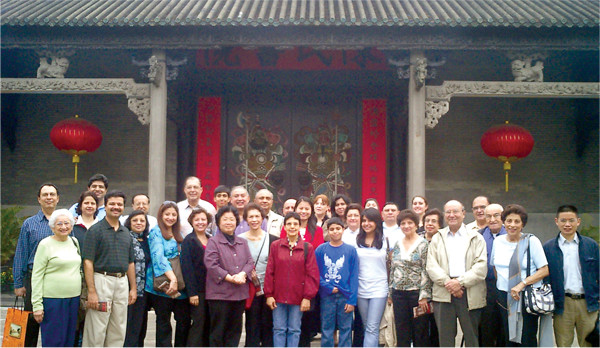
The Parsi group outside the Chan Clan Academy and Museum with Chan Yuhan and Guo Deyan
At the bottom of the hill stands the "Picnic House,” a structure originally built in 1861 and possibly used as a bungli, as notes Shroff, adding, "It was later redeveloped in 1923 into a two-storey Picnic House as there were no more burials taking place there.” He quotes the plaque inside the house which reads, "This building was erected in 1923 for the use of the Zoroastrian community of China from funds subscribed by the Parsee Zoroastrian community of Hong Kong, Canton and Shanghai, supplemented by a contribution from the Zoroastrian Charity Funds of Hong Kong, Canton and Macao. The original building, erected in 1861 by the late Mr Dorabjee Nusserwanjee Camajee for the use of the Zoroastrian community of China, was pulled down owing to its dilapidated condition and the present new building erected in its place.”
Though the area surrounding the cemetery and the Picnic House is under the occupation of the shipbuilding company which had used the House as its administrative office at one time, Shroff writes that at the time of the their visit it had been sealed off.
The cemetery had first been sighted by people who had been involved in military exercises across the border with China some time in 1998-99 and the trustees of the Hong Kong Anjuman had been duly informed of its existence, states Shroff. No further leads were available until some members of the Hong Kong branch of the Royal Asiatic Society completed all formalities and obtained the necessary permits from the relevant authorities to visit Guangzhou in 2003. When they visited the Parsee Cemetery they found it in total disrepair, so overgrown with dense vegetation that "local youths armed with machetes had to be called in to cut the mass of foliage and enable access to the site,” Shroff informs us. The tombstones were broken and missing in parts. On their return to Hong Kong, the Society members recounted their experience to the trustees of the Anjuman and provided the contact details of Dr Guo Deyan, an expert on Parsis in Canton. Deyan has written several articles and books, the most notable one being the Parsi Merchants in Canton during the Quing Period.
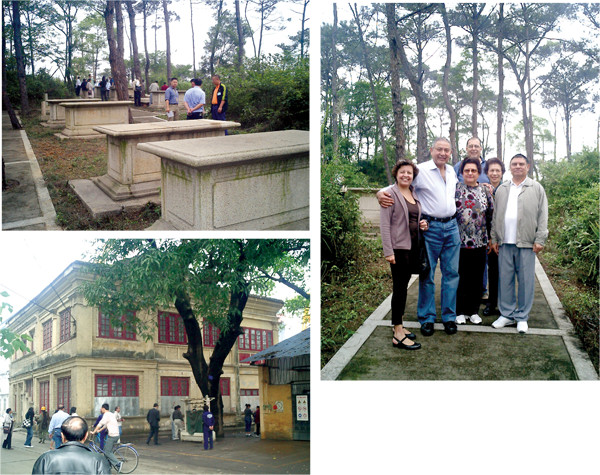
Clockwise from top left: The Whampoa Zoroastrian Cemetery; (L to R) Pervin and Jal Shroff, Dina Shroff, Noshir and Ms Pavri and Ervad Jimmy Sidhwa at the cemetery; the Picnic House. Below (L to R): Chan Yuhan, Jal Shroff and Guo Deyan
On the invitation of the Anjuman trustees Deyan visited Hong Kong in 2004 and presented a Power Point address showcasing the degradation of the cemetery. In the company of Dr Patrick Hase of the Royal Asiatic Society the trustees made an exploratory visit to the site and established contact with Madam Chen Yuhuan, director of the Guangzhou Bureau of Culture who is also secretary general of the Committee of Antiquities and Monuments of China. In the course of a regular exchange of correspondence with the Chinese authorities the Hong Kong Anjuman offered to pay the full cost of restoration but "the offer was politely declined and the Chinese undertook to foot the entire cost of the restoration exercise,” though the trustees were permitted to view the ongoing work, states Shroff. The exercise, which cost the Chinese government 380,000 RMB (approximately Rs 2.28 million), was completed in 2005. The Zoroastrians of Hong Kong hope that the Chinese will preserve it as a heritage site and have repeated their offer to bear any expense that might be entailed.

Shroff’s narrative describes the ease of travel and clockwork precision of the planned trip. The train from Hung Hom Railway Station in Hong Kong to Guangzhou took 75 minutes. "We breezed through immigration and customs formalities and boarded our bus for the 20-minute ride to the White Swan Hotel,” where Deyan and Yuhuan promptly came to meet them, he notes. The cemetery lay at the end of another hour-long bus ride. But their itinerary also included other places of historical and cultural interest. Shroff writes glowingly of the architectural decorations in wood, brick and stone, ceramic and lime, of jade, brick, wood and stone carvings, embroidery, pottery and glass etchings at the Chen Clan Academy built during the Quing Dynasty in the late 19th century. Shroff, in his capacity as president of the Anjuman, proffered the appreciation of the community and presented a silver plate to Yuhuan and a designer watch to her and to Deyan.
At an exhibition showcasing a selection of artifacts from the Guangzhou Museum titled "Gems left by overseas trade” the visiting Zarathushtis witnessed ivory carvings, embroidery, silk textiles, enamelware, porcelain, lacquer and oil, watercolor and glass paintings. "For about 85 years, from 1757 to 1842, Guangzhou had been the only port chosen by the Quing court to handle foreign trade activities. Artisans in Guangzhou created and produced various arts and crafts which carried both Chinese and European elements, destined for the Occident market. These prized specimens were ‘gems’ in the fullest sense of the word,” writes Shroff, adding, "Also included among the pictorial exhibits and the accompanying text documenting the history of early trade and traders in Guangzhou was what was patently a Parsi name – Wadia(?) – although this was misspelt in their records.”
Shroff describes Shamian, the district in the vicinity of their hotel, as connected to the rest of the city by a series of bridges. He writes that from the 18th to the mid-19th century, "it was the only place where foreign traders were permitted to set up their warehouses and factories. It became a British and French concession after they won the opium wars. With its slow pace of life, Shamian is a serene retreat and an ideal place to wander around those old colonial buildings that housed the trading offices and residences. The Chinese government has taken great care in preserving its heritage sites and it is believed there are now just under 200 buildings in this area that have been placed under protection orders. These have been identified by plaques on their facades. One of these was Pallonjee House which was later used as staff quarters by the Hong Kong and Shanghai Banking Corporation…” It would seem that the Chinese do not shy away from their history, even when the nation was at its nadir!
The entire trip with its sight-seeing and victualing had been organized by Pervin and Jal Shroff and Farida and Neville Shroff – "a beautiful fusion of hard work, patience and competent and efficient management,” Jal Shroff breathes satisfaction — and thankfulness to his Chinese hosts.
◆ ◆ ◆
From the archive