
Comment
The fire in the heart
The people of Central Asia who have descended from Zoroastrian stock are now openly expressing their ethnicity
In July 2011 a student of entomology (the study of insects that harm crop plants) from Uzbekistan specializing in tomato growing visited the Department of Plant Science at the University of California where I work. I sought him out to discuss Zoroastrianism and the Zoroastrians in Uzbekistan and was pleasantly surprised to find Bahodir Eshchanov knowledgeable about the subject. His ancestors, up to the time of the Arab conquests of the 7th century AD, had been Zoroastrians.
Eshchanov told me that he is aware that his name, Bahodir, means "bahadur” or brave. However, during the Soviet era it was customary for the local people to end their surnames in the Russian fashion with an "ov,” to deflect suspicion from the communist bosses as well as to secure jobs and promotions which were always controlled by the Russians. Since the collapse of the Soviet Union in 1992, the Uzbek and Tajik peoples are now openly expressing their ethnicity, including the study of Zoroastrianism in schools and colleges in Uzbekistan, he revealed.
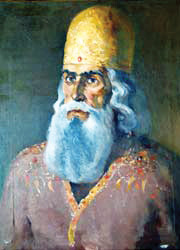
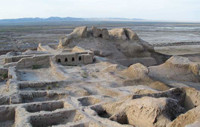
Ancient Zoroastrian village in ruins at Toprak-Kala, Uzbekistan and (left) painting of Zarathushtra found there
Although there are still a few thousand followers of the old religion, the teachings of Zoroastrianism are little known to the general public in Uzbekistan. The beliefs regarding the creation of the world, heaven and hell, the coming of a saoshyant (frashokereti), and the final judgment of the soul (on Chinvat Pul) after death were to a large extent borrowed from Zoroastrianism by Christianity, Judaism and finally Islam.
Zoroastrianism was already a mature religion by the time the other great religions started to develop. Being one of the oldest monotheistic world religions, Zoroastrianism influenced mankind more than any other creed. The exact date and place of the origin of Zoroastrianism, or the precise dates of the life of Zarathushtra himself are almost impossible to determine due to loss of books, religious manuscripts and literature which were destroyed by Alexander and later by the Arabs. However, Uzbek scholars are in agreement that Zarathushtra lived in the 7th century BCE (Before Christian Era). Thus, as decided by UNESCO (United Nations Educational, Scientific and Cultural Organisation) the world recently celebrated the 2,700th anniversary of the Avesta.
In Uzbekistan it is widely believed that Zarathushtra was married, had four children, lived to see his 77th birthday and was killed by a pagan priest. In the mid-20th century a Russian archeologist and orientalist Prof S. P. Tolstov studied ancient monuments dating from the mid-first millennium BCE and came to the conclusion that Zoroastrianism had originated in ancient Khorezm. Indeed, there are 63 Zoroastrian monuments dating back to antiquity in Iran, Afghanistan, and what is now Pakistan. Thirty-eight of these are in Uzbekistan, whereas 17 are located in Khorezm. Khwarezm, or Chorasmia, is a large oasis region on the Amu Darya river delta in western Central Asia, which borders the Aral Sea (which has since dried up thanks to the ill-advised Russian irrigation policy) to the north, the Kyzylkum desert to the east, the Karakum desert to the south and the Ustyurt Plateau to the west. It was the center of the indigenous Khwarezmian civilization whose capital from the 16th century onwards was Khiva. Today the Khwarezm region lies partly in Uzbekistan and partly in Turkmenistan.
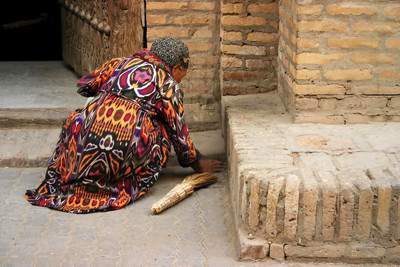
Uzbek woman cleaning courtyard with broom in the morning
It is noteworthy that Zoroastrian rites, though modified to some extent, are practiced by some Uzbeks to this day. For example, right after the wedding ceremony the bride is brought to her young husband’s house and the couple walks three times around the fire as though purifying themselves. It is only after this ritual that the groom takes the bride into his arms and carries her into their matrimonial chambers. Also, the practice of cleaning the courtyard of the house in the morning and decorating it with flowers and other markings is still prevalent as is evident from the photograph of an elderly Uzbek lady with a broom.
Navroz is the principal holiday in Uzbekistan. It is believed that this holiday was established by Zarathushtra himself and was celebrated on the first day of the new year, the vernal equinox, which falls on March 21. It symbolizes the beginning of new life, when evil is defeated and the world is miraculously transformed. That is why Navroz is especially cheerful, with many rites symbolizing renewal and bliss.
Zoroastrianism was widely practised in ancient Khorezm, Sogdiana and Bactria for 1,000 years. In the lower reaches of the Amu Darya River, three kilometers off the town of Khojeili, a unique archeological complex, Mazdakhan, has been discovered. These are the remains of a town that used to be a trade and crafts center of Khorezm. A branch of the ancient Silk Road ran through the town. Not far from Mazdakhan stands Chilpik with its many Zoroastrian motifs. According to the Uzbeks it was here that Zarathushtra composed the first lines of the Avesta. Zarathushtra was an ardent preacher and an inspired poet. His sermons and songs were later included in the Avesta. The earliest part of the book comprised 21 chapters.
The strong walls of the fortresses Ayaz-Kala, Toprak-Kala, Kuy-Krilgan-Kala, Burgun-Kala, Dev-Kala are still an integral part of Khorezmian landscapes. While examining these great monuments, archeologists have found the ruins of fire temples, household articles, ceramic objects and sculptures, all relating to Zoroastrianism and Avesta characters. Inside Toprak-Kala, for example, fragments of wall paintings and sculptural décor were found. Some Zoroastrian customs and traditions are evident in the present day life of the Uzbek people such as duels of fighting rams, and a typical Khorezm ritual dance called Lyazgi which it is believed was performed since Zoroastrian times.
On the Afrosiab hills of this region, which hide the ruins of the ancient Sogdian capital Marakanda, statuettes of the Zoroastrian goddess of fertility, Anahita, can still be found. One of the oldest mosques in the Uzbek city of Bukhara, Magoki-Attari was built in the 11th century AD on the foundations of a Zoroastrian shrine.
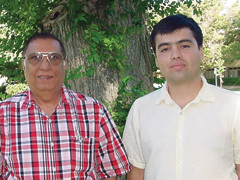
Ardeshir Damania (left) with Bahodir Eshchanov
According to Eshchanov even after the Islamic conquests many Zoroastrians remained in the cities of Tashkent, Samarkand and Bukhara. But after the Mongolian conquest of Genghis Khan, Zoroastrians moved away. The Central Asian Jews, or Bukhara Jews, still remain. Little is known about them, though this ethnic group has preserved many customs and rites which their ancestors had practiced that are associated with Zoroastrianism.
The Uzbek scientist further related that after the Islamic conquests of 640-642 AD a crippling Jaziya tax was levied on all Zoroastrians in Georgia, Tajikistan and Uzbekistan. If a Zoroastrian was unable to pay the heavy tax, the amount owed was written on a placard and hung around his neck. However, if the Zoroastrian visited a mosque during prayer times a small portion of the amount due was reduced on the placard when he emerged from the mosque. Many Zoroastrians thus had to repeatedly visit the mosque for months and even years before their debt could be completely erased. At some stage, a harassed Zoroastrian would just opt to give up and convert to Islam.
After the Islamic conquests some Zoroastrians fled towards China and, according to ancient Chinese texts, the first fire temple they established was in Changang in 612 AD. Today, in Northern Hengang, near the village of Jang-Defu, there still remains a 6th century Zoroastrian commemorative pillar which depicts priests wearing mouth masks, standing around the altar in a fire temple.
Eshchanov claims that some Zoroastrians are still living in remote villages in the mountains of Uzbekistan. These villages can only be reached on horseback as there are no motorable roads. These Zoroastrians are noted for their great self-confidence. While tackling difficulties they rely on the qualities that Zoroastrianism has cultivated in them for centuries. They have courage, optimism, and are always ready to do good. The followers of Islam may have extinguished fires in the temples and built mosques over the ruins of fire temples, but the real fire is in the hearts and minds of the people of Central Asia who still revere Zarathushtra.
Associate research geneticist at the University of California, Dr Ardeshir B. Damania’s area of interest includes biodiversity conservation issues, early agriculture, crop domestication and plants of economic and medicinal value. His early career was with the Food and Agriculture Organization of the United Nations and he subsequently worked with the International Center for Agricultural Research in the Dry Areas.
◆ ◆ ◆
From the archive