
Institutions
The making of Maneck Baug
Maneck Baug, a six-room residential facility located in the Sir Jamsetjee Jejeebhoy Agiary compound in Poona will be operational in September
Nestled in the heart of Camp (as old-time citizens of Poona still call the area in British army lingo) is the lovely Sir Jamsetjee Jejeebhoy (JJ) Agiary. Built in 1844, the Agiary was meticulously refurbished and renovated just a few years ago, and has added another feather in its cap with the opening on Sunday, August 24, 2014 of a residential wing, Maneck Baug.
The six well-proportioned rooms situated at the back of the sprawling property are to be let out to visiting Parsis. All the rooms are air-conditioned, equipped with wi-fi and have attached bathrooms.
The six well-proportioned rooms situated at the back of the sprawling property are to be let out to visiting Parsis. All the rooms are air-conditioned, equipped with wi-fi and have attached bathrooms.
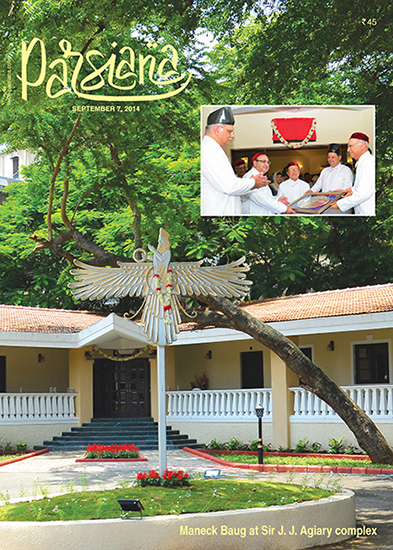
Cover: Poona’s Maneck Baug, (inset, l-r) Sir Jamsetjee Jejeebhoy, Firdaus Masani,
Meher Anklesaria, Behram Pudumjee and Kavas Patel
Photographs by Dilip S. Melwani
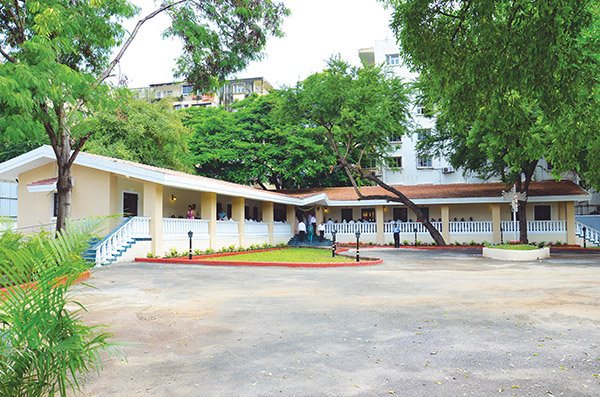
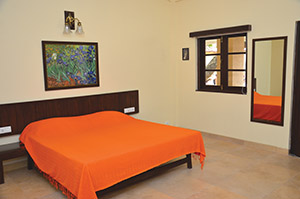
Maneck Baug (top) and a room in the facility
A jashan to mark the opening of the new wing was held on the same day and attended by some 200 well-dressed invitees, the women in beautiful kor ni saris and many of the men in daglis. It was a dry day fortunately so the overflow of guests from the two verandahs of the Baug could be safely accommodated on extra chairs outside.
After the hour-long jashan held in the new premises, the eighth baronet Sir Jamsetjee (Rustom) Jejee- bhoy thanked all those who had helped with their time and expertise in making Maneck Baug, built at a cost of Rs 1.75 crores, a reality.
"First I must thank the trustees for their understanding and patience. On a personal note I thank them for allowing me to name these rooms after my father (Maneckjee),” said Sir Jamsetjee.
A dedicatory plaque above the door to the small foyer, unveiled by Sir Jamsetjee, reads: "This building is respectfully dedicated to the enduring memory of Sir Jamsetjee Jejeebhoy, 7th Baronet, who served as trustee and chairman of the Sir Jamsetjee Jejeebhoy Poona Fire Temple Fund from 1948 to 2006.”
The eighth baronet presented salvers and medallions to the various agencies and people who had participated in the Maneck Baug work, such as Banoo and Rusi Boocha, whose firm Russell Fabricators designed and fabricated the elegant Asho Farohar that stands tall among the flowerbeds surrounding Maneck Baug.
The prettily laid out flower beds and lawns were the handiwork of Behram Engineer, who runs a small nursery and Hoshang Jamshedji, a passionate gardener.
The "master craftsman” as Sir Jamsetjee called Firdaus Chindhy of Poona’s celebrated furniture makers, "did what he had to do as a labor of love.”
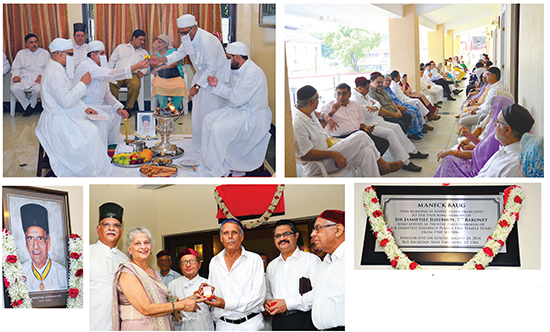
(Top row, l-r): jashan; invitees; (2nd row, l-r): Portrait of Sir Jamsetjee Jejeebhoy, 7th Baronet; Sir Jamsetjee Jejeebhoy,
8th Baro- net, Banoo Boocha, Meher Anklesaria, Rusi Boocha and Firoze Damania (ext r)
Firdaus Masani’s company SEW Engineering India Private Limited did all the electrical work for Maneck Baug.
Kekoo Colah, chief executive of Shapoorji Pallonji, the firm that did the civil work like paving, drainage and outside lighting, was thanked. Sir Jamsetjee also acknowledged Pallonji S. Mistry and his son Shapoor for their sizeable donation towards the construction of the rooms.
It was then the turn of Sir Jamsetjee to get a pat on the back from Meher Anklesaria, chairman of the local managing committee for Sir J. J. Agiary, for doing "so much development in so short a time.”
In fact, the development of the Agiary’s premises was there for all to see. A multi-purpose air-conditioned hall was built a short while ago that can be hired for small parties for Rs 8,000. At the far end of the grounds is the original, long, enclosed verandah-like structure that is given out for the "Parsi exhibition” that much of Poona flocks to, to buy traditionally embroidered blouses, sudrehs, condiments, embroidered dressing table sets and the like.
Before a sumptuous traditional lunch catered by King’s restaurant (whose speciality is their creamy falooda) guests were free to look at the new rooms. The six rooms are arranged in two wings of three rooms each, with a small foyer in the center and behind it a kitchen. An open verandah runs down both wings so all the rooms open on to it. There is greenery all around.
The rooms are equipped with a wardrobe with a built-in safe, a leather sofa, desk and luggage rack apart from the double bed. There is a TV in the lounge but not in individual rooms. Each room has a bathroom with all modern amenities.
Lady Delara Jejeebhoy pointed out the ramp that is built at the end of one wing, providing easy access to the wheelchair-bound, a feature that most buildings callously ignore.
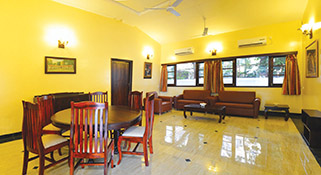
Common lounge at Maneck Baug
The charge is Rs 2,500 a day for the twin-sharing room, and Rs 500 per head for meals — breakfast, lunch and dinner — catered by King’s restaurant on East Street. The rooms will be operational from September.
The dilapidated priests’ quarters were cleared to make way for the new rooms. But not before going through 25 years of litigation to get the family of the deceased priest to move. "We then got permission from the Cantonment Board to demolish and rebuild on the existing area, and that’s why it’s just six rooms,” Sir Jamsetjee explains.
Though Poona does not lack hotels, it does lack good, affordable accommodation. Weddings are often held in the grounds of the Agiary and Maneck Baug would be ideal to put up out-of-town guests.
In 2009, the Agiary itself underwent an extensive renovation to emerge looking fabulous. "The entrance, main hall, kebla and passage were done first and a year later the dadgah and then the muktad room,” said Sir Jamsetjee.
There were nearly 100 tables in the muktad room now and the fresh flowers provided by the Agiary (not brought by individuals as in most agiaries), in their silver vases were a truly beautiful sight during the 10 days of prayers for the departed.
The wooden ceiling of the main hall was stripped of paint and now shines with polish. The flooring was re-polished and replaced and there is marble cladding on the walls. On either side of the main hall are two enormous antique wooden chests which were rescued from obscurity.
The Sir J. J. Poona Fire Temple Fund paid for much of the renovation, but Poona’s Parsis came forward to donate generously, says Sir Jamsetjee, and their names are listed on two plaques inside the Agiary.
The Poona agiary is one of four agiaries established by Sir Jamsetjee Jejeebhoy, the first baronet (1783-1859), the merchant prince and founder of the line. The others are in Navsari, Surat and Adajan.
The Jejeebhoy Trust also funds holiday villas and a sanatorium in Khandala, the Jamsetjee Jejeebhoy Dharamshala in Udvada and Jamshed Baug in Navsari, which is along the lines of Maneck Baug.
Rustom Jejeebhoy said that the first baronet visited Poona often and had a house called Fountain Hall where the Nehru Hall currently stands, at the corner of Moledina Road. He thinks that the Parsis of Poona felt the need for an agiary in the area and the munificent baronet obliged them.
The philanthropy of the first Sir Jamsetjee Jejeebhoy is legendary, with numerous public institutions and causes being financed by his generosity. Most well-known among them was the J. J. School of Art and the J. J. Hospital in Bombay — long since run by the government though there is still a Parsi ward for old and indigent Parsis in the Hospital that is maintained by the Jejeebhoy Trust and was recently refurbished. He also established the Parsi Benevolent Institution, the first indigenous educational institute in western India that has been educating children for the past 125 years.
Does such a legacy not put a heavy burden on succeeding generations?
"It’s not a burden but a privilege,” replies the current baronet. He lauds the vision of his ancestor in setting up institutions for which he perceived a need.
It is remarkable and commendable that more than a century and a half later, the funds and the commitment to maintain many of the institutions that still survive, and to add new ones, continues.
◆ ◆ ◆
From the archive