
Politics and Policy
Disturbed by Delhi
Radical moves initiated by the Delhi Parsi Anjuman resulted in the Federation passing a resolution requesting them to maintain the present status quo
Belying fears that the four to three unconcealed split among the Bombay Parsi Punchayet (BPP) trustees would reflect in the workings of the executive council and annual general meetings of the Federation of the Parsi Zoroastrian Anjumans of India (FPZAI) finally convened on September 13 and 14, 2014, those seated at the main table were remarkably civil and restrained.
As BPP chairman and Federation president Dinshaw Mehta mentioned in his opening remarks at the Banaji Atash Behram Hall in Bombay, "We are too small a community to keep fracturing it… We are losing credibility… Let us stop this bitching, infighting and put aside our egos which are humongous…and work together for a common cause.”
Among the common causes the Federation body unanimously supported was to send a resolution as read out by Federation joint honorary secretary and BPP trustee Khojeste Mistree to the president of the Delhi Parsi Anjuman (DPA) Yezad Kapadia requesting him to "maintain the status quo” with regard to membership, rather than accepting Zoroastrians not born of Parsi parents. "The burial ground in Delhi should not be used for non-Parsi/Irani Zoroastrian burials. The benefits from the DPA should not be given to other ‘sister communities’ as it should be used only for the Parsi Zoroastrians in India,” the resolution further noted.
As BPP chairman and Federation president Dinshaw Mehta mentioned in his opening remarks at the Banaji Atash Behram Hall in Bombay, "We are too small a community to keep fracturing it… We are losing credibility… Let us stop this bitching, infighting and put aside our egos which are humongous…and work together for a common cause.”
Among the common causes the Federation body unanimously supported was to send a resolution as read out by Federation joint honorary secretary and BPP trustee Khojeste Mistree to the president of the Delhi Parsi Anjuman (DPA) Yezad Kapadia requesting him to "maintain the status quo” with regard to membership, rather than accepting Zoroastrians not born of Parsi parents. "The burial ground in Delhi should not be used for non-Parsi/Irani Zoroastrian burials. The benefits from the DPA should not be given to other ‘sister communities’ as it should be used only for the Parsi Zoroastrians in India,” the resolution further noted.
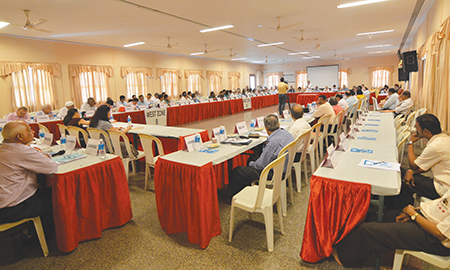
Federation meeting in progress
"Today the social media is very strong,” pointed out DPA representative and newly appointed joint honorary secretary of the Federation, Farrokh Rustomji, referring to the "awareness spread within a very short time” of the proposed changes that were to be decided at the DPA annual general meeting on September 21 (subsequently the DPA trustees defused the crisis by deciding that no vote on the reforms will take place at the September 21 meeting and that a specially constituted committee will first study the proposed revisions — editors). In his background note Rustomji explained that there is a "drastic increase” in the number of interfaith marriages among North Indian anjumans because of which years ago non-Parsi spouses were already accepted as associate members of DPA with no right to trusteeship, to enter the dar-e-meher or to burial at the Parsi aramgah. Stories in circulation that the agiary has thrown open its doors to non-Parsis and the head priest is being pressured to accept them "is a figment of imagination,” said Rustomji clarifying that "if the DPA members want (to give further rights to non-Parsi spouses) it will happen, if not, it will be a closed chapter.”
Acknowledging that "it was an unhealthy precedent that goes against the ethos of the Federation,” Mehta said he was permitting members of the Federation to express their views on the internal affairs of the anjuman since it was a major issue that could have bearings on other anjumans. The proposed change to permit Zoroastrians, even those with no Parsi connection, entry to the dar-e-meher, made Mistree remark that "all the Mikhail Chistyakovs (the Russian Zoroastrian who was assaulted in Sanjan by a group of 40 Parsi vigilantes when he was being initiated as a navar) of the world and all others…will be able to enter our consecrated places of worship.” If they plan to turn into a secular organization by helping ‘sister communities’ they "will have difficulty continuing as members of FPZAI,” felt Mistree. Clarified Mehta, "It is not correct to threaten them. We must be inclusive, not exclusive and drive them out…We don’t want to rock the boat at the current juncture.”
When former BPP trustee Burjor Antia who spearheads the defunct anjumans subcommittee was invited to express his views on this subject, he noted, "We are forgetting why we came to India — to preserve our religion, community, traditions and customs… With mixed marriages we will be wiped out…Our endeavor should be to preserve our religion and Parsipanu. Don’t allow our forefathers’ sacrifices to go in vain… Some Parsis are ultramodern. It is dangerous. It is suicidal.”
"Zoroastrians can continue to be large-hearted and accommodative…but let us respect the wishes of those who have donated property for the betterment of the community… Preserve the identity of ours that we have maintained for a couple of thousand years,” stated Brig (retd) Jahangir Anklesaria, president of the Ahmedabad Parsi Panchayat. Reiterated Jabalpur representative Bakhtawar Karbhari, "We need to draw the line somewhere.”
"To my mind, DPA has already violated certain things when it has thrown open its dharamshala to non-Parsis,” said Nargol representative Hoshang Wania who added, "Today the so-called rich Parsis stay in the Taj and their drivers stay in the dharamshala.” This claim was promptly and loudly rebutted by Dadi Mistry, former DPA president and current Zoroastrian representative on the National Minorities Commission: "No. No. No. Please do not make (false) accusations.” This facility is mainly for business contacts who visit Delhi. "A non-Parsi who wants to stay has to be recommended by a Parsi member of the DPA.” To dispel fears that this leaves Parsis with no rooms, Mistry clarified, "You look at the occupancy. There is enough vacancy at any point of time.” Being the only founder member of the Federation now remaining he made a plea "with folded hands” not to use the Federation platform "just to attack but to live together as Zoroastrians.”
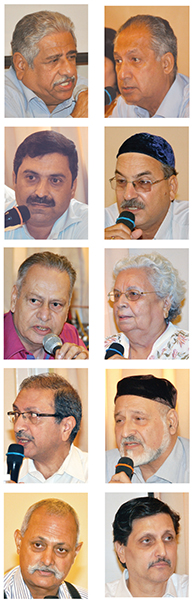
New team of Federation office bearers
(clockwise from top left):
Dinshaw Mehta, Tehmton Anklesaria,
Mancher Mubarakai, Mani Clubwala,
Khojeste Mistree, Yazdi Desai,
Brig (retd) Jahangir Anklesaria, Farrokh Rustomji,
Russi Jeejeebhoy and Sam Chothia
Since the Federation had "tried to put combined pressure” on the DPA, former BPP trustee Jamsheed Kanga representing the Satara anjuman proposed that the Federation member anjumans pass a resolution he had drafted concerning the BPP. He sought to collectively appeal to the BPP board "to sort out their differences and restore the dignity of the BPP and not shame our community in the public eye… In the past the trustees of the BPP have always been looked up to by all as akabars and leaders of the community as they acted in the best interest of the community and provided wise leadership to Parsis all over the world. They were dignified in their dealings and sorted out all issues within the community with decorum… We are sorry to note that within the present lot of trustees there is so much division and dissension that no work is being done in the BPP and by filing criminal and other cases against each other they are bringing shame to our community…” The ensuing pandemonium in the hall made Mehta advise Kanga, "Javaa dé ni, kai controversy karéch (forget it, why create a controversy)!”
Some of the issues that had suffered because of differences among the trustees was a report submitted by a subcommittee constituted at the last Federation meeting in January 2013 to suggest revised rules to improve the Federation’s functioning. Regretted Bomi Heerjee, president of the Indore anjuman and chairman of this committee, "We had submitted our report a long time ago. There is no mention of it on the agenda of this meeting. The rules are probably lying somewhere beyond the purview of this meeting… This is poor appreciation of our efforts… It hinders any suggestion we may like to make. The draft rules should not only have been circulated, they should have been discussed.” Explained Mehta, "Unfortunately because of the split (in the working of the BPP), your proposal for changes, although on our (BPP) agenda... no discussion has yet taken place. As soon as it is discussed it will be forwarded to the member anjumans for approval, probably by the next meeting.” Clarified Kanga, "These proposals are for the Federation... There is no precondition that the BPP has to decide. Please don’t delay. I don’t think you (the BPP trustees) will ever agree on anything.” Mehta maintained that he was hopeful that the "BPP could give inputs” but would now circulate it to the other member anjumans like they had the proposed custodianship agreement as drafted by the defunct anjumans subcommittee.
As explained Antia, the custodianship agreement is "in the larger interest of the community and community properties worth crores of rupees… Please sign the custodial agreement as early as possible.” The agreement between the Federation and an anjuman is meant to come into force when the anjuman’s numbers decline to 15 or less to primarily safeguard its real estate. Just as Muslims have got their Waqf laws to ensure their community properties cannot be encroached upon or sold, Parsis would like to bring in a similar act because "the bottomline of all our problems is the properties encroached by non-Parsis or Parsis claiming community property to be their own.” Added Mehta, "If you feel some clauses are not acceptable we are open to revision.” Madras and Calcutta had submitted their recommendations which the subcommittee would consider. When Rustomji suggested, "Let it be a time-bound action… Send in your suggestions within 30 days or we will assume you have approved it in principle,” he was surprised with the backlash from the West Zone B members representing the smaller anjumans of Gujarat.
Thundered Pervez Khergamwalla of Khergam, "I will never give my anjuman.” According to him, his uncle, father and he had sold portions of their family land to maintain the agiary "and you want it in one second? That will never be.” The Gujarat anjumans misconstrued approval of the custodianship agreement draft as a commitment to compulsorily sign the agreement and surrender their properties to the Federation. With their inherent mistrust of octogenarian Sorab Katpitia (who hitherto single-handedly managed the defunct anjumans portfolio) and his assistant Jimmy Bacha who in the absence of cooperation from anjuman office bearers would get records of their properties by filing a scheme with the government authorities, they construed the current Federation efforts as attempts to usurp their property.
Khushman Tamboli of Rajkot asked how the members can be expected to have faith in the Federation "if the organization is unable to look after itself?” He was alluding to the previous day’s annual general meeting when joint honorary treasurer Yazdi Desai reported that the accounts had not been finalized after he realized that an expenditure of Rs 36 lakhs shown in the BPP accounts as being made towards the Federation is in actuality being directed to a bank account in Surat without appearing on the Federation books. When Katpitia tried to explain that these funds are forwarded to him for distribution to dole recipients who earlier did not get their money orders by post, Mehta told Katpitia, "There is no allegation against you… It is a question of accounting principles.” According to Desai, it reflected "a lack of audit trail.” This being BPP money, Mehta said he would let the BPP auditor Falee Billimoria investigate the matter.
Among the Federation members, the Mhow anjuman that has been repeatedly lauded for being the first to sign the custodianship agreement with the Federation was under attack from former Mhow resident Pervin Jehangir who was representing Ilav at this meeting. She had circulated a letter without the chairman’s consent vilifying the Mhow anjuman and Federation office bearers for proving themselves "unworthy of being trusted” in connection with a land transaction they were proposing to enter into. By virtue of the veto power granted to each one of the nine Mhow trustees she managed to stall the land sale. The agitated vice president of the North Zone Tehmton Anklesaria reported, "For a trifle issue the lady has gone to the charity commissioner,” and urged her, "Don’t misbehave. We are not chors (thieves).” According to the Mhow anjuman president Cyrus Mancherji, she has been "a divisive element…ever since a new committee was elected in 2011” which she did not approve of.
Pervez Irani of the Iranian Zoroastrian Anjuman (IZA) pointed out that last year at the Federation meeting there was a letter in circulation stalling the sale of IZA land at Palghar. He advocated the need to pass a resolution prohibiting the circulation of such letters without the consent of the Federation office bearers.
A detailed report of the two-day proceedings will appear in forthcoming issues of Parsiana.
◆ ◆ ◆
From the archive