
In Memoriam
Instrumental ingenuity
Died: Vistasp Ardeshir Balsara, 82, music director of Bengali, Assamese, Oriya and Hindi films regarded as the Grand Old Man of Music in Bengal, on March 24, 2005 in Calcutta following cancer of the esophagus.
Thousands, including chief minister Buddhadev Bhattacharya, came to pay homage to the maestro as his body was laid out in state at the Saurabh Music Academy in Calcutta where he was president. "The scenes of grief that night as devoted followers came to pay their last respects would explain what cultural Bengal had lost that day,” noted a two-page tribute to the music legend in Calcutta Gavashni, January-March 2005.
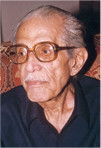
Having arranged and scored music for almost all the great singers from the earliest talkies to modern-day films, the ever humble Balsara had managed to adjust to all situations and to all kinds of performers, first when he was residing in Bombay and later when he migrated to Calcutta. Well known singers like Lata Mangeshkar, Asha Bhosale and Manna Dey respected his knowledge of music and valued his harmonium accompaniment. For the recordings then, the lead singer with the harmonium player would be on one side of the studio and the rest of the orchestra on the other side. One of Balsara’s pupils Ratan Mehta who must have accompanied Balsara to innumerable recordings which were a daily feature in those days, recalls Mangeshkar respectfully enquiring ever so often regarding Balsara’s presence, "Balsaraji hai kya?” From Monday to Saturday Balsara was in demand by the five most popular music directors of those days — Naushad, Shankar-Jaikishan, Anil Biswas, S. D. Burman and Kalyanji-Anandji — who had given him standing instructions to report at the studio daily. In that exclusive bracket of well paid artistes, he would receive Rs 100 per recording in those days.
"The interlude music of many a Hindi film song was to the strains of Balsara’s magic… For the song Ai mere dil khai aur chal sung by Talat Mehmood in the film Daag, the accordion was played by him,” recalls his fan Roda Hakim from Baroda. She also gives him credit for making a success of the Youths Own Union where he was a founder member. Besides hosting "some of the most memorable musical evenings…he made singers of so many Parsi youth. When Parsis were predominantly into western music, the love for Indian music was sown at such programs.”
Best known among the present generation for his proficiency on the harmonium and univox, Balsara, as his admirers recall, had once played 13 instruments in the course of one performance! A particularly unusual feat was his ability to play Indian classical music on a western instrument like the piano. "The supreme harmony that emanates from both his solo and jugalbandi (where two musicians play different instruments) performances leaves his audiences spellbound. While presenting the raags, his piano chords maintain the ethics of the purest form of raagdaris,” acknowledged tabla player Aban Mistry in her book, The Parsis and Indian classical music — an unsung contribution.
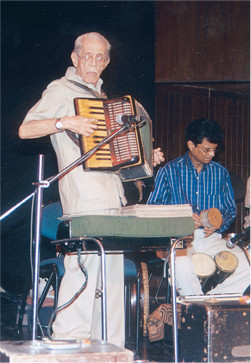
Balsara (top and above) giving accompaniment on the accordion
Among his compositions which have been recorded on audiocassettes are Raga on Keyboard and Duet on Piano (in both of which he played the piano), Raga Mood (orchestral compositions based on 10 Indian thaats), Colour and Moods (eight orchestral compositions without any black notes and five without any white notes), Shades of Tagore and Debatar Grash (orchestrations of Tagore’s songs and poem), 32 Bhajans based on 32 raagas tuned by him and Bhajan Bhav. His Learn and Play demonstrates exercises for practice of 304 scales! In fact he had written the notations of five to six of his popular cassettes in a book form in order to facilitate students of Indian classical instrumental music. He authored and published several books like Chords and Harmony in Indian Raagas, Easy Practising, Finger Exercise, Music Guide to Practise in 304 scales. These titles were compiled into one volume, Orchestra, by Delhi’s Sangeet Natak Academy.
Born in Bombay, Balsara’s initial training in music was under the tutelage of his mother Najamai and by the age of six he could play bhajans on the har-monium, it was recorded in his biography in Bengali authored by Shukla Ghoshal. He was subsequently groomed by Framroze Shroff, Ustad Bachumiya, Madam Hilda Feildberg and Pandit Munneshwar Dayal, notes Mistry in her book. Working for His Master’s Voice, he gained popularity as a musician, invited to record for Hindi film songs in Bombay. He was reportedly the founder secretary of the Cine Musicians’ Association and was also involved with the Music Directors’ Association.
In 1954 he migrated to Calcutta with three rupees in his pocket and stayed at the Dharamshala until work and wages came his way. For years he was at the helm of Calcutta’s famous institution Saazowaaz. A great admirer of Ravindra sangeet, Balsara had Rabindranath Tagore’s songs translated and presented in 16 Indian and eight foreign languages. For one of Tagore’s poems he had organized an Indian orchestra with 80 musicians!
When the Calcutta Municipal Corporation reopened on August 15, 1998 the historic Town Hall was dedicated to the people of West Bengal and a special reception accorded to four eminent Calcuttans: freedom fighter Kamala Mukherjee, singer Suchitra Mitra, Balsara and poet Golam Kuddus who were presented plaques and flowers.
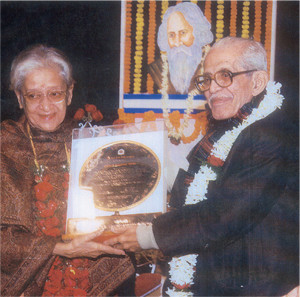
Balsara (right) receiving award from Suchtra Mitra
His international concert tours had taken him from USA to USSR and from West Indies to Japan. Within India too he was constantly in demand and his biography mentions how two days before a concert in Bhubaneshwar in 1995 came the news that his second son Sarosh had died in Germany at the age of 48. Though he was advised to cancel his trip, the disciplined musician felt obliged to fulfil his commitment in Bhubaneshwar before proceeding to Bombay for the last rites of his son. His elder son Hormazdyar had died when he was but 14 years of age. Valuing his wife Aloo’s support, Balsara had acknowledged, "While I nurtured music, she nurtured me.” She passed away in 2001.
Among the awards conferred on Balsara were the Sangeet Natak Academy Award, the Sangeet Research Academy Award, The Shiromani Award, Indira Gandhi Award, Rajiv Gandhi Award, Bhuvalkar Award, Satyajit Ray Award and the Swar Sadhna Ratna Award.
In 1970, Balsara selected some compositions from Firoze Batliwala’s Sarod-e-Avesta, redefined them and got them sung in the melodious voice of his disciple Dhunawaz Indorewala through the INRECO Record Company. At the time of the Parzor celebration in Calcutta in January 2004 when Balsara was receiving his share of attention as a talented musician, he had commented, "In the same way in which Zara-thushtra had given the message of Ahura Mazda to the world, Parzor had brought the message of Zoroastrian culture to Calcutta.”
With standing instructions to report at Balsara’s house at 7.30 in the morning for his music lessons, his disciple Mehta would invariably find the maestro engaged in prayer or in creating beautiful music in the early morning hours. After communing with God the genius would proceed to share his love for music.
◆ ◆ ◆
From the archive