
Professions
Thank you for the music
More than the monetary returns it is their love for music that keeps the bands and DJs continue with the business
Music and majaa (gaiety) make it memorable. From the soft and sonorous strands of the early hours to the strident and sizzling shrills as the evening progresses, the music providers feel obliged to make wedding and navjote functions enjoyable for the hosts and the guests, the young and the old, the dancers and the foot-tappers.
Almost all the Parsi initiated popular bands that had their heyday in the last century seem to have played their swan song except for the Dara Mehta founded Darling Orchestra that is now being led by his son Marazban, Hijackers, by Mehernosh Tantra, another in the name of Zubin Mehta and his Melody Boys, and Zarinaa and Party, the only one in charge of a lady, Zarin Variava. The days of Goody Seervai or Nellie Battiwalla serenading guests on their accordion seem to belong to a bygone era. As compared to six or eight or 10 performers who constitute a live band with a minimum of two singers (one for western, one for Hindi Bollywood numbers) and other instrumentalists — on the keyboard, guitar, drums, congo, bongo, saxophone, music these days is in charge of a single DJ (disc jockey), occasionally accompanied by a compere.
Having started singing in his father’s band "at the age of five,” Marazban Mehta’s "forte is singing duets in a combination of male and female voices.” Over the years he has "mastered various instruments like the drums, percussion, rhythm congo, bongo, octopad and keyboard.” Bookings for the Darling Orchestra are few and far between although their rates of Rs 6,000-6,500 are comparable to those charged by the DJs for an evening of recorded music. Now 61 and retired from the Wadia Group of Companies, he focuses his time on training the boarders of the A. F. Petit School and regaling audiences at community functions and institutions in his individual capacity. Having brought out a cassette of religious and traditional songs Chhaiyé Hamé Zarthosti, he is happiest when on a rare occasion a host says, "Chaalo majaa aavsé (we will have fun) let’s have some garba numbers.”
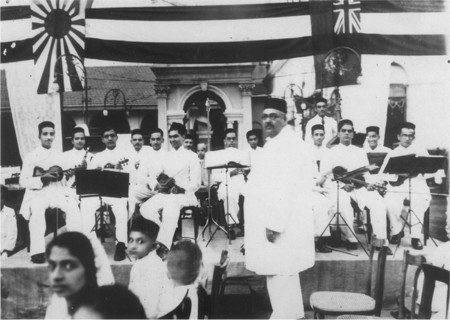
Young Men’s Parsi Orchestra in the early 1940s
Another band leader today who also had his first break with the Darling Orchestra at the age of eight is Zubin Mehta. Initially singing and later playing instruments like the congo, dholak, octopad (both roto and base), drums… he formed his group Zubin Mehta and his Melody Boys over 25 years ago. "Nowadays, 99 percent of the Parsis have DJ music,” he observes and hence his live band has been more in demand for functions organized by Sindhis, Gujaratis, Punjabis whom he charges around Rs 20,000. Along with a partner he also offers DJ music facilities to those inclined towards it. His son-in-law being the owner of Joss restaurant, Zubin Mehta has also been regularly playing there.
Most of the time, music is well received by the audience but there could occasionally be "some fussy party who may ask for the music to be made soft. All five fingers are not the same,” he believes. If the volume is turned down "dushman ni maiyaat maa aavélaa hoi tévu laagé (it would feel as if we are attending an enemy’s funeral),” he adds.
The volume complaint is mainly due to "people brainwashing each other that the music is loud or competitors trying to run down” pulsating-vibrating music, states Mehernosh Tantra who started his stage career 40 years ago as a singer and anchor with Pervez Bulsara’s band and after gaining experience with other bands, formed his own group, Hijackers. When required, he offers DJ music too which he hopes "is just a passing phase. When we were young we enjoyed jam sessions. Similarly today’s youth like to go to pubs for DJ music. It is a craze started after the CDs came into existence,” he observes.
A banker by profession, music for him "is more of a hobby,” and his rates may differ depending on the customers and the services needed. He is also known to offer concessions and perform free of cost, if he is so inclined. There is tremendous "cut-throat competition,” with even videographers/photographers offering music — originally as a complimentary deal and subsequently charging for the service. He is pleased that his band is invited not only in Bombay but has, on occasion, performed in other parts of India and even overseas.
"Business has gone down in the last four years with the coming in of DJs,” acknowledges Zarin Variava. Customers find DJs more economical as not only do they have to pay a lower sum for the recorded music but also because they do not have to offer a free meal to the six or nine members of the band. As compared to Parsi functions that may come her way once in two months, her band has many more bookings from Gujaratis, Sindhis, Punjabis, NRIs... Just as the venue could be open grounds or the confines of five star hotels, her package too, starting at Rs 15,000 could come inclusive of baraati singers/horses/magicians/acrobatics/dancers, depending on the customer’s choice.
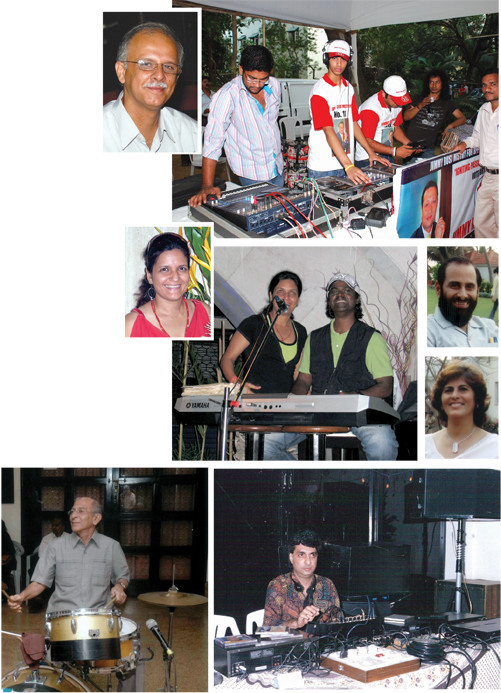
Top row: Sarosh Daruwalla and his high-end music system; (middle) Zeba Namdarian (left and center), Rashid and Armaity Bamanbehram; (below) Marazban Mehta (left) and Fredoon Behramfram
"It is very unfortunate that the band trend has stopped since 1996 due to the electronic sound revolution,” laments Sarosh Daruwalla of Mazda Audio Video Lab who is really keen to "support the revival of bands. Why should they be left behind?” he queries. For a band comprising largely of Parsi singers and musicians, he is willing to offer his sound systems at rates affordable to them, realizing that band members get insignificant amounts for the time, efforts and conveyance costs that they have to incur to ferry their instruments. "Kids love bands,” he states and therefore at navjote functions particularly bands should be available for them. This would also ensure that "Parsipanu rèhsé with the singing of Parsi songs and monajats” instead of the prevailing practice where DJs "bham-bham vagareené jaay (play thumping recorded music and depart).”
Daruwalla himself has invested Rs 40 lakhs to import the superior technology L’acoustics equipment from France for his functions in India. Whilst industrial houses like Tatas, Birlas, Mahindras book his services for their corporate functions, this equipment is also used for popular community events like the May Queen Ball, the Navroz function at the Dadar Parsi Colony Gymkhana or the more recent Jimmy Mistry mega function attended by 5,000 Zoroastrians bringing to a close his weeks of election campaigning. The flying speakers, 20 feet above the ground, ensure that the loud music does not hit the ears. His rates may vary from Rs 6,500-20,000 depending on the client’s choice of three music systems on offer — dB, Bose or L’acoustics. His speciality is "good, clean music. We play pumping music whilst maintaining certain decibel levels as we believe people come to a function not particularly for the music.” Only his team of 12 members is qualified to handle his sound systems, not even his son Aarish who wants to take over this aspect of the business, says the father. While Aarish has done a DJ course and helps out at pubs, it is only after he completes his studies in sound engineering that the father will consider him suitably qualified.
Celebrating his silver jubilee in the sound business that he launched in 1983 in the name of Sharps and Flats, Daruwalla gratefully records the necessary inspiration he gained from pioneering stalwarts Sam Poonawalla whom he had assisted for Mithoo Jesia’s shows Amar Jyoti Zarathushtra and Sarosh Bhabha. "They have shown us the way,” he maintains. When he introduced videography and photography to his business, Daruwalla changed the name of his concern to Mazda Audio Video Lab. While some clients come to him asking him to handle all three — music, photography and videography — Daruwalla says he is equally happy when clients distribute the business among three Parsi professionals. In fact, when customers do that he feels his earlier efforts to break the monopoly of some professionals at venues like Allbless Baug, Cama Baug and Sethna Agiary are justified. He hopes Malcolm Baug too would discontinue their monopoly system which instead of improving service only breeds complacency. Which Parsi professional gets the business and who gets to make profits is of no consequence to Daruwalla so long as everyone gets an opportunity to earn for ultimately, "Parsi naa paisa Parsi maa rèhvaa joié (wealth of the Parsis should remain within the community).”
When Maharukh Dadachanji came up with Valentine Audio around 15 years ago there were more live bands than DJs, she recalls. Determined to give the customers "a good substitute for the bands without compromising on the quality of sound,” she felt it necessary to invest in superior equipment. She soon realized that there is hardly any profit in this business which although seasonal, requires that the equipment be regularly maintained and upgraded.
"My USP (unique selling proposition) is that I really try hard to get people on the floor.” She feels she has done her job well when Parsis leave the choice of music to her saying, "We have seen you perform… dhamaal masti hovee joié (it should be lively and entertaining).” With 80 percent of her clientele being Parsis, she says, "There are different genres of customers — those who are particular and come with a definite list of songs, even the sequence in which they are to be played and others who leave the choice to me saying there should be a blend of western and Indian.”
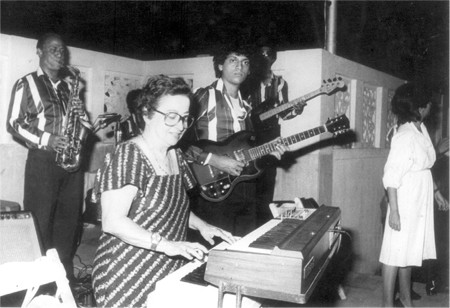
Legendary Nellie Battiwalla (on the keyboard) with her band
Experience has taught her that it is best to start with sober, English instrumental music in the early evening when most in the audience comprise ghérwalas (relatives). Knowing that the elders want to talk in contrast to the youngsters who want thumping music as an impetus to start dancing, she changes the direction of speakers as the volume is turned on. "My aim is to please 80 percent of the people 100 percent of the time,” she sums up. Additionally there is the factor of causing disturbance to neighbors in the vicinity that should also be handled sensitively, she realizes.
In the course of undertaking photography and video assignments, Armaity and Rashid Bamanbehram would be requested by clients to undertake music jobs too. Thus they included the sound dimension in their package in the mid 1980s. "It was more as a friendly service to the customers,” mentions Armaity. While they have to keep adding on to their repertoire of music, there are some eternal favorites which have to be carried to every venue, states Rashid — if it is a wedding, Here comes the bride and Congratulations will invariably be played; and if it’s a navjote — the children’s favorite Birdy Dance and Boogie-Woogie.
"I have one of the best collections in music, starting with the 1930s…the boodhas (seniors) get thrilled,” says Fredoon Behramfram who introduced Karl’s Classic as a hobby nearly a decade ago. Whether providing music for weddings or navjotes, or both music and lights for private parties and New Year nights, he ensures that he carries his superior sound equipment which includes "high decibel Bose designed speakers that throw out equal sounds that are crisp and don’t hurt the ears,” he explains. Since his valuable equipment has to be handled with great care he does not provide music for boat parties nor will he accept jobs for rave parties where there could be a possibility of drugs.
Whilst holding on to his full-time job at TCS, Rayomand Ambapardiwalla does DJ work as a hobby that he started after his wedding in 2001. Although most of the clients who opt for Soundwavez music are Parsis he accepts assignments from BPO companies, call centers and has also played for jam sessions. When there is a small or medium sized crowd he brings his own equipment and even arranges for disco lights but if there is a larger function on open grounds he borrows. "I adjust the volume as per the area,” he conveys, pointing out how elders constantly request ‘music dheemu karo (make the music soft)’ and the youngsters insist, ‘bau dheemu chhè (it is too soft); we can’t enjoy.’”
Among the Parsis there is a lot of demand for Bollywood and less of international music, notes Merzin Pardiwala whose outfit Crazy Sounds has been providing music for the last five years. Having always wanted to be a DJ it was a dream come true when he borrowed three-and-a-half lakh rupees to buy professional equipment including Denon and Pioneers where the volume, sound, sharpness and clarity can be assured at clubs and discotheques. While a sitting speaker may hit the ear, when using a flying system, sound travels on top so as not to jar the listener. Although he has gained a few Parsi clients and more non-Parsi customers, Pardiwala candidly admits that the demand for music "is not as much as I had expected.”
"With Parsis diminishing to a great extent, the (celebratory) events are naturally fewer,” points out Zeba Namdarian who did a three-month DJ course where she was taught how to mix songs and beats in music, and exposed to crowds in parties until she got the necessary confidence to handle assignments independently. Now while her associate does the DJ work Namdarian does the compering: "I talk and entertain. You have to interact. You have to enjoy and make the guests enjoy. Basically it is up to you how you get the people on the floor. Now what runs is only Bollywood. The Hollywood numbers of the ’70s-’80s are only played in the early part of the evening.” In her candid style she insists, "Music has to be loud. It has to hit your heart. It has to reach every corner of the baug.” Strumming the guitar in her younger days, now along with Sal Hutton on the keyboard she enjoys singing duets and organizing karaoke nights on Wednesdays and Fridays. With her experience in bartending "where the best of music was around me” she is confident of offering her clients a complete package with music, cocktails/mocktails, magic show, tattooing, hair braiding, jugglery…
More than the volume control, almost all the musicians/DJs that Parsiana spoke to were concerned with the 9.30/10 p.m. deadline when the sound system is compulsorily switched off at baugs and recommended that an extension be sought for this limit. Considering that on a working day most guests come in around 9 p.m. "by the time people get into the mood and take to the floor, the sound is switched off,” points out Variava who feels that in the early evening "khaali khursioné vaste vagaarvaanu (playing for the empty chairs)” seems futile. To adhere to the time deadline, power is switched off at 9.30 or 10 when "everyone is dying for that one last song,” as points out Namdarian. Halls therefore are considered better options as the music can conveniently carry on till 11 or 11.30 p.m.
Apparently none of the musicians or DJs is in a rush to wind up the evening. More than the money, it is their love for music that makes them continue in this field.
◆ ◆ ◆
From the archive