
Law
Appealing for Kobad
A Delhi based nongovernmental organization has written to the National Human Rights Commission seeking justice for Maoist intellectual Kobad Ghandy
An appeal has been made by the Development Research and Action Group (DRAG) to the National Human Rights Commission (NHRC) chaired by Justice K. G. Balakrishnan regarding the continued incarceration of Maoist intellect and analyst Kobad Ghandy presently lodged in Tihar Jail.
The letter dated April 22, 2014 signed by DRAG chairman Dr Gautam Vohra (published here with minor editing) refers to Ghandy’s failing health and requests he be granted bail or better medical and other facilities. Ghandy had written earlier on July 10, 2013 to the NHRC as well.
As a senior citizen of 67 years, Kobad Ghandy’s health has deteriorated in the harsh conditions of the high risk ward and we fear he may succumb to his ailments if he is not provided with care and medical attention forthwith.
The ideal situation would be if the judicial system released Kobad on bail, but for over four-and-a-half years legal delays have meant that Kobad has been unable to get the treatment he immediately requires. His various appeals to the jail authorities have met with limited success.
The letter dated April 22, 2014 signed by DRAG chairman Dr Gautam Vohra (published here with minor editing) refers to Ghandy’s failing health and requests he be granted bail or better medical and other facilities. Ghandy had written earlier on July 10, 2013 to the NHRC as well.
As a senior citizen of 67 years, Kobad Ghandy’s health has deteriorated in the harsh conditions of the high risk ward and we fear he may succumb to his ailments if he is not provided with care and medical attention forthwith.
The ideal situation would be if the judicial system released Kobad on bail, but for over four-and-a-half years legal delays have meant that Kobad has been unable to get the treatment he immediately requires. His various appeals to the jail authorities have met with limited success.
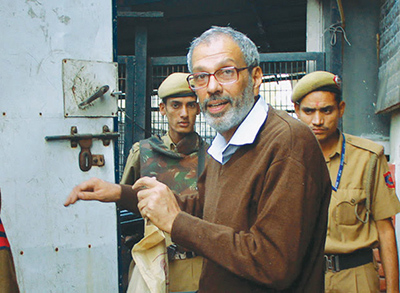
Kobad Ghandy outside Tihar jail
Photo courtesy Tehelka Photographer Shailendra Pandey
On January 7, 2013, he wrote the following to the DG (Director General) Prisons:
"It is now over three months since I wrote to you requesting the status of political prisoners or at least the facilities provided to senior citizens. In that letter I had mentioned my health problems will aggravate in winter. Not only have all problems aggravated, after my eye operation I am instructed not to lift weights, not to bend, not to allow dust for at least one month. Let alone the earlier facilities I am not even being given hot water regularly… For this reason my arthritis, slip disc and spondylitis problems have seriously aggravated. Also having high BP (blood pressure) and heart problems there is serious possibility of heart attack as there is not sufficient heat in the cell.”
He observes that medical care is not the issue, but that of facilities. Kobad states: "This is not a question of medical officials doing anything, it is a question of making facilities available. The medical officers are doing what is possible, but it is for the jail authorities to provide the facilities to a senior citizen.” Kobad requests the DG to shift him to Ward 4, or if he is not then he should be provided the following facilities in the high risk ward:
Facility to heat water. Allow the use of an electric kettle to boil water.
A separate sevadar (assistant) for him; he is willing to pay him what the prison decides
Permission for regular health foods and vitamins from mulaquaat and/or canteen
Right to ring family members once a week, and increase the time limit from five to 10 minutes.
Instead of acceding to his request, the prison authorities imposed further hardships on Kobad by transferring him from his ward. In his subsequent letter to the DG Prisons, dated October 28, 2013, Kobad notes: "After spending four years in Jail 3, suddenly, on October 18, I was transferred to Jail 1. Earlier I was never a part of the routine transfers that have been there since the last one-and-a-half years. I am aged over 66 years and suffer from many ailments, particularly urinary/skin, and orthopedic problems have become acute.
"At the time of transfer itself I was suffering from severe kidney/skin problems since a month and though I had been requesting to meet the SMO (senior medical officer) he never called me… It was in this condition that I had to undertake the harrowing transfer, going through three searches and having to lift my bags (some weighing up to 15 kg) myself no less than 18 times.”
Kobad was not allowed the help of a sevadar despite his request and because of the strain, he suggested that an orthopedic doctor examine him and prescribe treatment and since this was not done his problem has grown worse. Kobad ends the letter saying that there has not been any complaint against him in the last four years and asks the DG to grant him an interview.
In his letter to the superintendent of Tihar Jail Kobad says that he has written to the DG twice but has received no reply. He had drawn attention to the fact that since the charges were framed what remains does not warrant him being put in the high risk ward. Besides some minor Indian Penal Code 420 type charges, the only pending charge against him is under Section 20 of the UAPA (Unlawful Activities Prevention Act). This concerns membership of a banned organization. As per the Supreme Court ruling mere membership is no crime, if it is not linked to violence. There is not a single charge of violence against him under the Explosives Act, waging war, sedition, etc. With regard to the two Andhra Pradesh (AP) cases, the High Court has already granted bail. On these grounds, Kobad does not need to be in the high risk ward and denied his essential rights, especially considering his senior citizen status and very poor health.
Again, Kobad’s pleas have been ignored.
A brief background to his arrest and nature of charges will put the issue in perspective. Kobad was arrested in Delhi on September 20, 2009. It took a full three years for the trial court to merely frame the charges. With court dates being given after gaps of two months and time given at such hearings restricted to one to two hours, the case is proceeding at a snail’s pace. On one court date not only was the witness not cross-examined, the next date given was four months later.
A number of FIRs (first information reports) have been foisted on him and charges so far have been pressed only with regard to three. Most of these cases, the bulk of them in AP are based on unsigned confessions, some going back 15 years. All these cases have consciously been blocked by the police by clamping Section 268 on Kobad which stipulates that he cannot travel to other states for court hearings for fear of escape. Considering his age and ailments, this fear is ridiculous to say the least.
By dragging the Delhi case and by preventing his appearance in cases in other states, he is de facto being incarcerated indefinitely without being proven guilty. Kobad has provided an example of the type of cases foisted on him: "A while back I got a notice for a case in a district of AP dating back to November 1996 regarding some action that I had indulged in purportedly against the police. At that time there was no All India Maoist Party (it was exclusively state-based until the unity procedure in 1998) so how could I, based in Maharashtra, be involved? In fact at that time I was touring Europe — the visa details can be examined in my passport — and a new passport had been issued with full police verification.”
The best solution would be for the court to grant Kobad bail so that he can be cared for and provided medical attention to enable him to recover his health. Until such time, we at DRAG appeal to the NHRC to direct the concerned authorities to shift him from the high risk ward and place him in one where he gets the benefits due to senior citizens. As it is, the four-and-a-half years he has spent in jail, he has already served more than his sentence for any minor violation of the law he may have committed.
Kobad does not need to be in the high risk ward and denied his essential rights, especially considering his senior citizen status and very poor health
◆ ◆ ◆
From the archive