
The trials of time
“High risk” inmate Kobad Ghandy waits in Tihar Jail sans bail for his days in court
The visitors are family members of the "high risk” prisoners who are under-trials or convicted of heinous crimes. A group of young and middle-aged men gather in a small room outside the meeting section and chat jovially. The womenfolk seated outside talk amongst themselves and at one point tell a passing jail official to hurry up and produce the prisoners because they were sitting in the open on a warm summer afternoon without a fan, albeit in the shade. "You sit in air conditioned offices so you don’t know,” shouts one of the women in Hindu jocularly.
The jail official smiles and disappears into a facing, single storied structure. Next to it is another building with a sign painted on the wall stating, "Waiting hall.” But the entrance is blocked off by a wall of bricks sans plastering or paint. Several empty, wooden benches are situated at the building’s periphery.
Finally at around 4.10 p.m. one is permitted to enter the interview hall to be frisked for the fourth time by congenial, youthful Tamil policemen and for finger printing.
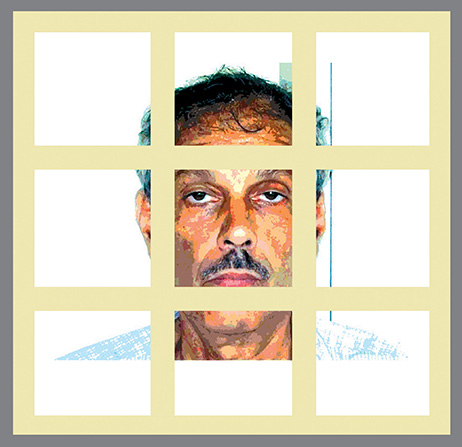
Graphic rendition of Kobad Ghandy’s most recent photograph, taken during his arrest in 2009
In the jangla, the guests and the Jail inmates stand on either side of the sealed partition that is divided into nine rectangular windows with yellow painted iron bars, each counter cordoned by wooden planks. On the black granite top at the level of one’s waist a black microphone is attached and a set of headphones provided. As the prisoners troop in they seek out their loved ones, friends, acquaintances, then position themselves at a window, don the headphones and begin their conversation.
Kobad Ghandy is recognizable from the photos splashed across the front pages of the national Press when he was arrested in South Delhi on September 20, 2009 whilst undergoing tests for suspected cancer. He has no difficulty in spotting another Parsi in the motley crowd. Sixty-three-year-old Ghandy had to stoop a bit to talk into the mike because of his height and occasionally placed his hand on his back as though in discomfort. He has arthritis and as a bed has yet to be installed in his new cell block, he finds getting up and lying down bothersome. Medicines are provided to prisoners and Ghandy’s cataract operation was performed last year at the prestigious All India Institute of Medical Science (AIIMS) by the same ophthalmologist who operated on the president/prime minister.
He is cheerful, happy to meet someone he has corresponded with over five years but never met. His late, elder brother Farokh, who founded Friendly Ice Cream and for a number of years ran a hotel in Mahableshwar along with his wife, was known to Parsiana.
Kobad, a Doon School alumnus had, on completion of his graduation from St Xavier’s College in Bombay, moved to London to study chartered accountancy in the late 1960s. But he was soon drawn to movements in the UK fighting racial discrimination. At a public meeting, a group opposing racial equality created a ruckus and in the melee that followed Ghandy was arrested and imprisoned for three months though he took no part in the fracas.
After his release he decided to return to India where he was attracted to Marxism and the struggle to improve the lot of the less privileged. "I have in some way or another been associated with the Naxalite movement as also Left/radical organizations in Europe. While doing so I have been active in trade unions, bastis, civil liberty organizations, dalits and tribals in Maharashtra,” Ghandy had recounted in a compilation to mark the 50th anniversary celebrations of The Doon School class of 1963. Besides contributing articles on the Indian and world economy as also the caste system in national publications, in 2004 he published a book, Globalization: Attack on India’s Sovereignty. In his struggles he was supported by his wife Anuradha Shanbag whom he had wed in 1977 and described as "not only an academic of renown but also a revolutionary of great commitment…(whose) life was suddenly snatched away due to an attack of malaria” in 2008, a year prior to his arrest.
At our meeting Ghandy was hopeful of his cases being resolved. A bail application had been moved before the Delhi High Court and the Sessions trial had been going well before that. The charges had been narrowed down to membership in a banned organization which Ghandy pointed out was not a crime as per the Supreme Court rulings. He noted he had been granted bail in two cases in Andhra Pradesh and the case filed against him in Punjab was not substantiated.
When asked if there were any other political prisoners in the cell block, Ghandy noted that unfortunately there were not. "There is no intellectual discourse.” The Islamists in the block were fundamentalists who stayed together. Most of the other inmates had criminal backgrounds. Mohammad Afzal Guru who was charged with the 2001 terrorist attack on India’s Parliament was "liberal. But they hanged him,” said Ghandy. Kobad’s sister Mahrouk Vevaina recalls her visits to her brother in Tihar Jail and how Guru would greet and speak to her. "He and Kobad would discuss (the French philosopher and writer Jean Paul) Satre,” amongst other thinkers, she reminisced.
In a letter dated May 20, 2013 Ghandy stated, "Here in prison, from all the religious people around me, the belief (very strong) in life after death (or reincarnation), makes people face death much more calmly. I saw that directly with Afzal — before, and while going to the gallows. I once remember him telling me ‘I am just waiting to meet all the other prophets — Moses, Christ, Mohammad, etc.’”
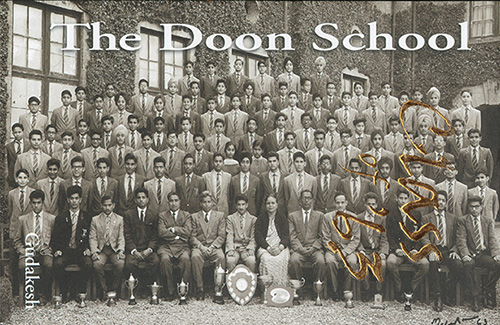
School group with Kobad Ghandy in front second row, fourth from left
Ghandy’s father Adi, a retired senior executive of Glaxo India had accepted his son’s radicalization philosophically. They conversed on the subject. After retirement the senior Ghandy moved to Panchgani. Prior to that the family had been staying at Worli Sea Face above Dr Pestonji Warden who founded Parsiana. Kobad says he was not acquainted with this activist avatar of his neighbor, having left when the venture was in its nascent stage and then being at Worli for a short time after his return from the UK. Seeing a reference to Warden in Parsiana, Ghandy wrote in a letter dated December 4, 2012, "I can’t believe it. He was our landlord at the Worli Sea Face flat. They lived on the ground floor and we upstairs! Really this world is so small.”
In a letter dated June 10, 2012 Ghandy stated, "Thank you very much for the Dipanjali issue. It was certainly interesting to read about the history of the Delhi Parsi Anjuman and Shirinbai Katrak’s involvement in it.” In an earlier letter Ghandy had stated, "Shirinbai Katrak was our grand aunt, sister of my grandmother from my mother’s side. Her husband, as far as I am told, died very early and they had no children… She was really a good old soul — spent most of her time in prayers and lived very, very frugally… It was she who was regularly donating money for this agiary and as far as I can recollect, renovation. I remember her discussing these things with my father for many, many years… Given her religious bent, I think this donation was probably the most important thing in her life. I would think it meant much to her.”
When reading Parsiana Ghandy finds "the articles on history and the religion interesting. As I am doing (or trying to do) some serious study on philosophy and religions, and I find some of Zoroaster’s writings/teachings particularly interesting, I have been making some extensive notes.”
In a letter dated January 13, 2014 Ghandy stated that (London based scholar) "Farrokh Vajifdar’s article was particularly enlightening. Also, read (noted jurist) Fali Nariman’s article where he too stresses the values.”
In yet another letter Ghandy remarked, "What you say about the indifference to the history of anjumans is actually to be seen in our attitude towards history generally in India. We just do not seem to have a sense of history. Look at the state of most heritage buildings, caves, and even serious archeological studies. Except for some good individual efforts little is being done. And an added problem is that in India, Hindu mythology is very intermixed with history.”
When his former cell block in Jail No. 3 was being renovated Ghandy was shifted to Jail No. 1. He said he had to leave many of his books behind as he was not in a position to cart them all to the new cell. He donated them to the library there. The new block has no library.
In a letter dated December 17, 2013, referring to the shift Ghandy wrote, he had been "slowly settling in. This has been more difficult with the winter coming upon us. Anyhow all said and done it is not too bad here. I shall try and continue with my yoga, etc but somehow much time goes in washing and cleaning so I seem to have less time for reading and writing.” He signed off wishing Parsiana "a merry Christmas and a very happy New Year. May the New Year augur well for us all.”
The 30 to 35-minute conversation flows easily back and forth and before one knows it the mikes are cut off. It strikes neither the inmate nor the visitor to wish each other "Navroz Mubarak” though that should have been the initial salutation, the day being March 21. Maybe the environment was not conducive.
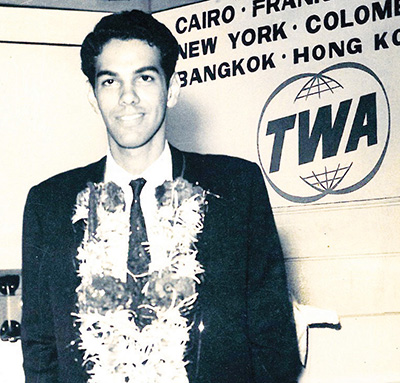
Going to UK for studies
Dragging in court
In a letter to Parsiana handed over after the interview in Tihar, Ghandy, starting with "Navroz Mubarak” requested if we "could discuss the status of the cases in the Trial Court and the bail application in the High Court,” with his lawyer, senior counsel Rebecca John and keep him informed. "Do give her my warmest regards and thank her for her efforts. Also her junior who has been attending the trial hearing (Bhavook Chauhan) has been cross examining the witness very well. He comes well prepared.”
John is not so sanguine of the legal battle. Seated in her Defense Colony office on the same day as Parsiana’s visit to Tihar, she noted that even if they succeeded in Delhi, Ghandy had a total of 44 cases against him in states such as Jharkhand, Gujarat, Andhra and elsewhere. Even if the charges were similar to the ones filed in Delhi and assuming they succeeded in obtaining an acquittal, the due process of law would have to be followed in all the other cases. Ghandy would have to be transported from jail to jail in the different states to stand trial. And allowing for the pace of judicial proceedings in the country, his chances of an early release at present appear dim.
Even after the Sessions Court rules, appeals would be filed in the higher courts. As it is the bail granted in Andhra had been overruled by the Supreme Court (SC), noted John. Chauhan brought in a thick file which showed the SC order and the list of cases filed against Ghandy all over India. John had defended the parties charged in the attack on India’s Parliament and S. A. R. Gilani, one of the accused who was subsequently acquitted had approached John to take up Ghandy’s case. She has done so pro bono, including bearing legal expenses.
Once the Delhi case is over Ghandy would have to find dedicated and capable lawyers in the other states willing to take up his cases pro bono.
Last August Ghandy had written, "after a four-month gap my court hearing will again begin this month-end. But just two dates are given and hopefully after that it is not delayed. Till now… dates (are given) after two-and-a-half months… Speedy trial (especially when a person is in jail) is a constitutional right. But people have been spending 10 to 15 years in jail and then are acquitted… Dragging cases is bad enough; dragging them with the victim in jail should be criminal in itself. Well that is life.”
In a letter dated October 1, 2013 Ghandy noted, "after four months I finally attended my court date on August 22 and I was shocked to hear that the court has been shifted from Tiz Hazari to Patiala House. Without any announcement apparently all Special Cell cases have been centralized in a court at Patiala House so that will mean more and more delay as the burden on that one court will be enormous. So the judicial system seems geared to keep one inside without conviction. Two days back two Kashmiris who were arrested two months before me, were just acquitted after spending four years in jail. This is routine here… Things just drag… Otherwise life goes on here. Mainly focussed on maintaining mental and physical health.”
‘High risk’ inmates
Moushumi Basu an associate professor at Jawaharlal Nehru University, who visits under-trials at Tihar Jail to lend moral support and supply provisions, sent Parsiana a report prepared in September 2011 by the Delhi based People’s Union for Democratic Rights titled "Beyond the Prison Gates: A report on living conditions in Tihar Jail.” Extracts from the report are published in this issue.
"Tihar is one of the most populated prisons in the whole of South Asia. As per the data provided by Jail authorities, Tihar’s nine jails have approximately 11,738 inmates as opposed to its capacity of housing 6,250 persons. 82% of Tihar’s inmates consist of under-trials, while convicts and detenues make up for the remaining 18%. In terms of total share, women prisoners constitute roughly four percent while men make up the remaining 96%...
"The Delhi Prisons Act (2000) along with the Delhi Prison Rules (1988) regulates the working of Tihar…
"Legally, it is an accepted norm that even where a person is convicted and imprisoned under sentence of court, he/she does not lose fundamental rights belonging to all persons under the Constitution, excepting those which cannot possibly be enjoyed owing to the fact of incarceration, such as the right to move freely or the right to practice a profession. The United Nations Standard Minimum Rules for the Treatment of Prisoners recognizes the rights of prisoners to medical care, education, recreation facilities, in addition to added guarantees of physical protection and security within jail premises…
"As per the data provided by the jail administration at Tihar, the majority of prisoners come from the lower strata of society. Around 77% of the prison population comprises persons earning an annual income of less than Rs 50,000 at the time of their arrest. Prisoners earning up to Rs1,00,000 constituted around 15% while the remaining eight percent were made of those who earned more than Rs 1,00,000. In terms of educational qualifications, 66% of all prisoners constitute those who are either illiterate, semiliterate and those not having completed matriculation or class X…
"The Prison Act and Rules makes no mention of the specific category of ‘high risk’ prisoners, the terminology is well in use to describe those on trial or convicted of charges of abetting, planning or participating in terrorist activities, political convictions, or arrested under laws such as the Unlawful Activities Prevention Act (UAPA). These set of so-called ‘high risk’ prisoners inevitably comprise of persons from Jammu and Kashmir, Uttar Pradesh, Bihar and North East India. A majority of them consist of under-trials, but their status as ‘high risk’ prisoners does not allow them to enjoy the same facilities as the other under-trials. For example, there are fewer sports and recreation facilities for high risk prisoners at present...
"Inmates of Tihar as per the Prison Manual are allowed to have two interviews per week with a designated place called the ‘mulaqat jangla’ attached to each jail…
"Since March this year, however there have been other changes that have been made in the rules relating to interviews. Every prisoner now has to submit a list of eight-10 names of persons (relatives/friends) who would be coming for the mulaqat. This means, no other person apart from those named can be a mulaqatee. Moreover, restrictions have also been placed on the kinds of articles that can be carried by visitors at the time of mulaqat. While till last year, visitors could carry two varieties of fruits — bananas and apples — from January 15, 2011, these too have also been stopped. Also restrictions have been placed on the kind of home cooked food that visitors can carry. No gravy items and dal is allowed to be taken in...
"The Delhi Prisons (Transfer of Prisoner, Labour and Jail Industry, Food, Clothings and Sanitation) Rules, 1988 in paragraph 73 mentions the food for prisoners, other than those sick in hospital. These consist of:
Early morning meal — half the cereals, half the oil, half the dal, half the vegetables and tea,
Mid-day meal — parched or boiled gram and tea,
Evening meal — the remainder of the cereals, dal, oil and vegetables.
[The Jail provides the day-to-day requirements of the inmates, says a middle aged visitor who had come to see his son who is serving a life sentence. Visitors are allowed to bring biscuits. Responding to our inquiry regarding the living conditions there, he observed there is no "dhiket” (problem) on that score; but after all a jail is a jail, he added philosophically. Ten years of the son’s term are over, four are left before his case will be considered by the jail authorities for parole/release. "I told my son to stay out of trouble,” says the father in Hindi.
Another visitor states the detenue he is meeting committed murder and after being imprisoned, killed another person behind bars.
Of late, prisoners have been allowed to phone twice a week for a total of 40 minutes.]
"The right to medical care is one of the most fundamental of all rights granted to each and every prisoner. The Delhi Prison Act (2000) in Chapter VIII provides for a dispensary/hospital in all the jails and access to such facilities for all prisoners ‘without delay’ and at the earliest. Besides, doctors and paramedics, a large number of NGOs also work alongside, providing specialized care and services to prisoners concerned.
"Prisoners have the right to access to reading materials, books, magazines and other recreational facilities. The Prison Act leaves it to the discretion of the superintendent to allow books/ magazines, etc being made available... This also includes access provided to prisoners to visit libraries within the jail.”