
Bawa Musings
MJDPC’s sub-culture dissipating
The Dadar Parsis are losing their uniqueness
Pesi was hugely irritated with the untimely ringing of bells in St Joseph’s Church, on the outskirts of the Mancherji Joshi Dadar Parsi Colony (MJDPC). His complaints to the Archbishop of Bombay went unheeded. Pesi then wrote to His Holiness, the Pope himself, who sent a personal reply to an elated Pesi. The bells rang less and the famous railing of MJDPC’s Five Gardens instantly christened him Pesi Pope. The truth of this implausible story will be verified by almost all senior citizens of MJDPC.
The railing, in its heydays, was imposing, cruel, funny and unsparing. The rally driver causing his terrified passengers to involuntarily relieve themselves in the Fiat, when being driven to Lonavala after midnight in an hour-and-a-quarter (remember there was no Expressway then), was called ‘Rocket.’ The kind-hearted, podgy manager of the Central Bank of India (Khodadad Circle Branch) was called ‘Bun pao.’ A Mae West look alike was ‘Nagoo Doll.’ There was a ‘Bafaat’ and a ‘Mike’ and a ‘Chocolate.’ Almost none escaped the mandatory rechristening à la Anthony Burgess’ dystopian novel — A Clockwork Orange. There were three or four railings but ‘Lokhan ni railing’ was the meeting point for authentic haadaas (an untranslatable expression for crude, unsophisticated louts and loutees) every evening. Nothing was sacrosanct and no reputation remained unscathed. Every eccentricity was celebrated and every idiosyncrasy pilloried.
The railing, in its heydays, was imposing, cruel, funny and unsparing. The rally driver causing his terrified passengers to involuntarily relieve themselves in the Fiat, when being driven to Lonavala after midnight in an hour-and-a-quarter (remember there was no Expressway then), was called ‘Rocket.’ The kind-hearted, podgy manager of the Central Bank of India (Khodadad Circle Branch) was called ‘Bun pao.’ A Mae West look alike was ‘Nagoo Doll.’ There was a ‘Bafaat’ and a ‘Mike’ and a ‘Chocolate.’ Almost none escaped the mandatory rechristening à la Anthony Burgess’ dystopian novel — A Clockwork Orange. There were three or four railings but ‘Lokhan ni railing’ was the meeting point for authentic haadaas (an untranslatable expression for crude, unsophisticated louts and loutees) every evening. Nothing was sacrosanct and no reputation remained unscathed. Every eccentricity was celebrated and every idiosyncrasy pilloried.
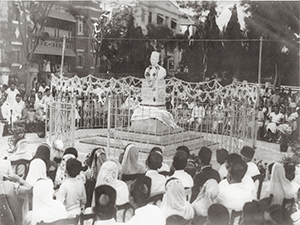
Unveiling of Mancherji Joshi’s statue at the entrance of MJDPC
Photo: Katrak Studio
Expletives were as ubiquitous as pigeons. Even inanimate objects like the daily newspaper, a bottle of milk or a cricket bat were routinely accused of having illicit relationships with their close female relatives. The Dadar Parsi was tough, macho and not exactly sophisticated. And they all were and are obsessively fond of their bikes and their Colony.
The Colony, of course, being a collection of unconnected 100 odd plots, most with a ground and three-storeyed building, having a single commonality – the Parsis-only covenant. This covenant was legally challenged in a bitterly fought litigation in the Bombay City Civil Court many decades ago. The Parsi Central Association (PCA) succeeded in upholding the covenant (thanks to the brilliance of noted lawyer Nadir Modi who appeared gratis and a somewhat sympathetic Judge Rego). MJDPC also has several non-covenanted plots, mostly of Parsi ownership.
Much against our liberal instincts, we must confess that this covenant has helped in preserving the quaint MJDPC sub-culture, notwithstanding that the Parsi-only buildings are now sandwiched between cosmopolitan apartments, after most have been mounted upon by additional floors on stilts.
As is inevitable, in the covenanted buildings Parsis have married non-Parsis and we understand that there are several flats having non-Parsi spouses and children. What is jarring is that the PCA has recently begun to flex its muscles against Parsi women introducing their non-Parsi husbands and children into these covenanted flats. PCA’s policies are counter-productive and may well backfire if one of these aggrieved ladies challenges once again the validity of the covenant, in the changed circumstances. The hotheads in PCA should be counselled by saner elements — like the venerable Mithoo Jesia — not to rake up an unnecessary controversy.
Like all Parsi institutions, the once bristling and strident MJDPC is fast mellowing. When we came to reside in one of the buildings (non-covenanted, of course), two decades ago, the warm and popular Yezdi Daruwalla (who soon died young and was much mourned) informed us that MJDPC was a very secure place ["before you can scream chor, chor (thief), men with sticks will rush out of their houses”]. All that has disappeared. Most have a look of resignation around them. Of course, MJDPC does come alive during the Jamshedi Navroz spring festival, and if you are keen to hear authentic, original Parsi, and almost lyrical, abuse, you can still visit the Dadar Parsi Gymkhana (a worthy competitor to the Dadar Parsis in this field were some Navsari mobeds we encountered during a navar ceremony).
Are the Dadar Parsis largely orthodox? Maybe, though not in the WAPIZ (World Alliance of Parsi Irani Zarthoshtis) sense of the term. They are more inclined to preserve Parsi properties in Parsi hands and more comfortable to relax and share laughter with fellow Parsis, preferably also from the MJDPC.
While adventurers abound, with the passing away of old hands like Rustom Tirandaz, MJDPC now lacks a charismatic personality to lead and electrify its 6,000 inhabitants and to gracefully preserve the unique heritage of this village like oasis with its gorgeous trees (all numbered) and its nostalgic lanes.
Unlike a Parsi baug, MJDPC, being a collection of scattered buildings, is fast losing its Parsi character. The numbers are eroding, the people are ageing. The bikes don’t backfire at midnight. ‘Bafaat’ has made his last faux pas. ‘Mike’ has been silenced. ‘Nagoo Doll’ does not look like Mae West anymore, or vice versa. ‘Rocket’ does not drive now. The railings are full of people, but not Parsis. The church bells ring again, more than they ought to, but there is no Pesi to write to the Pope.
Berjis M. Desai, managing partner of J. Sagar Associates, advocates and solicitors, is a writer and community activist.
◆ ◆ ◆
From the archive