
Poet from Poona
Often soulful and melancholic, Shernaz Wadia says her poems are inspired by nature, social issues and news items that have touched a chord in her
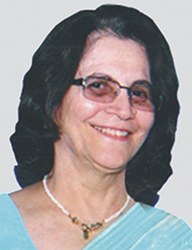
Shernaz Wadia: fascinated by words
Her "challenging and exciting poetic journey” with Meallem was undertaken after they became acquainted with each other’s poetry on ‘Your Space’ of the Muse India literary e-journal. Realizing they were "on the same wavelength mentally and emotionally,” they met in Bombay during Avril’s visit to India in 2010 and decided to experiment on a collaborative process. The method "involved each one independently writing a nine-line poem on a title that we would choose alternatively.” The one who chooses the title weaves the two poems into one composite whole through random mixing of lines. More about this can be read on their website: tapestrypoetry.webs.com. The duo is contemplating collaborating on and publishing another book of ‘tapestry’ poems.
Though it was easy to find publishers, she eventually self-published both her books. Whispers of the Soul was intended for family and close friends as she had compiled it at their insistence and did not wish to put it in the market. "But with Tapestry Poetry Avril was just not happy with what the publisher sent us for approval. There were other constraints too as she lives in Israel and the publisher was located in India. She finally decided that we publish them individually. To avoid different ISBN (International Standard Book Number) for identical books to be published in two countries, she bought the number in Israel and we both used it. I had only a limited number of copies printed,” says Wadia.
"To date, no editor has rejected any poem and that is a huge morale booster,” mentions Wadia who finds, "Most of my poems seem to write themselves, inspired by sight, sound, nature, social issues, news items that touch me… There have been occasions when I have woken up in the middle of the night with a line playing in my mind and I immediately jot it down. Later I edit the poem and give it a title. There are some poems I just can’t seem to finish. Incomplete ones remain in my file. After months I might chance upon one and finish it, or else I just delete it.”
The English language and the way one can play with words has always fascinated her. Since a very young age, she loved learning new words and would read the dictionary at random. "My maternal grandpa (Hormuzsha Hodiwala) had been nicknamed ‘walking dictionary.’ I guess I inherited my penchant for words from him. His home was never short of reading material: books on various subjects — religion, philosophy, fiction, theosophy; magazines in English and Gujarati including a rich trove of Reader’s Digest, which I used to devour during school vacations. Writing is a journey of self-discovery. As diarist Anais Nin has said ‘We write to taste life twice, in the moment and in retrospect,’” Wadia notes.
Wadia developed her love for poetry from her mother Nergish Bhathena who had notebooks of verses that she had copied down in her beautiful handwriting. Interestingly, Wadia wrote her first poem in partnership with a co-boarder when she was in Std. VII at St Joseph’s High School in Valsad. "One day she hesitantly brought me a poem she had written, ‘The Beggar.’ I helped her polish it, added a verse and then we submitted it for our school’s silver jubilee souvenir magazine. We have lost contact but I am always grateful to her for bringing me face to face with my muse.”
After school, she went to Wadia College in Poona to do a one-year diploma course in teaching, hoping to do three years of BA and then a doctorate in literature but following the death of her father Jalejar that year she had to move back to Surat where she joined St Xavier’s School as a primary teacher. Later she took up a correspondence course in journalism, but a very severe eye problem put an end to all reading, writing, etc for two years and she had to give up the course midway.
Wadia grew up in a typically Parsi household. Though she and her siblings Mahrukh, Pervin, Aban and Rumi were sent to English medium schools, "our mother ensured that we first learned to read and write the mother tongue, Gujarati. Whether we spent our holidays in Surat at my maternal grandparents’ home, or in our father’s home in village Bhatha, we imbibed Parsi values and cultural practices through example and stories. Muktad ceremonies were held for 18 days in our home in the village, we visited atash behrams regularly and were taught the navjote prayers at home. Most importantly, we were taught to respect other religions and be tolerant of differing views.”
About the Parsi community Wadia opines: "In general, I believe Parsis all over the world are doing well even though our cultural and religious ethos has not remained intact. We are also strongly divided over major issues and it is often difficult to tell the younger generation to draw inspiration from those who are unable to lead by example. I used to be proud of the community but today people from other communities are questioning our integrity, leaders and declining standards. Though this is sad and worrisome, I deem it an honor to belong to our once illustrious community. I am hopeful that our youngsters will do their best to redeem and continue the admirable legacy of honesty, charity and freedom of spirit left behind by our ancestors. The Zoroastrian precepts of manashni, gavashni and kunashni have been the guiding light and force of my life as an all-embracing philosophy of principled living.”
Shernaz married Dinyar Bejonji Wadia in 1970. Both her husband and father-in-law were well-known bonesetters or hadvaids of Surat. Three years after she lost her husband in 1989 to a massive heart attack, she moved from Surat to Poona where her daughters Daisy and Farzin were studying.
Though Wadia continued writing, she secreted away all her poems. Much later, in 2002 at the insistence of a dear young friend she began to post her poems on boloji.com. "By hiding your talent you are insulting God,” her friend urged the intensely private Wadia who now believes, "If it kindles the flame of hope or courage in even one life, we become the richer for it.” After boloji.com Wadia’s poetry was posted on other websites, e-zines, friends’ blogs and anthologies, both Indian and international. "Two of my poems ‘Shadows’ and ‘Treasured Homeland’ have been accepted by Indies In Action, a Facebook group that is bringing out an anthology Magnitude — The Awakening of Nepal in aid of the earthquake hit. It is an international project,” Wadia mentions.
"From the time I went public with my poems and articles, my family has always been very encouraging and accommodative, particularly my daughters and sisters. My husband too was extremely interested in and supportive of every endeavor of mine,” acknowledges Wadia.
Writing poetry does not pay much, she laughs. "Wanting to make a living solely from poetry is probably asking for penury, unless you are a firmly established and much-sought after poet. If at all any income accrues from the pursuit it would only augment regular earnings from a steady job or another profession.”
Wadia reveals, "I love to read poems by Arun Kolatkar, Jayanta Mahapatra, Gulzar, Maya Angelou, Robert Bly, Rainer Maria Rilke, Pablo Neruda, Seamus Heaney, to name just a few. It is very difficult to choose a favorite from among the masters, but I am completely bowled over by the works of Khalil Gibran. More recently I have started reading and immensely enjoying the poems of Vihang Naik.”
Her words for aspiring poets are: "To anyone interested in writing there is one piece of universal advice — read, read, read. Which authors and genres you read is a personal choice. Reading broadens horizons, lets us live through many experiences and imparts a sense of wonder when a word or line throws light upon a bit of inner knowledge or wisdom we were unaware of. But… however extraordinary a book may be, we must learn to think for ourselves.”
The Masterpiece (from Whispers of the Soul)
The miniature canvas of time that is my due, I’ve painstakingly covered in many a radiant hue.
Hope shimmers with the luster of liquid gold,/And love is emblazoned in colours bold.
With a soft caress peace pulsates in white/Lending the painting an ethereal light.
A few feeble scratches reveal brushes with sorrow,/With hope’s silver lining I’ve etched every tomorrow.
Life’s firmament I’ve speckled with vivacious relationships,/And arched across it the rainbow of a resplendent friendship.
Understanding, forgiveness, tolerance, envy, sadness too,/Dot the canvas in shades of violet, pink, orange, green and blue.
I’ve used every brushstroke, every pigment of time and space,/But You elevated it to a masterpiece with your Amazing Grace!
A Tapestry Poem
War Mothers by Avril
soldier, terrorist, civilian, militant — each nurtured with love in the womb, birthed into this world through pain, cradled and comforted with tenderness; a gift from God.
now defending, attacking, sheltering, fleeing death knocking at the door, your future generations about to be written out of history and we, the givers of your lives, can only weep...
War Mothers by Shernaz
wrecked… distraught… gazing
across the leaden line of loss
deep, pain-filled eyes mirrored hers
two sons dead…two mothers grieving
understanding crossed the border
barbed wires became bonds of empathy
desolate hearts wordlessly sealed
a bond of forgiveness
the sky wept — washed away hostility
War Mothers — Tapestry by Avril and Shernaz
soldier — terrorist — civilian — militant defending — attacking — sheltering — fleeing ; two sons, cradled and comforted with tenderness, now dead
wrecked — distraught
two mothers mourn the loss
of these gifts from God
nurtured with love in the womb
gazing across the leaden line of grief,
their future generations written out of history, deep, pain-filled eyes mirrored each other...
in their weeping hearts,
as death knocked at their doors,
an understanding crossed the border.
barbed wires became bonds
wordlessly sealed between these
givers of life; empathy and
forgiveness birthed into their world of desolationhostility washed away… the sky wept