
Vivid verses
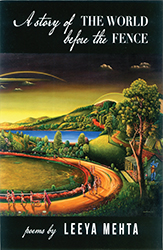
A story of The World before the Fence: Poems by Leeya Mehta. Published in 2020 by Finishing Line Press, P.O. Box 1626, Georgetown, Kentucky 40324. USA; website: www.finishinglinepress.com. Pages 35. Price US $14.99.
Leeya Mehta’s (pictured) A story of The World before the Fence is a slim volume of sensitive and thought-provoking poems. This is her second volume of verse, the first being The Towers of Silence. She has lived in Bombay, Japan and the USA from where her poems originate.
 The first set of poems deal with the flight of the Parsis from Persia, to protect themselves and their religion, and their subsequent arrival in their new home in India. In "Refugees,” the men row their women and children through the familiar Gulf of Hormuz into the unknown "black Arabian Sea.” It is a new moon night and the only light visible is from the "holy fire, fed carefully/ by their priest with sticks of sandalwood.” The priest rues the fact that after several generations they have been reduced "from conqueror to refugee.” The arrival in India is described by Mehta in vibrant and vivid images through the eyes of Armaity, the mother of two small children, exhausted by the journey, who raises her eyes to see:
...flocks of long limbed flamingos
rise up into the sky and scatter,
revealing a sanctuary of white beach.
In "Welcome,” Mehta converts the restrictions of the local ruler Jadav Rana skillfully into poetry. The Parsis must keep their old stories to themselves and not relate them to the natives; respect the many Indian gods but "do not give us yours;” cut firewood from the forests to maintain their fire "but do not take our children into your temple.”
In "The Towers of Silence,” Mehta stresses the importance and value of this form of disposal, as it would serve as a spot for family members to mourn the passing of their loved ones and find solace in the fact that they could:
rest together in the sepia shadow
of a pit
drilled into the center of the core.
She regrets that her grandfather, her mother and she herself will be unable to choose this form of disposal and will have to be cremated, their "ashes choking the sea.” Their children will be unable to trace them. Mehta uses stark and disturbing images to describe the disposal of her grandfather’s remains — "a suitcase of black static residue and/ small pieces of bone.”
Mehta spent time in Japan on a UN fellowship in human rights. The poems written about that have an elegiac note. "Decorum” starts with a visit to the Hiroshima Peace Memorial Park in memory of the victims of the nuclear attack on August 6, 1945 in which the USA dropped an atomic bomb on this city. The narrator is accompanied by a man with blue eyes and blond hair and though a Japanese woman asks if he is American, there is no bitterness or rancor. Mehta finds it difficult to believe that:
White men had dropped bombs on their faces
Yet they wanted to embrace us, bless us.
 A Japanese woman asks to hold their hands and prays for peace. She has been disfigured by the bomb, "Her forehead where her eyes should be.” The woman, Setsuko, was six years old in 1945, on her way to school on the back of a bicycle when they were bombed. Mehta uses bright and striking colors — silver bicycle and red bell — to accentuate the stark horror of the bomb and the pointless destruction of human life. On the way to dinner, they are stopped by another woman who lost her parents, husband and baby. Mehta could have used one word, ‘family,’ but consciously names each relationship individually to drive the horror home.
In "The Years,” the scene shifts to the USA. Images of winter are presented — bitterly cold, dark and dismal. Mehta effectively presents the plight of the immigrant unable to call either country home. There is a brief and happy sojourn in Bombay; she does not return to this city as she does not want to be separated from her family in the USA. Yet, her thoughts fly back to Bombay with the realization that:
the longing for what you cannot have
will keep you from settling anywhere.
Both Japan and USA come together In "Nudes I” and "Nudes II” where the poet describes bathhouses in Japan and in Virginia. Once women reach a certain age they are no longer conscious of their bodies:
We do not look for comparison,
do not measure smallness or girth. (Nudes II)
......I am
a recognizable female form
of no differentiated quality. (Nudes I)
It is only once the bath is over and she has to re-enter the familiar world, that:
I may care how I look, my face
perfectly poised at the moment of
reflection.
The first poem in "Fences” is written in memory of a friend from Washington who had a "genius for living.” But within months of their last meeting she passed away, leaving Mehta thinking nostalgically of the times they spent together drinking Irish Breakfast tea with milk and sugar.
In "Mother’s Day,” Mehta thinks back to her childhood in Bombay, and of her mother, who now lives in rural Virginia. Mehta juxtaposes skyscrapers, crowds, dogs with the startling image of a single "laburnum tree with bunches of gold flowers.” She remembers the "laughter of generations in your (her mother’s) heart.” She feels there are a lot of things that constitute a life — love is an important component — but laughter is important as well and she thinks it will be of great help, "When it is the end and there is nothing to mask what is coming for us.”
What is remarkable about the poems is that though they are compact, introspective and thought provoking, they are accessible to a lay reader who may not be familiar with contemporary poetry. Written in free verse, even the longer lines and paragraphs have a cadence and a music to them. One waits in eager anticipation for her novel, Extinction, which we hope will be published soon.
FIRDAUS GANDAVIA
Gandavia holds a doctorate in English literature and is a retired chartered accountant. He is a compulsive reader of fiction.