
Cover Story
Uniqueness of Udvada
Udvada (photographs by Shantanu Das). Published in 2013 by Spenta Multimedia, Peninsula Spenta, 2nd floor, Mathuradas Mill Compound, Senapati Bapat Marg, Lower Parel, Bombay 400013; www.spentamultimedia.com. Pp: 152. Price: Rs 2,000.
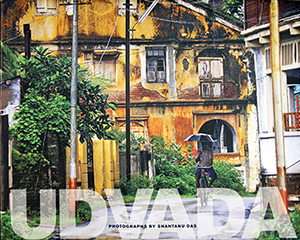 The problem of knowing a place like Udvada as intimately as we do is that we often miss the obvious. We tend to take the village for granted and, in the process, fail to register the eccentricities that make it so unique.
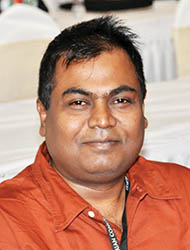
It takes an outsider like Shantanu Das, a Bombay-based photojournalist, to peel back the veneer and capture the ticking heart of the holy village on the brink of becoming a town. Parvez Damania who commissioned the book (in his words: to ensure that the coming generations must not be denied the Udvada we knew as children) did well to assign the task to a non-Zoroastrian who was able to inject a sense of wonderment into the project.
The coffee table book Udvada is more than a photo essay: it’s a time capsule of a pilgrim town that teeters on the cusp of a crumbling past and an uncertain future. Images pop out of the pages and stir up memories and emotions that are deeply embedded in the heart and soul of the global Zoroastrian community which has its roots in India. Turning the pages, we realized that Udvada is the legacy not just of those who reside in the beachfront town but it is one that can be claimed by the entire community.
Das’ camera hovers over the town like a bumble bee; stopping at every nook and corner to explore and freeze eternal moments in sharp focus. An old-world timepiece ticks away in front of an elderly lady in a mathabanu (head covering); a young girl in a topi holds her father’s hand as he leads her to Iranshah; smiling bright-eyed kids; a man spreadeagled on an easy chair, visible through the grills of a door; plants draped over a rusting balcony, the jagged-toothed ruins of what was once a grand mansion; two young kids sit at the feet of an elderly man, perhaps their grandfather; doorways with torans (bead festoons); creamy doodh-na-puff; wood-fire kitchens… each image tells a story that needs no prompting just loads of imagination as most do not have captions. Even the cameos that do have captions are cursory at best.
The problem of knowing a place like Udvada as intimately as we do is that we often miss the obvious. We tend to take the village for granted and, in the process, fail to register the eccentricities that make it so unique. It takes an outsider like Shantanu Das, a Bombay-based photojournalist, to peel back the veneer and capture the ticking heart of the holy village on the brink of becoming a town. Parvez Damania who commissioned the book (in his words: to ensure that the coming generations must not be denied the Udvada we knew as children) did well to assign the task to a non-Zoroastrian who was able to inject a sense of wonderment into the project.
The coffee table book Udvada is more than a photo essay: it’s a time capsule of a pilgrim town that teeters on the cusp of a crumbling past and an uncertain future. Images pop out of the pages and stir up memories and emotions that are deeply embedded in the heart and soul of the global Zoroastrian community which has its roots in India. Turning the pages, we realized that Udvada is the legacy not just of those who reside in the beachfront town but it is one that can be claimed by the entire community.
Das’ camera hovers over the town like a bumble bee; stopping at every nook and corner to explore and freeze eternal moments in sharp focus. An old-world timepiece ticks away in front of an elderly lady in a mathabanu (head covering); a young girl in a topi holds her father’s hand as he leads her to Iranshah; smiling bright-eyed kids; a man spreadeagled on an easy chair, visible through the grills of a door; plants draped over a rusting balcony, the jagged-toothed ruins of what was once a grand mansion; two young kids sit at the feet of an elderly man, perhaps their grandfather; doorways with torans (bead festoons); creamy doodh-na-puff; wood-fire kitchens… each image tells a story that needs no prompting just loads of imagination as most do not have captions. Even the cameos that do have captions are cursory at best.
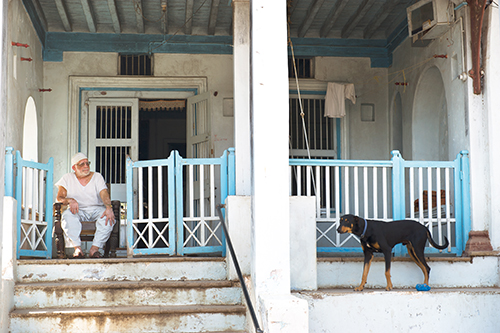
Verandah view taken by photojournalist Shantanu Das
Photographs of the Iranshah are — but naturally — missing but its presence fills the book as it does Udvada like a holy aura. For it is more than just the oldest fire in the world, it is also a crucible that brims with the collective devotion of the Zoroastrian community over the centuries: its hopes, aspirations, joys and, yes, even anguish. The holy fire is the heartbeat of the village.
Udvada can also serve as a handbook — a large one no doubt — on photography. Das vividly demonstrates the art of portraying a destination with telling cameos that seem to peek into its soul. The subtle use of light and shadow to evoke a mood; the zooming in on a detail like the etched profile of Queen Victoria on the railing of a balcony; the communities that people its streets and homes; its cuisine… While most would hide their cameras to protect them from the rain, Das brandishes his to conjure up an ambiance that is magical.
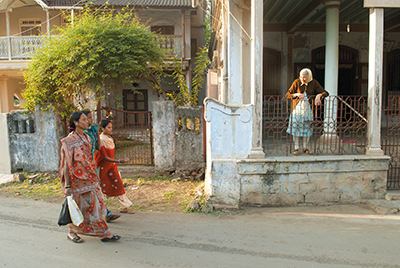
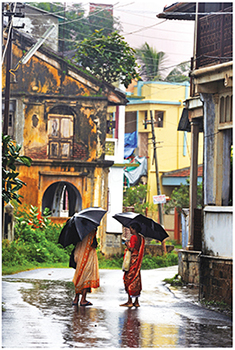
Lanes and bylanes of Udvada
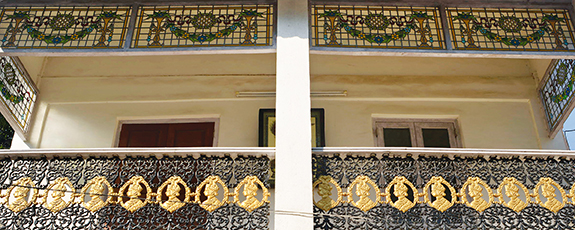
Balcony railing depicting Queen Victoria
For those who need textual inputs, Cyrus H. Merchant supplies the words. Merchant is aware that his text plays a supporting role at best and he keeps the narrative light and fluid with his tongue firmly in his cheek when stating the obvious. Thankfully, we are spared the retelling of the milk-and-sugar saga.
Udvada is essentially a visual safari of a pilgrim town and Maneck Davar, whose publishing house Spenta Multimedia designed, published and printed the tome, ensured that it did not suffer in any way because of the printing or the quality of the paper used. The very best inputs were obviously invested in the venture.
Damania, in his preface, also acknowledges the house of Godrej which "was supremely instrumental in opening the doors to the final publication of the book.”
Equal credit must also be given to the residents of and pilgrims visiting Udvada for they seemed to have welcomed Das and his prying camera with open arms rather than slammed its doors shut on the parjat (non-Zoroastrian).
◆ ◆ ◆
From the archive