
Binding through books
Books launched at the 10th World Zoroastrian Congress help to perpetuate the Zoroastrian legacy
Four books were launched at the 10th World Zoroastrian Congress (10WZC) — two on day one of the global meet on December 27, 2014 at the National Sports Club of India at Worli and two on the last day. They were Threads of Continuity by Ashdeen Lilaowala on kusti-weaving, Fire Altar by Keki Daruwalla, an anthology of poems, In Praise of Ahura Mazda by Ervad Burjor Antiaand Udvada photographs by Shantanu Das, commissioned by Parvez Damania. A preview of a fifth book to be published on Field Marshal Sam Manekshaw, written by Brig Behram and his wife Zenobia Panthaki was presented to the audience.
Launching forth
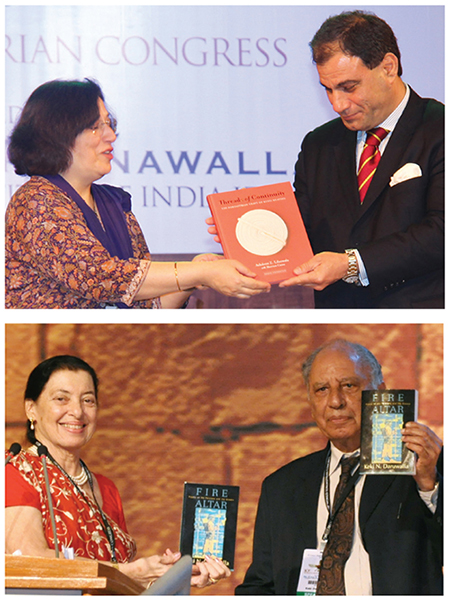
(Top) Shernaz Cama with Lord Karan Bilimoria launching Threads of Continuity;
Homai Modi launching Fire Altar with author Keki Daruwalla
Photos: Jasmine D. Driver
Daruwalla’s Fire Altar is a book of poems on the Persians and the Greeks, written between 1991 and 1993. It was launched by Homai Modi, social activist and one of the main Congress managers. The anthology celebrates the histories and legends of the grand Persian empires of Darius, Cyrus, Xerxes — their courts, battles, triumphs and losses, all of which are "barely represented in modern literature." The poems tie in narratives of the Persian empire with its history of tolerance, with the more well-known stories of Alexander and his Greek cohorts, the author’s journey seeking roots, meaning and both religious and social understanding. Fire Altar is a collection that includes six Pasargade Sonnets, of which the poet and novelist read out three.
Author of 12 books Daruwalla’s writing sets him apart from his former colleagues in the Indian Police Service. He retired as additional director of the Research and Analysis Wing, Government of India. The Padma Shri recipient captures multi layered contradictory realities of Indian life in his works and diverse cultural, historic and mythic landscapes. He earned the Sahitya Akademi and Commonwealth Poetry Awards. Wajahat Habibulla, chairman of the National Commission for Minorities (NCM) attended the book launch of his colleague Daruwalla, one of five members of the NCM. This specific Commission came to an end in February 2014.
A peek into a legendary man
The 10WZC audience got a flavor of what was to come in the coffee table book on Manekshaw.
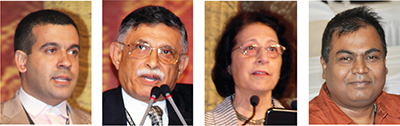
The book was subsequently released on April 5, 2014 in Delhi,two days after Sam Bahadur’s (Sam the Brave, as he was fondly called by one of his Gorkha soldiers who was unable to recall the "complicated" Parsi surname) birth centenary. Some anecdotes were relayed to enthusiastic applause from the 1,000-odd delegates by his aide-de-camp Panthaki whose career in the Indian army spanned 30 years. "Sam had the moral courage to confront a Major General who was indicted for taking graft," Panthaki said. The Major General took umbrage at the accusation. The (army) chief looked at him and said ‘Not only is the chief accusing you (the Major General) of your integrity, but is calling you a liar and a thief. And if I were you, I would shoot myself in the head or put in my papers.’ The next morning, the Major General’s resignation was on the chief’s table," Panthaki recalled. The Brigadier is also an ordained priest, a fact that was overlooked in the introductions. The Ervad’s wife Zenobia, currently working in the World Bank, nostalgically narrated how the generous Sam Bahadur offered to carry a parcel for her to her then boyfriend Behram, as he was in a remote location where no mail reached.
Manekshaw, always in simpatico with his staff dined in their mess. As Panthaki said, "Sam gave up eating bacon and eggs to eat puri-bhaji with his staff." The Field Marshal proudly publicized the fact that "My wife and I go around the country with a begging bowl so that my disabled staff don’t have to."
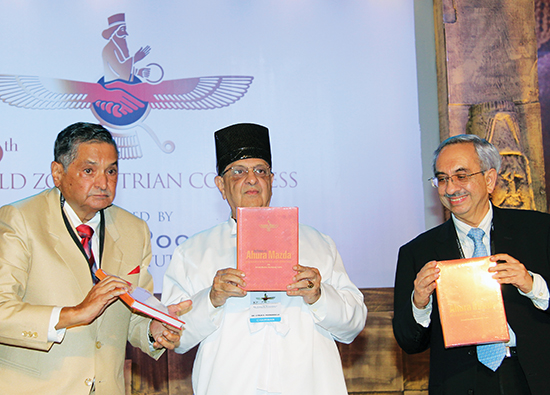
Antia’s compendium of his articles — mainly those that had appeared in the Jam-e-Jamshed Weekly — was launched by Dr Cyrus Poonawalla and Nadir Godrej on December 30, 2013, the last day of the Congress. In Praise of Ahura Mazda deals with a breadth of subjects ranging from the scriptures to the Zoroastrian code of ethics. The senior partner of Mulla and Mulla and Craigie Blunt and Caroe advises on what to pray, when and how, and writes on social, ethnic and socio-political issues. One of the articles even offers "Golden tips to our youngsters: How to achieve success in life."
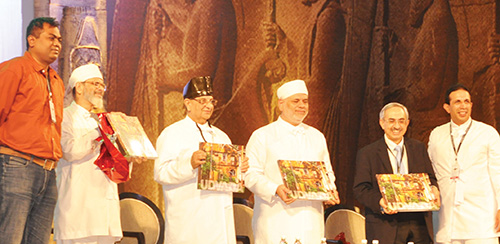
The coffee table book Udvada photographs by Shantanu Das with images of the hamlet
, was launched by the two Udvada high priests, Dasturs Khurshed Dastoor and (Dr) Peshotan Mirza. Poonawalla and Godrej also exhibited the books they unwrapped as president and vice president of the 10WZC. Damania wants to perpetuate the legacy of Udvada for young Zoroastrians "before a defining part of the Parsi universe (is) irretrievably lost. The Udvada we love is too rich in meaning to slip out of our hands," he says in the Foreword. Mirza traced the history of the arrival of Parsis in India and specified that in 1142 CE, clergy from Sanjan went to Navsari for priestly services. He talked of the tussle for jurisdiction and duties between the priests of Sanjan, Navsari and Udvada.
Dastoor alluded to the Udvada of today and specified that there were 15 mobeds under 50 years of age and the Iranshah can be taken care of for the next 30-35 years without any apprehensions. In a population of 7,000, only 70-75 Zoroastrians inhabit Udvada town with 60% of them being above 70 years and 15% between 60-70. He then drew the attention of the audience to how 20-25 of 250 heritage homes were lost last year, stating that some Zoroastrians under the pretext of saving the religion, opposed plans to allow the town to be declared a heritage site. Dastoor was impassioned about maintaining the sanctity of the atash behram and yet was being accused of "selling Iranshah." He informed the audience how the Udvada priests are the only clergy left who use well water for higher liturgical ceremonies, how they have nahan (ritual purity) for 10 days before giving boi, how they remain without any human contact for nine nights using only well water for preparing food during the bareshnum ceremony. Evidencing that he was willing to change with the times, he ended with a quote from Jivanji Modi "…times are rapidly changing — the heresy of today is the orthodoxy of tomorrow."